Ontario’s Pension Power Grab?

496px-Canada_blank_map.svgLeo Kolivakis is a blogger, trader and independent senior pension and investment analyst. This post was originally published at Pension Pulse.

The National Post published its editorial comment on Ontario’s pension power grab:

A new Fraser Institute report raises serious questions about the veracity of the Ontario government’s claim that a new provincial pension plan, intended as a supplement or alternative to restructuring and expanding the Canada Pension Plan, is needed because of a savings shortfall among retiring Ontarians.

The justification for the new pension plan, outlined in the Ontario Retirement Pension Plan Act — which was passed in the spring and is set to be implemented in 2017 — is that, “a significant portion of today’s workers are not saving enough to maintain their standard of living when they retire.”

As we have previously argued on this subject, however, the claim that retirees are not sufficiently funded — both with savings and existing pension benefits — is dubious. Indeed, a wealth of evidence suggests that a majority of Ontarians are saving enough through private and public investment vehicles to maintain their standard of living through retirement. On this ground alone, we should be skeptical of the Wynne government’s proposal.

But the Fraser report goes further in demonstrating that the fruit of more government-mandated savings schemes — which is what the Ontario Pension Plan will effectively be — would likely be offset in private savings. At least this is what happened before, according to the study, when mandatory increases to Canada Pension Plan (CPP) contributions came into effect in the late 1990s.

With each new percentage point of earnings mandated for contribution, the report finds, there was a “substitution effect,” namely a 0.895 per cent drop in voluntary savings. In other words, an additional dollar contributed to the CPP led to a proportionate decrease in the average household’s private savings. If such findings prove consistent with the implementation of this provincial plan, then the entire exercise will be a waste, leading to greater government control over retirement savings than is currently the case.

As co-author Charles Lammam told the Financial Post, “If (Canadians’) income and (lifestyle) preference(s) do not change, and the government mandates additional savings through government pension plans, Canadians will simply reshuffle their retirement savings, with more money going to forced savings and less to voluntary savings.”

The report also rightly points out that government-mandated savings offer less flexibility than private savings vehicles such as RRSPs, which allow Canadians to withdraw money to pay for a home or their education. Of course, reduced private savings mean not only fewer options for what one can do with those savings, but also greater dependence on government to doll out one’s retirement income.

Perhaps the worst part of this story is the way Ontario’s new pension plan is being sold as a kind of gift from the government, rather than a further burden to be borne by workers for the sake of questionable outcomes. The government will be taking your money for safe keeping, thus forcing you to save on its terms.

Moreover, maximizing the return to pensioners is not the only goal here: it is also going to provide “new pools of capital” for government projects; in other words, a tax hike under the guise of a retirement savings plan. And by diverting money from private investments, it will reduce the amount of capital available to the business world — the economic engine of our country that, unlike government, actually creates wealth and encourages job growth.

It would be far better to encourage private savings, thus giving individuals and households more control over their financial planning, rather than making them more beholden to the unreliable investment prerogatives of the government of Ontario. That would be a retirement savings plan worth supporting.

Unfortunately, I wouldn’t expect anything less from the Fraser Institute and National Post than the pathetic drivel being put out on the Ontario Retirement Pension Plan.

Let me briefly share with you my thoughts on this new report. First, I don’t dispute the claim of the authors that increasing CPP contributions or ORPP contributions will lead to less private savings but the reality is that far too many Canadians dreaming of retirement are not actually saving for it.

Second, and most importantly, so what if there is less private savings? Banks, insurance companies and mutual fund companies will all cry foul but the reality is they’re all more or less charging Canadians outrageous fees, peddling the same mediocre funds which drastically underperform public markets over a long period (I’m talking about the bulk of funds here).

Third, and related to the second point, the authors of this report conveniently ignore the brutal truth on defined-contribution plans. The truth is defined-contribution (DC) plans are vastly inferior to defined-benefit (DB) plans for many reasons, chief among them is they’re expensive and largely rise and fall with the vagaries of public markets. In other words, there are no guarantees with DC plans, if a bear market develops when you’re getting ready to retire, you’re pretty much screwed.

Fourth, the authors ignore the numerous advantages of a well-governed DB plan:

In a nutshell, here are the main benefits of DB pensions worth highlighting:

  • Provide predictable retirement benefits not subject to vagaries of public markets
  • Pool longevity risk and investment risk
  • Lower costs significantly by bringing assets internally, avoiding fees charged by many closet indexers and external managers
  • Invest in public and private markets directly or externally with some of the best global money managers. Private equity is trying to tap the DC pension space but this won’t change the fact that DB pensions have an advantage because they invest directly into private markets and funds, and co-invest with GPs on large transactions.
  • The alignment of interests is much better in DB pensions than DC pensions

Finally, there is one big myth that really irks me which I want to lay to rest. The assets of Canada’s top ten and most other DB pensions are a product of investment gains over the long-run. Contributions from employees and sponsors make up a small part of assets. Over 2/3 of the growth in assets comes from investment gains, not contributions, a true testament of the power of compounding but more importantly, of  the governance of these plans which allows them to attract professionals who can add significant value-added over public market benchmarks, lowering the cost of these plans.

Fifth, apart from these benefits, DB plans offer Canadians safe and predictable income streams when they retire, which means they can count on their pension payouts to continue consuming in their golden years. More consumption means more economic activity, more government revenue from sales and property taxes and less money spent on guaranteed income supplements (GIS) to individuals living in pension poverty. All this will help Canada’s long-term debt profile, something which should please the folks at the Fraser Institute.

Lastly, all these claims that private savings plans are “more flexible” should be taken with a shaker of salt. “Pay down your mortgage” on your grossly over-valued house or condo and “pay down student debt” while you retire in poverty doesn’t really offer Canadians the flexibility they need or want.

In short, all these studies and articles criticizing the ORPP are fundamentally flawed and grossly biased to the point where I’d be embarrassed if I had my name on any of them. These Canadian think tanks are nothing more than claptraps for Canada’s powerful financial services industry. I would ignore anything they publish on public pensions.


Photo credit: “Canada blank map” by Lokal_Profil image cut to remove USA by Paul Robinson – Vector map BlankMap-USA-states-Canada-provinces.svg.Modified by Lokal_Profil. Licensed under CC BY-SA 2.5 via Wikimedia Commons – http://commons.wikimedia.org/wiki/File:Canada_blank_map.svg#mediaviewer/File:Canada_blank_map.svg

New Jersey PERS Chairman Requests Cost-Benefit Analysis of Investments After Weak Return; Some Lawmakers Back Request

Graph With Stacks Of Coins

The New Jersey State Investment Council, the panel that oversees the state’s pension investment portfolio, announced on Wednesday that the portfolio had returned 4.58 percent through 11 months of FY 14-15.

The return comes in below expectations, and short of the system’s assumed return rate of 7.9 percent.

During the meeting, New Jersey PERS chairman Tom Bruno requested a cost-benefit analysis and a forensic audit of the system’s investment portfolio.

From NJ Spotlight:

Tom Bruno, chairman of the board for the Public Employees Retirement System, one of the individual retirement funds that make up the overall pension system, asked Byrne and the other council members during the meeting yesterday to authorize a forensic audit and cost-benefit analysis of the alternative investments to address all of the questions that have been raised.

“I think it’s time for an independent look at this,” Bruno said.

And two members of the Senate oversight panel, Sens. Robert Gordon and Loretta Weinberg, (both D-Bergen), issued a statement yesterday echoing Bruno’s call for the review.

Byrne said during the meeting that the issue would go before the council’s audit committee and Bruno’s request would be put up for a discussion during the next meeting, which right now is scheduled for September.

“I certainly want to do everything possible to assure that people feel like they are getting good value for their money,” Byrne said. “If the work of the audit committee isn’t satisfactory then we can talk about the next steps.”

But Byrne also didn’t commit outright to allowing the independent review, something that drew an immediate response from Bruno.

“I think we just keep kicking this can down the road,” Bruno said.

New Jersey’s pension system is valued at around $78 billion.


Photo by www.SeniorLiving.Org

NY Pension Considers Lowering Return Assumption Due to “Problematic” Investment Climate

Thomas_P._DiNapoli_crop

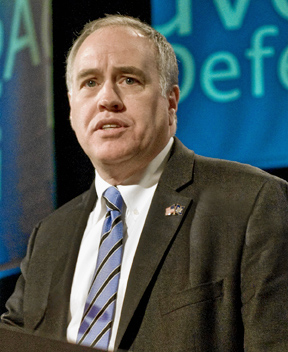
Comptroller Thomas DiNapoli – the sole trustee of the New York Common Retirement Fund – said this week he is considering lowering the fund’s assumed rate of return.

The fund’s annual return assumption currently stands at 7.5 percent; it was lowered from 8 percent in 2010.

The nationwide average sits at 7.68 percent, according to NASRA.

More from the Journal-News:

Comptroller Thomas DiNapoli said the $176.8 billion pension fund, the third largest in the nation, is considering lowering its 7.5 percent average return assumption amid uncertain times on Wall Street.

[…]

“I think moving forward the investment climate continues to be very volatile and problematic. So certainly we have always been, on the scale of public funds, conservative,” DiNapoli said in an interview this week with Gannett’s Albany Bureau.

“If we do lower that assumed rate, that would certainly be a conservative approach. And one that I think would be reasonable,” he continued.

Still, a lowered rate of return would likely mean higher contribution rates in the short term for municipalities, who were burdened by growing retirement costs after the recession in 2008 and 2009. This year is the first time in the last five years the state lowered rates for municipalities.

DiNapoli said his office would need to consider a variety of factors in determining whether to lower its expected rate of return. In New York, the comptroller is the sole trustee of the pension system.

“Whether or not we’ll lower it and by how much is what we are pondering right now,” DiNapoli said. “The stock market can’t stay up as high as it has forever. I think being a little more conservative would be prudent.”

The Common Retirement Fund is the third-largest pension fund in the country, and manages $176 billion in assets.


Photo by Awhill34 via Wikimedia Commons

Milwaukee Pension CIO “Troubled by Lack of Transparency” In Private Equity Industry, Calls for Change

5857462455_b0929c5cbe_z

David M. Silber, the chief investment officer of the City of Milwaukee Employees’ Retirement System, penned an editorial over at P&I this week calling for better transparency in the private equity industry.

The editorial is notable because it’s rare to see a pension investment professional take such a loud and public stance on private equity transparency.

Silber does note that his criticism has little to do with the asset class’ performance, but rather the secrecy surrounding subscription documents, fees and expenses.

The whole piece is worth reading, but here’s an excerpt:

The City of Milwaukee Employes’ Retirement System believes it is in the best interest of everyone involved in the private equity industry for private equity managers to stop claiming that fees, expenses, internal controls and subscription documents are confidential information.

[…]

While CMERS trustees believe that private equity investments are an important part of a diversified portfolio, CMERS is troubled by the lack of transparency that private equity managers offer investors on issues including fees, internal controls and subscription documents. The stated fees on private equity vehicles are lucrative to begin with, but the unstated fees managers earn in the form of transaction, consulting, monitoring and other fees are far more concerning…

CMERS leadership is skeptical of private equity managers’ insistence that fee structures, internal controls and subscription documents, particularly limited partnership agreements and side letters, are confidential information that provides a given manager a competitive advantage. Another way of saying this is that CMERS officials have never heard a manager attribute its top-quartile returns to its fee schedule, allocation of expenses, internal controls or obfuscating legal documents. What should differentiate one private equity manager from another are qualities including, but certainly not limited to, experience, relationships, skill, resources and alignment of incentives and interests.

[…]

CMERS challenges the private equity industry to acknowledge that much of what is claimed to be confidential:

* does not provide a competitive advantage and

* should be made public through increased transparency with investors going forward…

Read the full piece here.


Photo by TaxRebate.org.uk

Christie Rejects Lawmaker’s Plan to Increase Pension Contributions; Says Higher Payments “No Solution”

ChrisChristie2

New Jersey Gov. Chris Christie this week publicly rejected a plan by a top lawmaker that would’ve increased the state’s pension contributions and expedited the timeline for the state to work up to making its full actuarially required payment.

[Pension360 covered the lawmaker’s plan here.]

Christie said he would not entertain the idea of increasing contributions unless lawmakers agreed to further reforms, which would likely be benefit cuts or benefit formula changes.

From NJ.com:

Gov. Chris Christie has a warning for state Assembly Speaker Vincent Prieto, who is working on a plan to increase state contributions to New Jersey’s public employee pensions: It’s not an option without more reforms.

“If all it does is to stretch out the time requirement to make the same payment for the same bloated system, then it’s no solution,” Christie told NJ Advance Media while in New Hampshire campaigning for president.

“It’s just like extending your mortgage another ten years. What we need to do is to reduce the size of the mortgage and that’s the only way we’re going to be able to fix the pension problem in the state.”

The Prieto plan is currently under review by union leaders to see if it’s something they could accept.

However, on Friday, Christie was adamant that stretching out the same payment over time was not an acceptable solution.

“We cannot afford this,” he said. “And the fact is that if the unions don’t get real about the fact that we can’t afford it, it’s going to go bankrupt.”

Prieto had already begun meeting with union leaders about his plan to increase state contributions, but they remained non-committal about supporting the deal.


Photo By Walter Burns [CC BY 2.0 (http://creativecommons.org/licenses/by/2.0)], via Wikimedia Commons

Diving Into bcIMC’s 14.2% Return for 2015

bcimc+results

Leo Kolivakis is a blogger, trader and independent senior pension and investment analyst. This post was originally published at Pension Pulse.

Janet McFarland of the Globe and Mail reports, B.C. pension management firm reaps benefits of global markets:

A tactical decision to shift investments into global stock markets paid off last year for British Columbia Investment Management Corp., which earned a 14.2-per-cent return (net of costs) for the year and boosted its total assets to $124-billion.

BCIMC reported it moved more assets into global equities during the fiscal year ended March 31, 2015, while reducing its weighting in fixed income holdings and mortgages, responding to volatility in Canadian stock markets as oil prices declined.

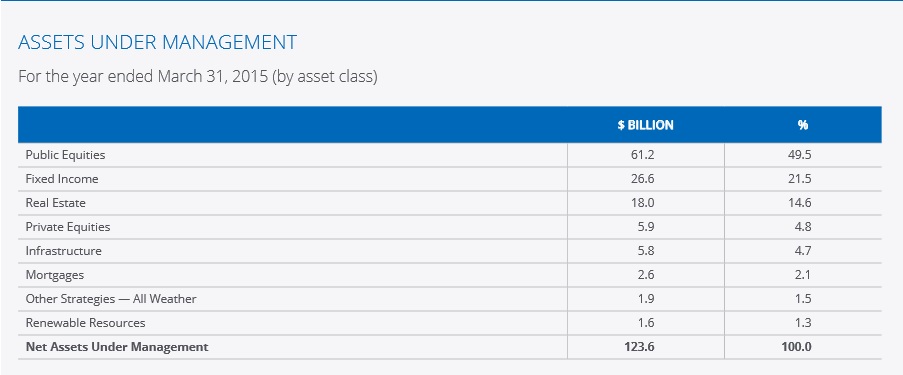
The fund ended the fiscal year with 49.5 per cent of its assets invested in public stock markets, up from 47.6 per cent a year earlier. BCIMC had 21.5 per cent of its holdings in fixed-income securities such as bonds, down slightly from 22 per cent last year, while 14.6 per cent of the portfolio is in real estate, a decline from 17.4 per cent at the end of fiscal 2014.

The fund said its Canadian public equity holdings earned a 7.5-per-cent return last year, while global public equities earned a far higher 23 per cent and emerging markets equities posted 21.4-per-cent gains, illustrating the value of shifting out of Canada’s volatile stock market.

Although the fund adjusted its weightings last year, chief executive officer Gordon Fyfe said it continues to have a long-term investment strategy to ensure member funds are able to deliver pensions to their members.

“Maintaining our discipline, while focusing on due diligence and diversification allows BCIMC to manage market risks so our investments can provide stable cash flows and will appreciate in value over time,” he said in a statement.

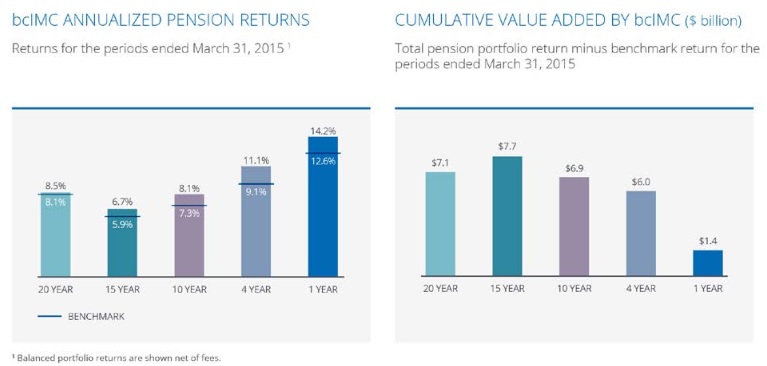
BCIMC said investing in passive benchmarks last year would have earned a 12.6-per-cent return, so its active investment strategy added $1.4-billion in additional returns. Over the past 10 years, BCIMC earned an average 8.1-per-cent annualized return, exceeding its benchmark of 7.3 per cent.

BCIMC published its annual report Thursday, showing its executive compensation payments for the past year. Mr. Fyfe, who joined the fund last July, earned $2.2-million in total compensation for the portion of the year he worked, while Lincoln Webb, senior vice-president of private markets, earned $1.27-million in fiscal 2015.

BCIMC oversees investments for B.C. public sector pension plans as well as other government funds. It is Canada’s fourth-largest pension fund manager behind the Canada Pension Plan Investment Board, the Caisse de dépôt et placement du Québec and the Ontario Teachers’ Pension Plan.

You can view bcIMC 2014-2015 Annual Report here. There is an interactive version and a PDF file. You can also view the press release on these results here.

As discussed in the article above, the biggest driver of bcIMC’s results in 2014-2015 was this tactical shift into global equities at the end of March 2014. With a little over half of the assets in global public equities, bcIMC benefited from the “beta boost” and decline in the loonie that other large Canadian pensions benefited from as they shifted public and private assets away from Canada.

On page 17 of the Annual Report, there is a detailed discussion on the drivers of public equities:

Our emerging markets funds were a key driver of returns in our public equity program. The Active Emerging Markets Equity Fund outperformed the benchmark by 7.2 percentage points. Over a four-year period, the fund returned 7.5 per cent against a benchmark of 4.6 per cent. China and India performed exceedingly well and clients benefited from being overweight to these regions. We continued to increase our exposure to China. bcIMC deployed an additional $200 million into the domestic China A-Share market, which gained 120 per cent last year.

Our global equity funds also drove overall returns. The Active Global Equity Fund returned 24.9 per cent against a benchmark of 22.3 per cent. The Thematic Public Equity Fund returned 30.8 per cent against a benchmark of 22.3 per cent. Our exposure to the health care theme was an important driver of the value-added performance.

The chart below from page 12 of the Annual report shows the breakdown in performance of global equity markets during bcIMC’s fiscal 2015 (click on image; total returns all in C$):

As shown above, China significantly outperformed other regions (+100%) mostly owing to the brewing bubble there which is now bursting, but there were solid gains in the U.S. and Japan (+29%), especially when you factor in the decline in the Canadian dollar relative to these currencies.

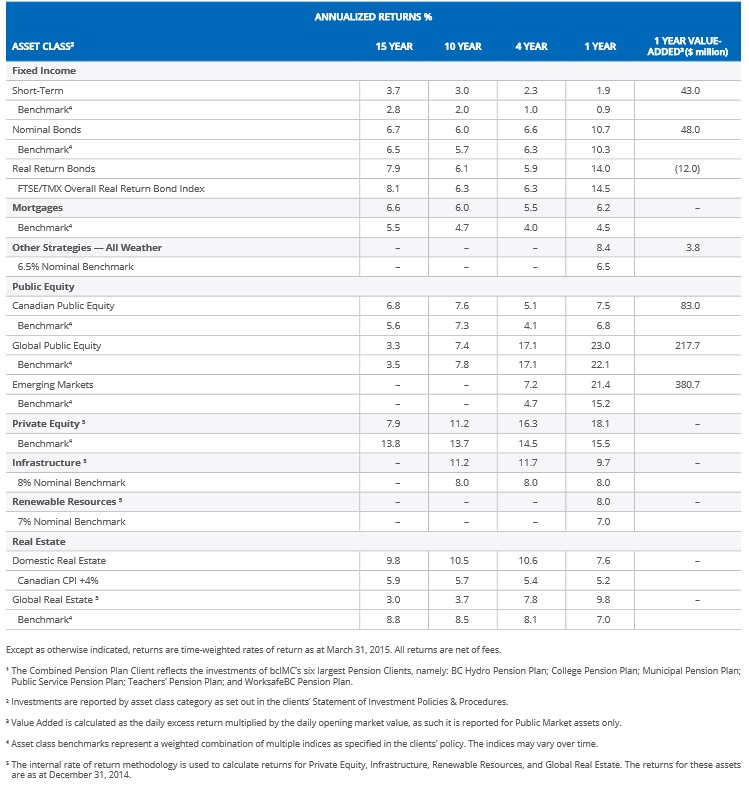
But the gains didn’t just come from public equities. The table below from page 14 of the Annual report provides a breakdown of returns by asset class (click on image):

As shown, there were solid gains in Private Equity (18.1% vs 15.5% for its benchmark) and gains in Infrastructure and Renewable Resources were decent but not spectacular (9.7% and 8% respectively vs a 7% nominal benchmark). Similarly, gains in Canadian (+7.6%) and Global Real Estate (+9.8%) were decent relative to its benchmark of CPI+4% (+7%) but not spectacular.

(Note: For some reason, the performance of Private Equity, Infrastructure and Renewable Resources is unaudited whereas the performance of Real Estate is audited. No discussion on why this is the case).

As you can see from the table below taken from page 3 of the Annual report, Private Equity, Infrastructure and Renewable Resources make up roughly 11% of total assets (click on image):

Relative to its larger peers, bcIMC was late shifting assets into private equity, which is why that 5% weighting of total assets will double in the coming years. The bulk of private market assets at bcIMC are in Real Estate, which now accounts for 15% of total assets (it was 18% last year when the loonie was stronger).

In order to better understand and fully appreciate bcIMC’s investment approach, I highly recommend you read a March 2014 article from Benefits Canada, How bcIMC is transforming its portfolio, where its former CEO/CIO Doug Pearce goes over their investment portfolio.

In that article, you will read why bcIMC doesn’t invest in hedge funds and how it develops greenfield projects in real estate:

With real estate investments—which account for about 18% of bcIMC’s total portfolio—the company focuses on development (buying land and building on it) rather than on purchasing property. “Returns are greater when we develop,” Pearce says, citing high real estate prices as a reason for this approach. “It’s something the larger pension plans can do in Canada.” Currently, bcIMC has 24 development projects across the country, including office, industrial, retail and multi-family apartment buildings.

The company’s real estate holdings are almost entirely in Canada because this is a market that bcIMC understood when it started these investments. But, as the program matures, it will become more international in the future, Pearce says. By contrast, he adds, the majority (77%) of the agency’s infrastructure investments are outside of the country—generally in developed nations, because fewer of Canada’s infrastructure assets have come to market. Together with renewable resources, infrastructure investments make up 6% of bcIMC’s total portfolio.

However, the corporation doesn’t endorse all alternatives. For example, it has always avoided hedge funds. “In B.C., our clients are relatively conservative. Therefore, putting leverage on the portfolio is very limited,” Pearce explains. “[And] we didn’t like the non-transparency of hedge funds.”

bcIMC’s new CEO/ CIO, Gordon Fyfe, is breaking tradition on hedge funds as the “All Weather” strategy on page 14 from table above is an allocation to Bridgewater. Moreover, he will increasingly focus his attention on private markets, which is what he did when he was running PSP Investments.

The fact that bcIMC’s Real Estate portfolio is almost entirely in Canada makes sense from a liability standpoint but it doesn’t make sense from a diversification standpoint and returns in that asset class didn’t benefit from the decline in the Canadian dollar, which I think will continue as the Canadian economy has turned for the worst.

It is worth noting that the former head of real estate at bcIMC, Mary Garden, has departed the organization. Gordon will be actively looking to replace her as he figures out how to bolster and diversify that asset class.

In his CEO/ CIO report in the Annual Report (starts on page 6), Gordon Fyfe had this to say on enhancing bcIMC’s investment strategies:

Ultimately, bcIMC’s goal is to invest our clients’ money and generate value-added returns. Our clients depend on these returns to pay pensions and insurance obligations long into the future. We must ensure our strategies maximize returns within our clients’ risk parameters. To keep pace with the rapid evolution of the investment world, our investment activities will become increasingly sophisticated and adapt to the changing capital markets.

Updating our investment strategies includes expanding our use of derivatives and leverage in our programs to facilitate cost-effective rebalancing of our clients’ portfolios. We view the use of certain derivative products as an efficient tool to reduce the risk of portfolios, as well as to allow for quicker transitions of assets and to produce higher returns. In short, derivatives can benefit our clients. Similarly, leverage allows us to take advantage of low interest rates, and when used as a strategy, can free up capital to be used elsewhere.

We will also increase our global investment footprint and expand our range of products to ensure our clients can benefit from a wider range of investment opportunities. These include expanding our currency management capabilities, increasing global private market investments, and adding high yield debt.

The use of leverage and derivatives might pave the way to incorporate risk parity strategies and hedge funds in bcIMC’s portfolio (as stated, the “All Weather” strategy on page 14 from table above is an allocation to Bridgewater).

Finally, the table below from page 36 of the Annual Report provides information on the compensation of bcIMC’s senior executives (click on image):

As you you see, Gordon Fyfe enjoyed a total compensation of $2,169,699 in fiscal 2015 after arriving at bcIMC in July 2014, more than twice as much as other senior executives which all made roughly $1 million. Of course, Gordon’s compensation was drastically reduced from the good old days at PSP Investments but he’s still part of Canada’s pension plutocrats and gets to enjoy his millions living in his home town of Victoria, British Columbia where all his family lives.

To be fair, what counts in compensation is long-term performance based on the last four fiscal years and in this regard, bcIMC’s senior managers have exceeded their benchmarks. Also, as Gordon Fyfe stated: “To put this into perspective, we returned 8.1% (annualized) against a 10-year combined benchmark of 7.3%. That translates into $6.9 billion in additional value to our public sector pension
clients.”

I congratulate Gordon and the folks at bcIMC for a solid performance in fiscal 2015 but warn them to start reducing their risk to Chinese public equities and even emerging markets (hope they already did). That trade panned out exceedingly well in fiscal 2015 but it will be a total disaster in fiscal 2016.

On the thematic portfolio, I’m still bullish on U.S. biotechs (IBB or XBI) and by extension healthcare (XLV) which has big biotechs among its holdings and continue to add to my positions in each big biotech dip. I continue to steer clear of Canadian equities and all energy/ commodity shares as my fear remains that global deflation will win over global reflation.

Small Hedge Funds Outperform the Large, Especially In Crisis Times : Research

2611679744_5da955a118_z

Smaller hedge funds tend to outperform their larger counterparts, especially during times of crisis, according to a recent research paper.

The research is relevant to pension funds because pensions often select managers based on the advice of consultants, who often recommend large-ish hedge funds – and, although some pension funds are opting to go smaller, most take their consultants’ advice.

From CIO Magazine:

In a study of hedge fund size and performance between 1994 and 2014, City University London’s Andrew Clare, Dirk Nitzsche, and Nick Motson found investors were better off at the smaller end of the scale.

According to the study, the largest decile of funds returned an average of 0.61% per month, with a standard deviation of 0.66% and a Sharpe ratio of 0.62. The smallest decile, however, generated an average return of 0.74%, a standard deviation of 0.72% and a Sharpe ratio of 0.74.

Smaller funds outperformed their larger counterparts for all but three of the 20 years covered by the study, the paper found, with correlations intensifying for periods following the collapse of the tech bubble and the global financial crisis.

[…]

Additionally, hedge fund managers do not age well, the study claimed—at least in terms of performance.

“One would hope that a hedge fund’s performance would—like a vintage wine—improve with fund age, as the fund’s managers become more experience at managing their funds and strategies,” the paper said.

Despite these expectations, data revealed that older funds produced lower returns compared with their less-established counterparts. And the relationship was particularly negative during 1996 to 2002.

Read the paper here.


Photo  jjMustang_79 via Flickr CC License

California Treasurer Says He’ll Look Into CalSTRS’ PE Fees As Carried Interest Scrutiny Expands

CalSTRS

Two weeks ago, CalPERS came under fire for not collecting data on the carried interest fees it pays to its general partners. In the wake of scrutiny from national media and state Treasurer John Chiang, the pension fund sent out a directive to staff to begin collecting the fee data.

Now, the scrutiny has expanded to include CalSTRS; the teachers’ pension fund admitted earlier this month that it did not collect data on its carried interest fees, either.

From the Financial Times:

The second-largest US public pension fund has admitted it has failed to record total payments made to its private equity managers over a period of 27 years.

The admission by Calstrs, the $191bn California-based pension fund, prompted John Chiang, the state treasurer of California, to declare he will investigate the failure, which poses serious questions as to how pension fund money is being spent.

[…]

A spokesman for Calstrs, which helps finance the retirement plans of teachers, said the fund does not record carried interest. “What matters is the overall performance of the portfolio.”

Following questions from FTfm, Mr Chiang said he would demand Calstrs look into payments of carried interest to its private equity managers.

“Disclosure [of carried interest fees] is very important,” said Mr Chiang, who sits on the administration board of both Calstrs and Calpers.

[…]

Calstrs, which manages a $19.3bn private equity portfolio and has 880,000 members, said it has no plans to upgrade its systems for tracking and reporting payments to private equity managers.

Margot Wirth, director of private equity at Calstrs, said it used “rigorous checks” to ensure private equity managers took the right amount of carried interest.

All of Calstrs’ partnerships with private equity managers were independently audited, Ms Wirth added. She said the pension fund carried out its own internal audits and employed a specialist “deep dive” team to look at private equity contracts.

Carried interest is a profit-sharing fee paid by pension funds to the general partners with which they’ve invested.


Photo by Stephen Curtin via Flickr CC License

Video: CPPIB’s Head of International Investments Talks Private Equity Investing, Challenges of Opening Asia Office

In this interview, Mark Machin – Head of International Investments for the Canada Pension Plan Investment Board – talks about the challenges of opening an Asia office, how the Asian market is different from others, and why it’s not for everyone.

He also gives his take on private equity and infrastructure investing.


Video source: AVCJ TV

Photo credit: “Canada blank map” by Lokal_Profil image cut to remove USA by Paul Robinson – Vector map BlankMap-USA-states-Canada-provinces.svg.Modified by Lokal_Profil. Licensed under CC BY-SA 2.5 via Wikimedia Commons

The Trillion Dollar State Funding Gap?

6793829413_369c06f927_z

Leo Kolivakis is a blogger, trader and independent senior pension and investment analyst. This post was originally published at Pension Pulse.

Mandi Woodruff of Yahoo Finance reports, State pension funds face $1 trillion funding gap:

More depressing news for workers who depend on a pension to fund their retirement: State-run pension funds faced a $968 billion shortfall in 2013, up $54 billion from the year prior, according to a new report by The Pew Charitable Trusts. When local pension fund shortfalls are factored in, the total pension funding gap surpasses $1 trillion.

“Policy makers are going to need to find a way to address [this funding gap] and it’s going to have to come down to some kind of plan to pay it down in an orderly fashion,” said David Draine, a senior researcher at Pew Charitable Trusts.

On average, state pension plans were only 74% funded. The implications for workers are huge. If states don’t find a way to fully fund pension plans, many workers who have dutifully paid into pension plans may not get back what they’ve put in and young workers may not get to participate at all.

Fewer than half of states were able to meet their required annual contributions to pension funds in 2013. New Jersey and Pennsylvania were the furthest behind— each was only able to make only half its annual funding contribution. As a result, more than one-third of their state pension funds were unfunded.

Overall funding rates were the worst in Illinois (with just 39% funded) and Kentucky (44%), where pension funding levels have declined for three years in a row. Just two states managed to finish the year with 100%-funded pensions: South Dakota and Wisconsin.

It should be noted that Pew’s report only looks at funding rates for 2013 and does not factor in the significant investment gains of 2014 (the S&P 500 index rose around 11% last year, according to data from FactSet). But even if it had, the budget shortfall would still likely exceed $900 billion, the report says.

They probably aren’t wrong on this point. In a recent analysis by Boston College’s Center for Retirement Research (CRR), researchers predicted that the pension funding rate would be 74% for 2014, the same rate as Pew’s report, which looked at 2013. If the market continues to improve, however, that funding level could reach 81% by the year 2018, CRR said.

To close the funding gap, like anyone who’s ever been overwhelmed by credit debt knows, states need to step up, Pew argues.

States have adopted pension funding standards that allow them to drag out their pension debts over a longer period of time (a maximum of 30 years) — similar to homeowners who want to stretch out their mortgage payments as long as possible. The result is smaller payments that are easier to swallow but don’t actually put a significant dent in the principal debt.

“This is similar to the negative amortization loans some homeowners used in the run-up to the financial crisis,” the Pew report says. “Initial payments on those loans failed to pay down any principal, and homeowners fell deeper into debt as a result.”

To see how your state ranked, check out the report here.

In June 2012, I wrote an extensive comment on the state of state pension funds. Back then, the funding gap for U.S. state public employee retirement benefits climbed by $120 billion to $1.38 trillion in fiscal 2010, which was understandable given the 2008 crisis hit pensions’ assets and liabilities as investments took a huge hit and bond yields tumbled to record lows.

Three years later we see that the situation hasn’t drastically improved even though U.S. stocks are soaring to record highs. What gives? A few things. First and foremost, states have failed to top up public pensions for years which is why the situation has consistently deteriorated.

Second, the main driver of pension funding gaps is interest rates and with rates still hovering around historic lows, it’s hard to see any significant improvement in state pension funding gaps. Worse, if another financial crisis hits markets, rates will go even lower and deflation will decimate all pensions.

Third, U.S. public pension funds are delusional, stubbornly clinging to their the pension rate-of-return fantasy which will force them to take greater risks in illiquid alternative investments to make their 7.5%-8% bogey. But illiquid alternatives are no panacea and I would heed the wise advice of Ron Mock, Ontario Teachers’ President and CEO, and start scaling back on them at this time.

Interestingly, over in the Netherlands, Dutch regulators just lowered the average return pension funds are allowed to assume over the long run, forcing them to hike premiums to build up capital due to persistent low interest rates. The Dutch take their pensions seriously which is why they monitor pension funding gaps very closely to make sure the assumptions being used reflect current market conditions.

But in the United States, regulators pretty much turn a blind eye to public pension funding gaps and the assumed rate-of-return used to discount future liabilities. Instead, state politicians enact stupid policies like shifting employees to defined-contribution plans, further exacerbating pension poverty, or they “extend and pretend” by emitting pension obligation bonds, something which can turn out to be the next bigger short.

Finally, in my opinion, the problem with U.S. public pensions is they lack the proper governance to bring assets internally to lower costs. I wrote about this in the New York Times, arguing that until U.S. policymakers get the governance right and introduce risk-sharing in their plans (just like the Dutch do), state pensions are doomed for failure. 


Photo by http://401kcalculator.org via Flickr CC License


Deprecated: Function get_magic_quotes_gpc() is deprecated in /home/mhuddelson/public_html/pension360.org/wp-includes/formatting.php on line 3712