Danish Pension Bucking The Hedge Fund Trend?

Leo Kolivakis is a blogger, trader and independent senior pension and investment analyst. This post was originally published at Pension Pulse.

Peter Levring of Bloomberg reports, Hedge Funds Haven’t Lost Appeal for Biggest Danish Pension Fund:

As a number of prominent pension funds stop using external managers they say charge too much in exchange for paltry returns, the biggest pension fund in Denmark is bucking the trend and sticking with the hedge funds it uses.

“In our case, funds have played a small but a good part in our portfolio,” Carsten Stendevad, the chief executive officer of ATP, which oversees about $118 billion in assets, said in an interview in Copenhagen.

The comments stand out at a time when a number of other pension funds have questioned the sense of continuing to rely on hedge funds to generate extra returns. There are plenty of examples of prominent skeptics. Rhode Island’s $7.7 billion pension fund terminated investments in seven hedge funds, including Brevan Howard Asset Management and Och-Ziff Capital Management Group LLC, it said earlier this month.

The largest U.S. pension plan, the California Public Employees’ Retirement System, voted to stop using hedge funds two years ago. Others who have stuck with the hedge funds they outsource investments to have faced criticism as the decision has led to losses, such as the New York state comptroller. Its loyalty to the industry has cost the Common Retirement Fund $3.8 billion in fees and underperformance, the Department of Financial Services in the U.S. said on Oct. 17.

Hedge fund investors pulled $28.2 billion from the industry last quarter, which is more than at any time since the aftermath of the global financial crisis, according to Hedge Fund Research Inc.

ATP declined to say which funds it uses or how much of its portfolio is managed by the industry. Investors can’t lump all external managers into one bucket and there’s plenty of variety left out there for it to still make sense to outsource to hedge funds, Stendevad said.

“There are so many types of hedge funds and we would look at all of them on a multi-year risk-adjusted return basis,” he said. “Looking at the ones we have, they’re quite different.”

ATP divides its investments into two categories: a so-called hedging portfolio, which is by far the larger of the two and designed to guarantee pensions. Its investment portfolio tries to boost the fund’s returns to top up Danes’ pensions. The fund returned 5.8 percent on its investments in the third quarter. For the first nine months, ATP’s investment portfolio returned 12.3 percent. It made money on private equity, bonds, real estate, infrastructure and credit instruments, but lost money on inflation hedges.

Stendevad said the double-digit returns ATP has generated probably aren’t sustainable, citing extreme monetary policies and the uncertainty created by Britain’s decision to turn its back on the European Union.

ATP will only continue using hedge funds as long as the returns justify doing so, Stendevad said.

“Of course the burden of proof is on them to demonstrate that they can deliver strong risk-adjusted returns,” he said. “And of course those who can do that have a good future. There are many that don’t, but that’s true for all active management to demonstrate added value.”

Stendevad, who joined ATP from Citigroup in the U.S. in 2013, is leaving the fund at the end of this year to spend more time with his family. He will be replaced by Christian Hyldahl, who comes from a position as head of asset management at Nordea.

So what is going on? Didn’t ATP get the memo that good times are over for hedge funds?:

For years they have been the elite of the fund management industry, enjoying colossal fees, gigantic homes and champagne lifestyles.

Now the good times may be over for hedge funds. Investors are taking their money elsewhere.

Last week the $US7.7 billion Rhode Island state pension scheme announced that it would take back half of the $US1.1 billion it had invested with seven hedge funds, including Och-Ziff and Brevan Howard.

Its decision comes after similar moves this year by the New York, New Jersey and Illinois state pension funds, which collectively have redeemed about $US6.5 billion. Kentucky and Massachusetts have also withdrawn money.

According to eVestment, an analytics and data provider, almost $US60 billion has left hedge funds this year, including $US10.3 billion in September.

It is an accelerating trend that began two years ago when the California Public Employees Retirement System (CalPERS), the benchmark for many public sector pension schemes, said that it was redeeming some of its hedge fund investments.

In the context of a $3 trillion industry, $60 billion of withdrawals may not seem like a crisis. But they are causing disquiet.

The main reason is that investors are becoming more cost-conscious. Few are prepared to stump up the gigantic fees charged in the glory years. Chris Ailman, chief investment officer of the $US187 billion California State Teachers Retirement System, spoke for many when in May he said that the industry’s traditional “two-and-twenty” model, where fund managers charge 2 per cent of assets under management and an additional 20 per cent of any profits earned, was broken.

Frankly, investors have decided that many hedge funds do not justify their high fees. According to eVestment, hedge funds delivered a positive return in September for the eighth consecutive month, taking the industry’s average return during the first nine months of 2016 to 4.4 per cent. But that’s poor set against the 9.7 per cent that investment-grade bonds have returned this year, let alone the S&P 500, which was up 6.1 per cent in the same period.

Among the worst performers have been some of the industry’s best-known names. The master fund at Brevan Howard fell by 0.8 per cent in 2014 and by almost 2 per cent last year. To date, it is said to be down by 3.4 per cent this year. Alan Howard, the firm’s billionaire co-founder, has responded by removing management fees on new investments from existing clients. Blaming poor performance on the fund having become too big, after assets under management swelled to $US27 billion in 2014, he has also capped it at $US15 billion.

Another industry legend to have cut fees is Paul Tudor Jones, a hedge fund pioneer, who let go nearly one in six of his staff this year after $US2 billion in redemptions. Other big names to have suffered poor returns this year include John Paulson, the hedgie famed for making billions in 2007 betting on a US housing crash, and Bill Ackman, a regular on America’s business channels.

Several factors have made it harder for the industry to make money. One is ultra-low rates and the rise of passive investing. These mean that many assets now move in tandem, making it harder for investors to add value by stock-picking or by alighting on specific situations or opportunities. Another is that markets are not as inefficient as before. Trading in some assets, notably interest rate products, is now dominated by algorithmic or “black box” traders that make fewer mistakes than human beings. With fewer mortals participating in such markets, there are fewer market anomalies for hedge funds to exploit, making it harder for them to claim an edge.

Poor performance is only one factor, however. Another is growing irritation at the billionaire lifestyles of some of the characters within the industry. This cannot be ignored by those running the retirement funds of public sector workers. Letitia James, the public advocate for New York and the city’s second-highest-ranking public official, told board members of the New York City Employees System this year to dump their hedge fund investments. She told them: “Hedges have underperformed, costing us millions. Let them sell their summer homes and jets and return those fees to their investors.”

Also helping to spark the redemptions have been other reputational hits prompted by tougher action on the part of regulators. Last month Och-Ziff agreed to pay $US412 million in penalties after entering a deferred prosecution agreement to settle claims of alleged bribery in five African countries. Most of the settlement was paid for by Daniel Och, the company’s founder and a former Goldman Sachs trader. Jacob Gottlieb, another big name, is in the process of closing his firm, Visium Asset Management, after one of its fund managers, who subsequently killed himself, was charged with insider trading. Leon Cooperman, another of the industry’s billionaire pioneers, is preparing to fight charges that his firm, Omega Advisors, profited from insider trading.

All these factors have created an unpleasant cocktail for the sector. One of the very best television series this year has been Billions, the story of hedge fund manager Bobby “Axe” Axelrod and Chuck Rhoades, the US attorney who tries to bring him down. The second series airs early next year, but to judge by the way things are going, soon it may look as much of a period piece as the film Wall Street does now.

No doubt, these are hard times in Hedge Fundistan and some investors want these hedge fund gurus to sell their summer homes so they can collect back some of the the gargantuan fees they lost while subsidizing their lavish lifestyles in return for paltry, sub-beta or negative returns.

I’ve been very critical of hedge funds on my blog for a long time. I’ve also warned investors that these are treacherous times for private equity and there’s a misalignment of interests in that industry too.

But with interest rates at historic lows and stock markets looking increasingly vulnerable to a violent shift, the elusive search for alpha continues unabated.

The only problem is when it comes to hedge funds, most investors, like Rhode Island, are meeting Warren Buffett, and realizing they’re not getting what they signed up for, namely, real, uncorrelated and high absolute returns that offer meaningful diversification benefits.

Are there too many hedge funds engaging in the same strategy? No doubt, crowded trades are a huge problem in the industry, especially among the large funds. But the other problem is a lot of hedge funds have gotten way too big for their own good, and more importantly for that of their investors. Too many seem content on collecting that 2% management fee on multibillions but are not offering the returns to justify the hefty fees they charge.

Hedge funds will blame the Fed, low interest rates, ZIRP, NIRP, crowding, high-frequency trading, passive investing, robo-advisors and increased regulations which makes it harder for them to engage in insider trading (and don’t kid yourselves, a lot of hedge funds engaged in this illegal activity in the past).

Whatever the reason, investors are fed up and in a deflationary world where rates are stuck at zero, fees eat up a lot of returns, so it becomes harder to justify paying hedge funds big fees, especially when they consistently under-perform markets over a long period.

So what’s the answer to hedge fund woes? A nice long bear market? Maybe but don’t forget what I always warn you of, most hedge funds stink, charging alpha fees for leveraged beta. This is why their hefty fees are a total disgrace, something which should have been addressed years ago by large institutional investors who have the power collectively to cut these fees down to normal.

Of course, some institutions are more than happy to keep on paying huge fees to hedge funds that (hopefully) are delivering great uncorrelated returns net of fees. Others are tired of playing this game and exiting these investments altogether or putting the screws on their hedge fund managers to lower the fees.

And while some US public pensions are exiting hedge funds or significantly lowering their allocation to them, others like ATP and Ontario Teachers’ Pension Plan are still very committed to these funds.

The key difference? When it comes to hedge funds, both ATP and Ontario Teachers know what they’re doing, they have committed substantial resources to their hedge fund program and have top-notch professionals sourcing and monitoring these external managers. They also use managed account platforms (like Innocap here in Montreal) to address liquidity and other risks.

Why Fresno, California Avoided Bankruptcy, Unlike Stockton

Reporter Ed Mendel covered the Capitol in Sacramento for nearly three decades, most recently for the San Diego Union-Tribune. More stories are at Calpensions.com.

At a time when some are calling soaring state and local government pension debt a crisis, there is a notable outlier. The Fresno city pension system has been fully funded for at least a decade and last year projected a $289 million surplus.

The main reason Fresno pensions have remained fully funded: The city’s public employee unions have accepted comparatively low retirement benefits, a particularly important concession by the police and firefighters who are a big part of the budget.

When another Central Valley city, Stockton, declared bankruptcy four years ago city officials said they would not cut the largest debt, a $211 million pension “unfunded liability,” because attractive retirement benefits are needed to remain competitive in the job market.

Stockton’s decision to cut only bond debt, despite a federal judge’s landmark ruling that CalPERS pension debt also can be cut in bankruptcy, was contested by two national bond insurers and a major bondholder, Franklin.

Not having a large pension debt to pay off helped Fresno cope with budget deficits during the recession. Speaking to the Bond Buyer last August, Mayor Ashley Swearengin recalled Time magazine mentioning Fresno as a possible bankruptcy.

Swearengin

Moody’s did not give Fresno bonds a hard-earned upgrade from a junk rating until last summer. Nearly a dozen rounds of painful quarterly budget cuts, begun early in the recession, left Fresno with a depleted workforce as the city struggled to close budge gaps.

“We had 4,100 employees and now we have 3,300,” Swearengin told the Bond Buyer. “Of those jobs, only 200 to 300 were layoffs. The rest were people who left, retired, or positions that had been held vacant, but were funded.”

The Fresno pension systems, never falling below 100 percent funded on an actuarial basis, continued receiving required employer-employee contributions during the recession, a timely addition to pension fund investments as the stock market began a major bull run after the bottom in 2009.

“In some people’s minds the city might have landed in bankruptcy if the city management and the unions hadn’t agreed on the incredibly hard step of instituting layoffs and freezes to keep the city functioning,” Robert Theller, Fresno Retirement Systems administrator, said last week.

Theller attributed the fully funded pensions to low payouts, unions that disagree with management on some points but are generally cooperative, good timing on a $152 million pension obligation bond in 2002, and conservative pension boards that invest carefully.

“It’s a well-run ship, and it has been for many decades,” said Theller, one of the reasons he was excited about taking the post last January.

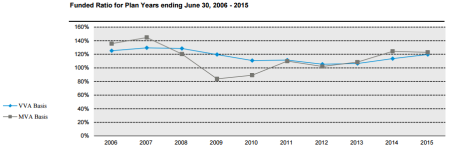
Fresno Police & Fire Retirement System funding level

Fresno city pensions can seem at odds with conventional pension wisdom. The investment earnings forecast is 7.5 percent, which critics usually contend is overly optimistic and conceals massive debt.

Recruitment and retention of Fresno city employees is not said to be a serious problem, even though retirement benefits are well below those offered by the Fresno County pension system, deep in debt with a $1 billion unfunded liability.

Like the large coastal cities, Fresno, the largest Central Valley city (estimated 2015 population 520,052, Sacramento 490,712), has independent city and county retirement systems that are not part of CalPERS, the giant California Public Employees Retirement System.

The rare Fresno city pension surplus was reported last March by Robert Fellner of Transparent California, a searchable public data base that lists the pay and pensions of individual state and local government employees and retirees.

Fellner said the average Fresno city pension for a police or firefighter with 30 years of service was $70,627 and the average pension for other (non-safety) 30-year city employees was $39.644.

In comparison, he said, the average Fresno County pension for a non-safety employee with 30 years of service was $61,513, more than 50 percent higher than the pension of a similar city employee.

“Fresno County will spend a staggering 52 percent of pay on retirement benefits, which is over triple the 16 percent rate that Fresno City pays, and over 17 times more than the 3 percent that the median private employer spends on employees’ retirement accounts,” Fellner reported.

The city and county both provided average full-career pensions that exceeded the average pay, $36,975, of private-sector workers in Fresno County, Fellner said, according to 2014 data from the U.S. Bureau of Labor and Statistics.

On the same day last month, Oct. 25, Fellner’s Fresno report was featured on Fox television news, while an academic newsletter distributed a study that found the Fresno County pension system led the nation in eating up county budgets.

The study by the Center for Retirement Research at Boston College used its own methodology to compare the percentage of “own-source revenue” (excluding transfers from state or local government) taken by pensions, retiree health care, and debt service.

Fresno County ranked No. 1 (see chart below), in a nationwide sample of 178 counties, with pensions taking 57.1 percent of own-source revenue, retiree health care (OPEB) 0 percent, and debt service 4.5 percent.

In an email response to a request for comment on the study, the Fresno County Employees Retirement Association said it “does not control, create, or negotiate benefit formulas” and “continues to have the ability to provide guaranteed retirement benefits.”

Fresno ranked No. 33 in the study, among a nationwide sample of 173 cities, with pensions taking 8.9 percent of own-source revenue, retiree health 2.2 percent, and debt service 7.1 percent.

The president of the Fresno Police Officers Association, Jacky Parks, said last week the low city pensions have had an impact on recruiting and retention. For example, he said, a “lateral transfer” from an employer in CalPERS can be difficult for several reasons such as differences in “pensionable pay.”

Jacky Parks

CalPERS sponsored legislation, SB 400 in 1999, that gave the Highway Patrol a “3 at 50” pension formula providing 3 percent of final pay for each year served at age 50, capping the pension at 90 percent of pay.

Critics say the costly “3 at 50” formula, widely adopted by large local governments, is “unsustainable” and a major cause of pension debt. Fresno offers a “2 at 50” formula increasing to 2.7 percent at age 55, capped at 75 percent of pay.

Parks said Fresno also has a DROP plan that allows officers to earn a retirement benefit comparable to the “3 at 50” formula. He said most officers enter the DROP plan at age 50, limiting them to no more than 10 additional years on the job.

(The Deferred Retirement Option Program freezes the pension earned at that point. The pension amount, plus COLAs and interest at a rate approved by the pension board, goes into a special account until the employee leaves the job.)

Parks said Fresno officers are “proud we have a solvent system” and are aware that “everyone is a little worried” about the financial condition of the Fresno County retirement system.

“The philosophy of our (pension) trust is that you need to be financially responsible so this is going to be forever, so the next guy that gets here doesn’t need to worry,” Parks said.

crc-chart

PSP Seeds European Credit Hedge Fund?

Leo Kolivakis is a blogger, trader and independent senior pension and investment analyst. This post was originally published at Pension Pulse.

Kirk Falcomer of the PE Hub Network reports, PSP Investments commits €500 mln to European credit platform (added emphasis is mine):

Canada’s Public Sector Pension Investment Board (PSP Investments) has committed €500 million ($735 million) in seed capital to a new European credit platform. The platform, created by David Allen‘s AlbaCore Capital, will focus on private and public credit markets where there are inefficiencies in pricing, including high yield, leveraged loans and direct lending. PSP said it may deploy more capital in partnership with AlbaCore for specific deal opportunities. PSP launched a private debt strategy in November 2015. Earlier this year, the pension fund hired Oliver Duff to lead its strategy in Europe.

PRESS RELEASE

PSP Investments commits €500 million in newly-created European credit platform AlbaCore

Seed Investment in AlbaCore to Add to PSP Investments’ Existing Private Debt Activities in Europe

MONTRÉAL and LONDON, Nov. 1, 2016 /CNW Telbec/ – The Public Sector Pension Investment Board (“PSP Investments”), one of Canada’s largest pension investment managers, announced today a €500 million seed investment commitment made by an affiliate of PSP Investments in a new specialist European credit platform promoted by AlbaCore Capital Limited (“AlbaCore”), recently formed by David Allen. This is one of the largest commitments PSP Investments has made to an external strategy. AlbaCore intends to focus on private and public credit markets where there are significant inefficiencies in pricing, including European high yield, leveraged loans and direct lending. PSP Investments may deploy further capital in partnership with AlbaCore in certain substantial investment opportunities in Europe.

“PSP Investments sees great opportunity in the European credit market and, as such, entered the market earlier this year with the hiring of Oliver Duff to lead our European private debt activities, which focus on sponsor-financed acquisitions, first liens, second liens and other debt instruments across the capital structure,” said David Scudellari, Senior Vice President and Head of Principal Debt and Credit Investments at PSP Investments. “With its expertise and extensive network of relationships, the portfolio team working for AlbaCore is well positioned to source bespoke, attractive transactions that will add to our existing activities,” Mr. Scudellari added.

Private Debt is PSP Investments’ newest asset class. It was created in November 2015 with the objective to deploy over C$5 billion (over €3.4 billion) in debt financings globally. Since inception, the team has committed to over 20 transactions in North America and deployed C$2.4 billion (€1.6 billion). Oliver Duff joined PSP Investments’ London office in September 2016 with the mandate to develop the organization’s presence in the European leverage finance market, build relationships with local partners and contribute to achieving PSP Investments’ deployment goal.

About PSP Investments

The Public Sector Pension Investment Board (PSP Investments) is one of Canada’s largest pension investment managers with C$116.8 billion of net assets under management as at March 31, 2016. It manages a diversified global portfolio composed of investments in public financial markets, private equity, real estate, infrastructure, natural resources and private debt. Established in 1999, PSP Investments manages net contributions to the pension funds of the federal Public Service, the Canadian Armed Forces, the Royal Canadian Mounted Police and the Reserve Force. Headquartered in Ottawa, PSP Investments has its principal business office in Montréal and offices in New York and London. For more information, visit investpsp.com or follow Twitter @InvestPSP.

About AlbaCore

AlbaCore’s specialist European credit platform is focused on opportunities across European corporate credit markets. The platform’s selection process is based on fundamental research focusing on capital preservation and total return.

So who is David Allen and why is PSP seeding his new fund, AlbaCore Capital, with such as substantial investment?

Back in May, Nishant Kumar of Bloomberg reported, Canada Pension’s David Allen Said to Depart to Start Hedge Fund:

David Allen, a money manager in London at the $212 billion Canada Pension Plan Investment Board, is leaving to start his own hedge fund, according to a person with knowledge of the matter.

Allen, who is a managing director responsible for credit investments, will leave Canada’s largest pension fund on Friday and start his own investment firm later this year, said the person who asked not to be identified because the information is private.

The money manager established and managed a credit opportunities fund that has invested more than 9 billion Canadian dollars ($6.9 billion) since he joined the firm in 2010, the person said. The fund returned an annualized 15.3 percent over the last six years, they said.

Allen declined to comment, while Mei Mavin, a spokeswoman for the pension firm, confirmed his departure. “We thank David for his many contributions to CPPIB and wish him all the very best on his new endeavors, ” she said in an e-mailed statement.

Allen was a partner and head of European investments at GoldenTree Asset Management in London before joining the pension fund.

Obviously David Allen is extremely qualified to run a credit fund. Before leaving CPPIB where he racked up huge gains running their European credit portfolio, he worked at GoldenTree Asset Management where he was a member of the Global Investment Committee, Portfolio Manager for US Media, Telecom, Gaming Partner and Head of European Investments (he founded GoldenTree’s European office).

Prior to GoldenTree, he was an Executive Director at Morgan Stanley where he ranked as the #1 High Yield Media analyst in the US according to Institutional Investor Magazine (2002).

Allen has been busy building his team since May. He hired Matthew Courey, former head of high-yield bond trading at Credit Suisse and Joseph Novarro, the former managing partner at investment firm Renshaw Bay, to become the chief operating officer of his private debt fund.

In late September, Allen also hired Bill Ammons away from CPPIB to join his new fund:

Former Canada Pension Plan Investment Board fund manager Bill Ammons has joined David Allen’s new credit startup AlbaCore Capital as a founding partner and portfolio manager.

The new fund is planning to commence operations by the end of the year, according to Reuters. Ammons worked for Allen when they were both portfolio managers at CPPIB.

Allen was a managing director responsible for credit investments at CPPIB, which manages some $217 billion and is Canada’s largest pension fund, before leaving in May of this year to start his own shop in London.

Ammons joined CPPIB in 2010 and worked on its European credit investment team, Reuters noted. He managed a European sub-investment grade credit portfolio investing in leveraged loans, high yield, mezzanine, PIK, converts and distressed positions across the primary, secondary and private credit markets, according to his LinkedIn profile.

Beforehand, he was part of BofAML’s restructuring and leveraged finance team in London, and was previously on the leveraged finance team at Wachovia.

He comes aboard AlbaCore alongside Matthew Courey, who was head of high-yield bond trading at Credit Suisse, and Joseph Novarro, who was managing partner at money manager Renshaw Bay and joins the firm as COO. Both are also founding partners, and the four will reportedly form the nucleus of AlbaCore’s investment and management committees.

David O’Neill, former head of European institutional equity trading for KCG Holdings, also recently joined AlbaCore recently as head of operations and risk management.

Based in London and founded in early June 2016, AlbaCore’s initial size is unknown and details about the strategy or strategies it will pursue remain sparse beyond a concentration in European private and public credit opportunities.

The four founding partners of AlbaCore Capital are featured in the picture above which was taken from their LinkedIn profiles.

So what do I think of this deal to seed AlbaCore Capital? A few brief thoughts:

  • I like this deal for a lot of reasons. No question that David Allen and Bill Ammons are excellent at what they do which is why they posted solid numbers while working at CPPIB. Will they keep delivering 15% annualized at AlbaCore? I strongly doubt it but even if they deliver 10% + with low volatility and correlation to stocks and bonds, that will be great for PSP and its members. That all remains to be seen as markets will be far more challenging in the next five to ten years.
  • Was this deal cooking for a while? I believe so and think PSP’s President and CEO, André Bourbonnais who was David Allen’s boss at CPPIB, was in talks about this deal ever since Allen departed CPPIB. In fact, I wouldn’t be surprised if Bourbonnais prodded Allen to leave CPPIB, promising him he would seed his new fund or Allen confidentially told him he wanted to start this new fund and would love to have PSP as a seed investor (it helps to have friends in high places). Either way, seed deals of this size don’t happen on a whim.
  • I’m not sure if it’s technically a hedge fund (the release calls it a credit “platform”) but seeding this new fund with such a sizable commitment comes with risks and benefits. The risks are the fund will flop spectacularly and PSP will deeply regret its decision to back it up with such a hefty commitment. But if it succeeds, PSP will enjoy the benefits of being an anchor investor, which means it won’t be paying 2 & 20 in fees (not even close) and if it has an equity stake (not sure it does), it will make money off that too (or do some sort of revenue sharing). The specific terms of the deal were not disclosed but I’m sure they were mutually beneficial to both parties.
  • Other specifics were not disclosed as well like the specific breakdown of investment activities and geographic exposure within Europe. That likely remains to be determined as AlbaCore will invest opportunistically as opportunities arise in high yield, leveraged loans and direct lending. For PSP, it gains meaningful, scalable access immediately to very qualified portfolio managers who are very much in tune with what is happening in European credit markets.
  • This deal represents a significant push for PSP in private debt, a new asset class that makes perfect sense, especially when the economy is slowing and banks aren’t lending. Oliver Duff who leads PSP’s European private debt activities and reports to David Scudellari, Senior Vice President and Head of Principal Debt and Credit Investments at PSP, is very qualified and will use this investment to deploy more capital in partnership with AlbaCore for specific sizable deal opportunities.
  • European debt markets are challenging to say the least but that is why it helps to have partners who understand these challenges and can seize opportunities as well as advise PSP as bigger opportunities arise.

All in all, I like this seed deal for a lot of reasons but caution everyone to temper their enthusiasm as the investment landscape will be far more challenging in the next ten years and return expectations across all asset classes need to come down.

Some other thoughts? People will say why didn’t PSP just hire its own team, why seed AlbaCore Capital? Like I stated, PSP gains immediate, scalable access to European private debt markets with this seed investment and it’s not paying 2 & 20 in fees or anywhere close to that amount as a seed investor. Also, this partnership will prove useful for deployment of capital in bigger deals where PSP has the size to invest directly or co-invest along with AlbaCore.

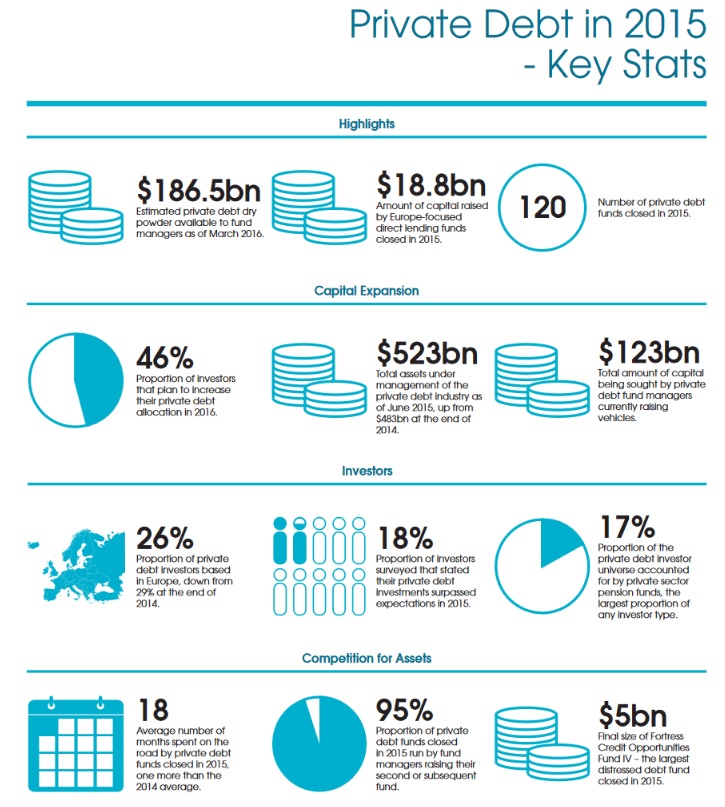
If you want to read more on the rise of private debt as an institutional asset class, click here to read an excellent report from ICG. Also, the figure below was taken from sample pages from the 2016 Prequin Global Private Debt Report (click on image):

As you can see, private debt isn’t an emerging asset class, it’s already here and big pensions like CPPIB and PSP Investments are going to be critical players in this space (CPPIB already is and PSP is on its way there).

There are structural factors that explain the rise of private debt as an asset class, including a slowing economy, historically low rates, bank regulations and in Europe in particular, where the banking sector is a mess and deflation and low growth are here to stay, private debt opportunities will abound especially for PSP, CPPIB and other pensions with a very long investment horizon.

Are there risks to private debt? Of course there are, especially in Europe, but if these deals are structured properly and PSP can take advantage of its long investment horizon, it will mitigate a lot of risks which impact funds with a shorter investment horizon like hedge funds and even private equity funds.

I’ll leave you with some more food for thought, Carlyle is shifting its focus back to lending after its unsuccessful venture into hedge funds:

Carlyle’s first big investment in a hedge fund firm was Claren Road Asset Management, which was founded by four star Citigroup traders in December 2010. Carlyle took a majority stake. A few months later, it bought a stake in the Emerging Sovereign Group (E.S.G.), which started with a seed investment from Julian H. Robertson, the billionaire investor.

It was part of a bigger push by Carlyle to branch out before its initial public offering in 2012. Soon after, it bought a stake in Vermillion Asset Management, a commodities investment manager. Other private equity firms like Blackstone have followed similar strategies, buying hedge fund stakes, as have the family investment offices of extremely wealthy people, like that of the Alphabet chairman, Eric E. Schmidt.

But over the last two years, nearly $8 billion has flowed out of Claren Road. It is bracing for another $1 billion to be withdrawn in the next few quarters. This year, it announced plans to cut ties with E.S.G., selling its majority stake in the $3.5 billion hedge fund. Last year, Carlyle split with the Vermillion founders Chris Nygaard and Andrew Gilbert after deciding to redirect the business toward commodity financing and away from managing money. By the end of the year, its assets in hedge funds are expected to total just $1 billion.

Now, Carlyle will focus on another part of its global markets strategies business: lending. It will focus on private lending to companies, buying distressed debt from companies in sectors like energy, and investing in complex pooled investments like collateralized loan obligations, stepping into the business as banks retrench after the financial crisis. Last month, it hired Mark Jenkins from the Canada Pension Plan Investment Board. Mr. Jenkins helped expand the pension fund’s direct lending.

Carlyle may still face challenges in its global markets strategies unit, and its pivot to lending from hedge funds has been met with some skepticism. During a phone call with analysts after its third-quarter earnings announcement this week, an analyst from JPMorgan Chase questioned whether Carlyle’s experiment in hedge funds might be repeated in its new venture into lending.

“I think in hindsight, you were late to hedge funds, made significant investments and it didn’t end well,” the analyst said, adding, “Why is this different?”

In response, Mr. Conway emphasized that Carlyle had better expertise in private markets, its traditional business, than in the public markets in which its hedge fund investments were mainly invested.

Christopher W. Ullman, a spokesman for the firm said: “We’re building on well-established firmwide strengths. This is a long-term strategic commitment. Credit is an attractive asset class and always will be.”

A little side note, when I covered the big executive shakeup at CPPIB, I stated Mark Jenkins might have approached Carlyle being disappointed that he wasn’t named CPPIB’s new CEO and there may have been a conflict of interest as he was responsible for private markets at CPPIB.

After a high level discussion with a senior manager at CPPIB, I was told that Jenkins was planning his exit for some time and that the appearance of him leaving after Mark Wiseman left to join Blackrock was “unfortunate and coincidental.”

Also, this person told me Jenkins was not directly responsible for investing in Carlyle or any other fund and that these decisions are made in an investment committee which he was part of but not directly responsible for fund investments.

I apologize to Mark Jenkins if my comment added fuel to the conspiracy fire but one thing that still concerns me is all these senior people at CPPIB leaving to join established funds or to start their new fund capitalizing on their key relationships.

Sure, it’s a free market and nothing says they need to stay at CPPIB or PSP for the rest of their career but the governance at these funds needs to be bolstered to make sure there is nothing remotely shady going on and that if a key manager leaves, there is ample time to ensure a successful handover of big investment portfolios.

Yes, CPPIB can handle the departure of a Wiseman, Bourbonnais, Allen, Ammons and Jenkins but if this becomes a regular occurrence, the optics don’t look right and it will become a problem for the fund going forward.

One final note, as you see PSP ramping up its private debt portfolio, think about my recent comments on the Liberals attacking public pensions and the future of retirement plans.

When I say nothing compares to Canada’s large, well-governed defined-benefit plans which invest directly and indirectly across public and private markets, this example of investing in private debt highlights why no defined-contribution, target date or variable benefit plan can compete with Canada’s large DB plans over a long period.

Again, if you have anything to add, shoot me an email at LKolivakis@gmail.com and I’ll be glad to share your insights. Please remember to kindly donate or subscribe to this blog on the top right-hand side under my picture and support my efforts in bringing you the very best insights on pensions and investments.

San Antonio Fire & Police Pension Names Finalists in Emerging Manager Search

The $2.7 billion San Antonio Fire & Police Pension Fund this week named two finalists in its search for emerging managers to handle two separate allocations: one to run an infrastructure fund, and the other to run an emerging markets equity allocation, according to Pensions & Investments.

There was no RFP issued for this sweepstakes, and allocation sizes are currently unknown. The retirement system’s manager of emerging managers, Attucks Asset Management, ran the search.

Who are the finalists? P&I reports:

The emerging markets equity finalists are Ativo Capital Management and Thomas White International; the infrastructure finalists are Ullico Investment Advisors and J.P. Morgan Asset Management (JPM). All finalists have been invited to make presentations at the Nov. 23 investment committee meeting.

Over the summer, the pension fund hired emerging managers Altum Capital Management and Varadero Capital to handle a combined $15 million in structured credit.

Elizabeth Warren, Bernie Sanders to Railroad Pension: Prioritize Diverse Asset Managers

Elizabeth Warren, Bernie Sanders and a half dozen other senators last month penned a letter to the National Railroad Retirement Investment Trust, encouraging the prioritization of diversity when selecting asset managers.

[The letter can be read here. It’s also embedded below.]

The NRRIT is the entity that manages the $25 billion portfolio of federal railroad employees.

The Senators are seeking clarity on how the NRRIT selects external money managers, with the stated goal of encouraging the entity to develop a program to allocate more funds to women or minority-owned funds. From the letter:

“Our economy and nation thrives when we develop inclusive political and economic institutions. Therefore, it is in our national best interest to share in a common goal of ensuring government better represent the diversity of our nation,” the Senators stated.

“We believe there is a great opportunity for your plan to set a clear example for institutional investors and the PBGC’s initiative could be a model for increasing investment with diverse managers across all asset classes… Accordingly, we request that you submit a plan that outlines how the NRRIT could similarly create a program for smaller and diverse asset managers,” the Senators concluded.

A similar letter was written by Sen. Booker to the PBGC in 2014. It seemed to work; the PBGC now has a program in place (the Smaller Asset Managers Pilot Program) allowing smaller firms to compete for allocations. From a press release:

In July 2014, Senator Booker led his colleagues in raising “the severe underrepresentation of diverse and emerging managers” at the Pension Benefit Guaranty Corporation (PBGC), after learning that the PBGC had allocated $0 of its over $85 billion in assets to diverse managers. In May of 2015, the PBGC launched a pilot program for smaller asset managers and earlier this year, the agency allocated $875 million to five investment managers selected for the pilot.

Here’s the letter:

Lessons For Harvard’s Endowment?

Leo Kolivakis is a blogger, trader and independent senior pension and investment analyst. This post was originally published at Pension Pulse.

Nicholas A. Vardy, Chief Investment Officer at Global Guru Capital, wrote a comment for MarketWatch, How one man in Nevada is trouncing the Harvard endowment:

This past weekend, I attended a gala reception for over 500 European Harvard alumni gathered in the impressively refurbished main hall of the Deutsches Historisches Museum (German Historical Museum) in Berlin.

Harvard’s President Drew Faust regaled alumni with self-congratulatory statistics on how Harvard is spending the fruits of its current $6.5 billion fund raising campaign, refurbishing undergraduate housing and getting Harvard’ science and engineering departments up to snuff.

There was other news from Cambridge, Massachusetts that President Faust ignored in her polished plea to well-heeled alumni in Berlin.

And that has been the embarrassing performance of the Harvard endowment over the past decade.

For all of Harvard’s fund raising prowess — second only to Stanford — six years of Harvard’s current capital campaign has been barely enough to offset the decline in the value of the Harvard endowment since 2011.

Almost a decade after reaching its peak, the Harvard endowment is smaller today in nominal terms than it was in 2007.

Boasting a value $35.7 billion, Harvard’s endowment tumbled about 5% or $1.9 billion over the past 12 months. A big chunk of the most recent drop stemmed from Harvard endowment forking over $1.7 billion to the university itself– a roughly 30% subsidy to its annual operating budget.

What is of growing concern to Harvard alumni and staff is that Harvard endowment’s investment returns over the past 12 months were a negative 2%. That (yet again) trailed traditional rival Yale, which eked out a 3.4% gain.

Harvard’s Endowment: A State of Crisis

So what is the culprit behind Harvard’s poor investment performance?

Some of last year’s poor performance may be due to bad luck. After a volatile start to the year, Harvard’s portfolio of publicly traded stocks lost 10.2% through June 2016. Throw in a couple of unfortunate blow ups in Latin America, and voila — the Harvard endowment recorded its first annual loss since 2008.

Still, concern about Harvard’s poor investment performance is about more than just a single unlucky year.

Over the past decade, the Harvard endowment has generated an average gain of just 5.7%. Harvard’s five-year track record of 5.9% puts it at the back of the class among its Ivy League rivals, just ahead of Cornell.

Not that the school hasn’t noticed.

The Harvard endowment plowed through several CEOs in recent years. The recently hired former head of Columbia’s endowment will be the eighth CEO to lead the Harvard endowment — including interim heads — in the past 12 years. His predecessor left after just 18 months on the job.

The largest university endowment in the world has not lacked for investment talent. The Harvard Management Company’s staff is chock full of former Goldman Sachs partners and other high-compensated Wall Street investment talent

Nor has Harvard’s staff of around 200 former Masters of the Universe been shy about writing themselves checks for huge salary and bonuses. Former CEO Jane Mendillo earned $13.8 million in 2014. Other top traders at Harvard have made as much as $30 million in a single year.

How Nevada is embarrassing Harvard

Carson City, Nevada, is a long way from Cambridge, Massachusetts.

That’s where Steve Edmundson manages the Nevada State Pension fund — which, at $35 billion, is just about the same size as the Harvard endowment. Nevada’s State Pension fund, however, differs from Harvard in other crucial ways.

First, Steven Edmundson is the only investment professional managing the Nevada State Pension Fund. The University of Nevada, Reno, alumnus has no other internal professional staff.

His investment strategy?

Do as little as possible — usually nothing. That is because Edmundson invests Nevada’s pension fund’s assets in low-cost passive investment vehicles.
Second, Edmundson earns an annual salary of $127,121.75. That’s a long way from the multimillion dollar pay packages collected by top portfolio managers at Harvard. Ironically, his salary also matches just about exactly the $126,379 salary of an Assistant Professor at Harvard — typically a 27-year-old academic who has just completed her Ph.D.

Third, and perhaps most astonishingly, the Nevada State Pension Fund’s investment track record soundly beats the Harvard endowment over the past decade.

While Harvard returned 5.7% annually over the last 10 years, the Nevada State Pension fund has generated annual returns of 6.2%. Over five years, Nevada has extended its lead, returning 7.7% per annum, while has Harvard stagnated at 5.9%. That outperformance of 1.8% per year is a country mile in the investment world.

As it turns out, Nevada is also beating the returns of the nation’s largest public pension fund, the California Public Employees’ Retirement System, or Calpers. Nevada’s investment returns beat Calpers over one-, three-, five- and 10-year periods.

Sure, Calpers is a different beast, managing about $300 billion. However, it also has a staff of 2,636 employees to generate its returns

Edmundson is essentially a one-man band.

What is to be done?

So does Nevada’s outperformance of the Harvard endowment mean it should abandon the famous “Yale model” of endowment investing with its eye-popping allocations to alternative asset classes like private equity, venture capital, and hedge funds?

Should Harvard mimic the Nevada State Pension fund success, fire the bulk of its investment staff, and only invest in low-cost index funds ?

Although that strategy would likely improve Harvard’s investment performance, the answer remains “probably not.”

Over the past 10 years, Yale has generated an annualized return of 8.1% on its endowment with a staff of about 25 investment professionals, by definition staying true Davis Swensen’s original “Yale model.”

And after all, Yale did outperform Nevada’s 6.2% return over the past decade. An outperformance of 1.9% per year is substantial.

So it seems less that the “Yale model” itself is broken than it is Harvard’s investment team that has tripped over itself during the past decade. But it does mean that the Harvard endowment and its overpaid staff of 200 investment professionals has to get its act together.

And it had better do so … and fast.

On Friday, I went over why Harvard’s endowment was called “fat, lazy, stupid” and why the McKinsey report highlighted some disturbing issues where past investment officers manipulated benchmarks in real assets to pad their performance and justify multimillion dollar bonuses.

Over the weekend, I continued reading on Harvard’s endowment and came across this and other articles. In early October, Paul J. Lim wrote a comment for Fortune, 3 Reasons That Harvard’s Endowment Is Losing to Yale’s:

The largest educational endowment in the world is under new management, and it’s easy to see why.

Harvard Management Co., which oversees Harvard’s mammoth $36 billion endowment, has named Columbia University’s investment chief N.P. Narvekar as its new CEO. At Columbia, Narvekar produced annual total returns of 10.1% over the past decade, which trounced the 7.6% annual gains for Harvard.

The hiring comes days after Harvard’s investment fund reported a loss of 2% in the 12 months ended June 30. Making matters worse, rival Yale announced that its $25 billion endowment grew 3.4% during that same stretch, leading the student editors of the Harvard Crimson to declare: “This is unacceptable.”

The prior year wasn’t much better. While Harvard’s endowment gained 5.8% in the prior fiscal year ending June 30, 2015, that performance ranked second-to-last among all Ivy League endowments, earning half the returns of Yale.

Normally, differences of this magnitude can be chalked up to basic strategy. But the fact is, Harvard and Yale invest rather similarly. Instead of simply owning stocks and bonds, both endowments spread their wealth among a broader collection of assets that include U.S. and foreign stocks, U.S. and foreign bonds, real estate, natural resources, “absolute return” funds (which are hedge-fund-like strategies), and private equity.

Still, there are subtle differences between the two approaches. And while most investors don’t have access to—or interest in—exotic alternatives like private equity and venture capital funds, the differences between the performance of the Harvard and Yale endowments offer a few lessons for all investors.

#1) Focus your attention on what really matters.

Academic research shows that deciding on which assets to invest in—and how much money to put in each type of investment—plays a far bigger role in determining your overall performance than the individual securities you select.

But while Harvard and Yale’s investment management teams both spend time concentrating on their “asset allocation” strategies, only one gives it its full attention.

Yale runs a fairly streamlined office with a staff of just 30. That’s because the actual function of picking and choosing which stocks or bonds or real estate holdings to invest in—and how best to execute the actual trades—is farmed out to external managers at professional investment firms.

This allows the Yale Investments Office to spend all its time figuring out the optimal mix of investments based on their needs and the market climate.

Harvard, on the other hand, runs what’s called a “hybrid” system. In addition to setting asset allocation policies and hiring external managers like Yale does, the investment staff at Harvard Management Co. also directly invests a sizeable portion of the endowment itself, selecting securities and being responsible for executing the trades.

This is why HMC employs more than 200 staffers by comparison.

Yet as Harvard’s recent performance shows, it’s hard to be good at all aspects of investing.

Indeed, Robert Ettl—who has been serving as HMC’s interim chief executive and will become chief operating officer under Narvekar—noted in a recent report that the endowment’s disappointing showing “was driven primarily by losses in our public equity and natural resources portfolios.”

Ettl went on to note that “we have repositioned our public equity strategy to rely more heavily on external managers”—a tacit admission that Harvard’s internal equity managers were probably responsible for a decent portion of that poor performance.

And as for the natural resources segment of HMC’s portfolio—which involves owning physical commodities such as timber on plantations owned and managed by Harvardthat lagged its benchmark performance by a massive 11 percentage points in fiscal year 2016. As a result, Ettl said HMC recently replaced the internal head of its natural resources portfolio.

#2) Turnover is never good, especially when it comes to management.

At Yale, David Swensen has managed the school’s endowment for 30 straight years, generating annual returns of about 14% throughout his tenure, far in excess of his peers and the broad market. That long, stable tenure has allowed Yale to maintain such a consistent strategy—of being willing to delve into somewhat risky and illiquid assets including venture capital, private equity, hedge funds, and physical assets—that this approach is now called “the Yale Model.”

Harvard is another story altogether.

When Narvekar assumes his duties at HMC on December 5, he will be the eighth manager to lead Harvard’s investment portfolio—including interim heads—in the past 12 years.

And each manager has put his or her own spin on the underlying investment style, forcing the endowment to switch gears every few years.

For example, Mohamed El-Erian, who briefly ran the endowment before leaving to become CEO and co-chief investment officer at PIMCO, increased the endowment’s use of derivatives and hedge funds and exposure to the emerging markets. El-Erian’s successor Jane Mendillo then took the fund in a more traditional direction. But she had the unenviable job of unwinding HMC’s exposure to El-Erian’s illiquid bets during the global financial crisis.

Every time the endowment deploys new strategies and unwinds old ones, turnover rises. And high portfolio turnover usually leads to poor performance, higher costs, and more taxes.

#3) Don’t try to copy other investors. Success is hard to replicate.

Under both Stephen Blythe, who served for less than a year and a half before taking medical leave, and interim CEO Ettl, Harvard Management has shifted a greater portion of its equity strategy to external managers—in apparent emulation of Yale.Narvekar himself is said to be closer to Yale’s Swensen, operating a relatively small staff that relies exclusively on external managers.

But it’s hard enough for successful managers to replicate their own success. It’s doubly hard trying to emulate other successful investors.

In fact, David Swensen at Yale is on record as saying that individual investors should not even try to copy what Yale is doing with its endowment.

Instead, Swensen tells investors to keep things simple by establishing a broadly diversified portfolio and then using low-cost, low-turnover index funds as vehicles of choice.

Ironically, some investment managers argue that this is a strategy that Harvard’s endowment should focus on as well.

While Harvard’s endowment has beaten the broad stock and bond markets over the past 15 years, on a risk-adjusted basis, it has actually done no better than a basic 60% stock/40% bond approach.

This may explain why financial adviser Barry Ritholtz has argued that rather than trying to emulate the Yale Model, Harvard should be taking a page from Calpers, the giant pension fund manager that invests on behalf of California’s public employees.

A couple of years ago, Calpers made a big splash by saying that it would be cutting back on its use of expensive actively managed strategies, including hedge funds, while focusing more on low-cost index funds, which simply buy and hold all the securities in a given market.

Now those are lessons—low costs, index funds, and buy and hold—that apply to your 401(k) as much as they do to Harvard’s endowment.

Great advice, right? Wrong!! The next ten years will look nothing like the last ten years.

In fact, in their latest report (it was a video update), “A Recipe For Investment Insomnia,” Francois Trahan and Michael Kantrowicz of Cornerstone Macro cite ten reasons why markets are about to get a lot harder going forward :

  1. Growth Is Likely To Slow … From Already Low Levels
  2. The Risks Of Zero Growth Are Higher Today Than In The Past
  3. The U.S. Consumer No Longer The Buffer Of U.S. Slowdowns
  4. The World Is Battling Lingering Structural Problems
  5. A U.S. Slowdown Has Implications For The World’s Weakest Links
  6. The Excesses Of China’s Investment Bubble Have Yet To Unwind
  7. Demographic Trends In Japan … An Insurmountable Problem?
  8. Central Banks Have Reached The Limits Of Monetary Policy
  9. Slower Growth Is The Enemy Of Portfolio Managers
  10. P/Es Are Hypersensitive To The Economy At This Time

Also, Suzanne Woodley of Bloomberg notes this in her recent article, The Next 10 Years Will Be Ugly for Your 401(k):

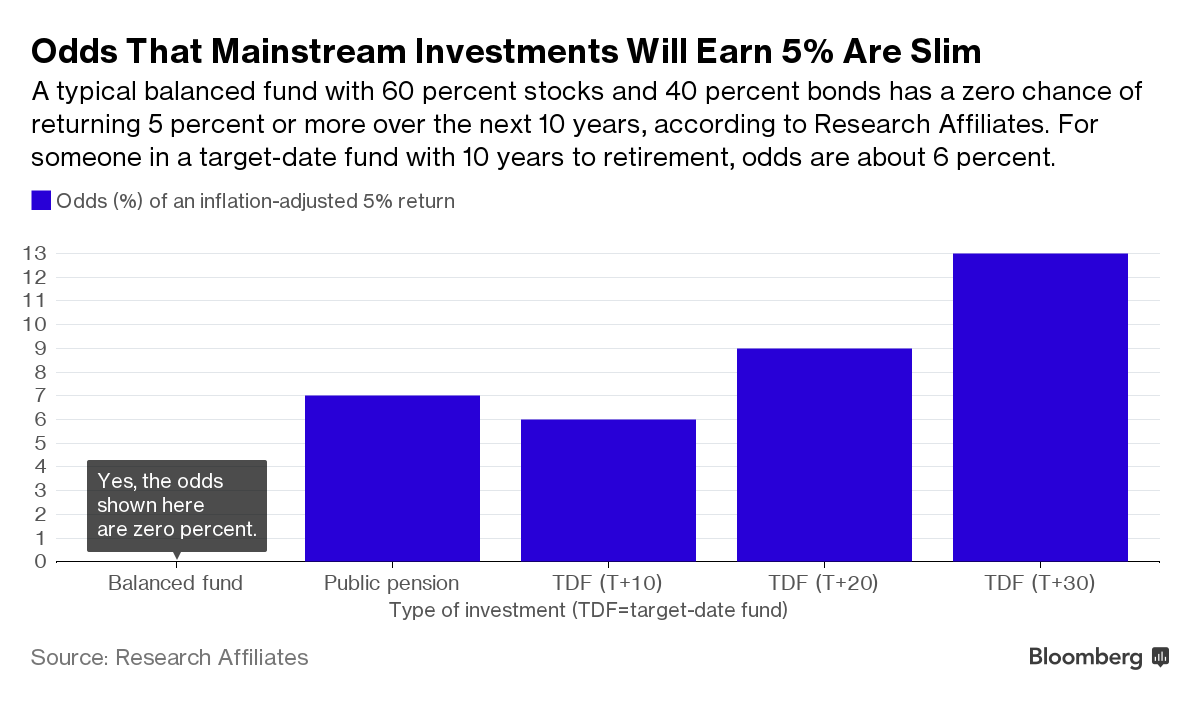
It doesn’t seem like much to ask for—a 5 percent return. But the odds of making even that on traditional investments in the next 10 years are slim, according to a new report from investment advisory firm Research Affiliates.

The company looked at the default settings of 11 retirement calculators, robo-advisers, and surveys of institutional investors. Their average annualized long-term expected return? 6.2 percent. After 1.6 percent was shaved off to allow for a decade of inflation1, the number dropped to 4.6 percent, which was rounded up. Voilà.

So on average we all expect a 5 percent; the report tells us we should start getting used to disappointment. To show how a mainstream stock and bond portfolio would do under Research Affiliates’ 10-year model, the report looks at the typical balanced portfolio of 60 percent stocks and 40 percent bonds. An example would be the $29.6 billion Vanguard Balanced Index Fund (VBINX). For the decade ended Sept. 30, VBINX had an average annual performance of 6.6 percent, and that’s before inflation. Over the next decade, according to the report, “the ubiquitous 60/40 U.S. portfolio has a 0% probability of achieving a 5% or greater annualized real return.”

One message that John West, head of client strategies at Research Affiliates and a co-author of the report, hopes people will take away is that the high returns of the past came with a price: lower returns in the future.

“If the retirement calculators say we’ll make 6 percent or 7 percent, and people saved based on that but only make 3 percent, they’re going to have a massive shortfall,” he said. “They’ll have to work longer or retire with a substantially different standard of living than they thought they would have.”

Research Affiliates’ forecasts for the stock market rely on the cyclically adjusted price-earnings ratio, known as the CAPE or Shiller P/E. It looks at P/Es over 10 years, rather than one, to account for volatility and short-term considerations, among other things.

The firm’s website lets people enter their portfolio’s asset allocation into an interactive calculator and see what their own odds are, as well as how their portfolio might fare if invested in less-mainstream assets (which the company tends to specialize in). The point isn’t to steer people to higher risk, according to West. To get higher returns, you have to take on what the firm calls “maverick” risk, and that means holding a portfolio that can look very different from those of peers. “It’s hard to stick with being wrong and alone in the short term,” West said.

At least as hard though is seeing the level of return the calculator spits out for traditional asset classes. Splitting a portfolio evenly among U.S. large-cap equities, U.S. small-cap equities, emerging-market equities, short-term U.S. Treasuries, and a global core bond portfolio produced an expected return of 2.3 percent. Taking 20 percent out of short-term U.S. Treasuries and putting 10 percent of that into emerging-market currencies, and 10 percent into U.S. Treasury Inflation Protected Securities, lifted the return to 2.7 percent. Shifting the 20 percent U.S. large-cap chunk into 10 percent commodities and 10 percent high-yield pushed the expected return up to 2.9 percent. Not a pretty picture.

Moral of the story: Since most people’s risk tolerance isn’t likely to change dramatically, the amount you save may have to.

I’ve long warned my readers to prepare for a long bout of debt deflation, low and mediocre returns, and high volatility in the stock, bond and currency markets.

If you think buying index funds or using robo-advisors will solve your problems, you’re in for a rude awakening. No doubt, there is a crisis in active management, but there will always be a need to find outperforming fund managers, especially if a long bear market persists.

All this to say that I take all these articles with a shaker of salt. That “one-man phenom” in Nevada was very lucky that the beta winds were blowing his way during the last ten years.

Luck is totally under-appreciated when considering long-term or short-term performance. For example, I read an article in the Wall Street Journal, King of Pain: Fund manager is No. 1 with a 40.5% gain, discussing how Aegis Value’s Scott Barbee survived tough times, wins our contest easily with 12-month skyrocket.

When I drilled into his latest holdings, I noticed almost half the portfolio is in Basic Materials and Energy, and his top holdings include WPX Energy (WPX), Coeur Mining (CDE) and Cloud Peak Energy (CLD), all stocks that got whacked hard in January and came roaring back to triple or more since then.

This transformed Scott Barbee from a zero into a hero but does this mean he will be able to repeat his stellar 12-month returns? Of course not, to even think so is ridiculous (in fact, I recommend he books his profits fast and exits energy and basic materials altogether).

I’m telling you there is so much hype out there and caught in the crosswinds are retail and institutional investors who quite frankly don’t understand the macro environment and the structural changes taking place in the world which will necessarily mean lower and volatile returns are here to stay.

The lessons for Harvard endowment is don’t pay attention to Nicholas Vardy, Barry Ritholtz or any other so-called expert. They all don’t have a clue of what they’re talking about.

As far as replicating the Yale endowment, I think it makes sense to spend a lot more time understanding the macro environment and strategic and tactical allocation decisions, and this is definitely something David Swensen and his small team do exceptionally well (Swensen wrote the book on pioneering portfolio management and he is an exceptional economist who was very close to the late James Tobin, a Nobel laureate and long-time professor of economics at Yale).

But Harvard’s endowment  doesn’t need advice from anyone or to replicate anyone, it has exceptionally bright people working there and their new CEO will need to figure out how to manage this fund by capitalizing on the internal talent and only farming out assets when necessary.

The articles above, however, confirmed my suspicions that several past investment officers got away with huge bonuses that they didn’t really deserve based on the performance of the fund and certain sub asset classes, like natural resources.

On LinkedIn, I had an exchange with one individual who wrote this after reading my last comment on Harvard’s endowment criticizing the benchmarks they were using for their real assets:

This issue is even more critical especially for pensions and endowments which invest more directly into real assets which are typically held for the long-term (not divested yet) as their bonuses tend to be annually paid out based on these real assets’ valuations (which are marked-to-model), hence, can be subject to massage or manipulation if their fiduciary awareness and governance are not deep, etc…

To which I replied:

[…] keep this in mind, pensions have a much longer investment horizon than endowments and they have structural advantages over them and other investment funds to invest in private equity, real estate and increasingly in infrastructure. If they have the skill set to invest directly, all the better as it saves on costs of farming out these assets. Now, in terms of benchmarks governing these private market assets, there is no perfect solution but clearly some form of opportunity cost and spread (to adjust for illiquidity and leverage) is required to evaluate them over a long period but even that is not perfect. Pensions and endowments recognize the need to find better benchmarks for private markets and clearly some are doing a much better job than others on benchmarking these assets. The performance of these investments should be judged over a longer period and in my opinion, clawbacks should be implemented if some investment officer took huge risks to beat their benchmark and got away with millions in bonuses right before these investments plummeted.

Let me give you an example. Let’s say Joe Smith worked at a big Canadian pension fund and took huge opportunistic risks to handily beat his bogus real estate benchmark and this was working, netting him and his team big bonuses right before the 2008 crisis hit.

And then when the crisis hit, the real estate portfolio got whacked hard, down close to 20%. Does this make Joe Smith a great real estate investor? Of course not, he was lucky, took big risks with other people’s money and got away with millions in bonuses and had the foresight to leave that pension before the crisis hit.

Legally, Joe Smith did nothing wrong, he beat his benchmark over a four-year rolling return period, but he was incentivized to game his benchmark and it was up to the board to understand the risks he was taking to handily beat his benchmark.

Here I discuss real estate but the same goes for all investment portfolios across public and private markets. People should be compensated for taking intelligent risks, not for gaming their benchmark, period.

Decision-Maker Moves: New CIOs for South Carolina Pension, UT Endowment

October brought a handful of major changes in the investment departments of pension systems, foundations and endowments. Here’s a roundup:

Connecticut Treasury Names Deputy CIO for $30B Pension System

Laurie Martin joined the Connecticut Treasury Department this month to serve as the Deputy Chief Investment Officer for the $30 billion Connecticut Retirement Plans and Trust Funds (CRPTF).

Martin will serve directly under CIO Deborah Spalding, who was hired last year after the retirement of long-time CIO Lee Ann Palladino.

Martin’s background, per a Treasury release:

Martin joins the Connecticut Treasury after serving twelve years as Director of Treasury Services at Baystate Health, Inc. There, she managed the company’s integrated investment program which included endowment, pension (defined benefit and defined contribution), insurance assets and operating funds. Prior to Baystate Health, Martin held investment accounting positions at ITT Hartford and Mass Mutual Life Insurance Co. She began her career at KPMG Peat Marwick as an audit and tax specialist.
University of Texas Endowment Names Interim CIO

Mark Warner has been tapped as interim CIO of the University of Texas Investment Management Company (UTIMCO).

Previous CIO Bruce Zimmerman resigned in mid-October, and the search for his replacement is underway. In the meantime, Warner will be at the help of the $37 billion endowment.

Warner has been with UTIMCO for 8 years, and served as head of natural resources investments. He’s also been responsible for the endowment’s emerging markets and private equity portfolios.

New CIO for $28B South Carolina Retirement System

Geoffrey Berg has been tapped as the new CIO for the South Carolina Retirement System Investment Commission, the entity which manages investments for the state’s $28 billion retirement system.

Berg had already been serving as acting CIO for 12 months, following the departure of previous investment chief Hershel Harper.

The System hired executive recruiter Korn Ferry to search for the new CIO; but the firm found the best candidate was already working in the position.

Colorado Public Employees CIO To Retire

Jennifer C. Paquette announced, CIO for Colorado’s $44 billion Public Employees’ Retirement Association (PERA), will retire in the first quarter of 2017.

PERA is looking to hire a search firm to begin the process of finding Paquette’s successor, according to a release.


Canada’s Liberals Attack on Public Pensions?

Leo Kolivakis is a blogger, trader and independent senior pension and investment analyst. This post was originally published at Pension Pulse.

The Public Service Alliance of Canada (PSAC) put out a press release, Liberal bill an attack on pensions:

The Liberal government is following the Conservatives’ lead by introducing legislation that will allow employers to reduce pension benefits.

Bill C-27, An Act to amend the Pension Benefits Standards Act, had its first reading in the House of Commons last week.

A target benefit pension plan is a big gamble

This bill will allow employers to shift from good, defined benefit plans that provide secure and predictable pension benefits, into the much less secure form of target benefits.

Unlike a defined benefit plan, where the employer and employees contribute and retirees know how much they can expect when they retire, the amount you receive under a target benefit pension plan is just that, a target. Meaning, the plan aims to give you a certain pension benefit, but there’s no guarantee.

The other big difference is that target pension benefit plans shift the financial risk from the employer to employees and pensioners.

PSAC will oppose this bill

Bill C-27 opens the door to eliminating or reducing defined benefit pension plans. PSAC has opposed target benefit pension plans since the previous Conservative government introduced consultations.

We will continue to resist any move in this direction, and continue to push for retirement security for all Canadians.

A PSAC union member brought this to my attention, providing me with some context:

Bill C-27 was introduced in the Parliament of Canada on October 19th, 2016 and will allow for the conversion of defined benefit pension plans to less secure “target benefit” pension plans. Quite remarkably this legislation has thus far been flying under the mainstream media radar.

In the opinion of the PSAC, Bill C-27 will eventually lead to the demise of “defined benefit” pension plans in the federal jurisdiction and is a component of the Morneau agenda to dismantle the Public Service Superannuation Act.

To say the least, I was shocked when I read this and replied: “Wow, interesting, I thought only the Harper government would try to pull off such sneaky, underhanded things. Hello Trudeau Liberals!” (at least Harper wore his colors on his sleeve when it came to pensions and his government did introduce cuts to MP pensions).

It never ceases to amaze me how politicians can act like slimy weasels regardless of their political affiliation. If Bill C-27 passes to amend the Pension Benefits Standards Act, it will significantly undermine public pensions of PSAC’s members and they are absolutely right to vigorously oppose it.

Who cares if the pensions of civil servants are reduced or shifted to target benefit plans? I care and let me state this, this bill is a farce, a complete and utter disgrace and totally incompatible with the recent policy shift to enhance the Canada Pension Plan (CPP) for all Canadians.

Think about it, on the one hand the Trudeau Liberals worked hard to pass legislation to bolster the Canada Pension Plan and on the other, they are introducing an amendment to the Pension Benefits Standards Act which will open the door to eliminating or reducing defined-benefit plans at the public sector.

The irony is that PSAC’s members helped the Trudeau Liberals sweep into power and this is how they are being treated? With friends like that, who needs enemies?

More importantly, there is no need to amend the Pension Benefits Standards Act to introduce target pension benefit plans because these pensions are safe and secure and managed properly at arms-length from the federal government at PSP Investments.

[Note: I can just imagine what the folks at PSP think of Bill C-27, something like “what the hell is the federal government trying to do here?!?”].

And let me repeat something, just like variable benefit plans which I covered in my last comment, target date benefit plans offer some interesting ways to help people invest properly for retirement, but they too suffer from the same deficiencies of defined-contribution plans because they invest solely in public markets and offer no guarantees whatsoever.

In fact, John Authers of the Financial Times wrote an article on this in the summer, Target-dated funds are welcome but no panacea for pension holes:

Much is riding on target-dated funds. As this week’s FT series on pensions should make clear, defined benefit pensions face serious deficits — but the same mathematics of disappointing returns and ever greater expense for buying an income also applies to defined contribution plans.

DC plans have been poorly designed. For years, 401(k) sponsors were lulled by the equity bull market into allowing members to choose their own asset allocations, and switch between funds and asset classes at will. This was a recipe for disaster, as members tended to sell at the bottom and buy at the top. The strong returns of the 1990s convinced many that they could get away with saving far less than they needed.

The industry and regulators have been alive to the problem, and their response is sensible. Now they offer a default option of a fund that aims to ensure a decent payout by a “target date” — the intended retirement date. These funds automatically adjust their asset allocation between stocks and bonds as the retirement date approaches, which in general means starting with mostly stocks and shifting to bonds as retirement approaches. This (good) idea mimics the best features of a DB plan.

Such funds are undeniably an improvement on the “supermarket” model of the 1990s. Savers avoid the pitfalls of taking too much or too little risk, and regular rebalancing helps them sell at the top and buy at the bottom.

But TDFs have problems, which are growing increasingly apparent. First, are their costs under control? Second, do they have their asset allocation right? And third, can we benchmark their performance?

On costs, the news is good. US regulations require 401(k) sponsors to look at costs, and the response has been to drive down fees. According to Morningstar’s Jeff Holt, TDFs’ average asset-weighted expense ratio stood at 1.03 per cent in 2009, and by last year had dropped to 0.73 per cent — a 30 basis point fall, which in a low return environment could make a very big difference when compounded.

But if TDFs are coming under pressure to limit costs, the pressure over asset allocation is taking them in every direction. They are designed as mutual funds, so they still do not hold the kind of illiquid assets that the best DB funds can fund, such as infrastructure. That is a problem.

So is the entire balance between stocks and bonds. The notion from the DB world was to reach 100 per cent bonds by the retirement date, when the fund could be used to buy an annuity. With low bond yields making annuities expensive, and life expectancy far longer than it used to be, this no longer makes much sense. A 65-year-old, with a decent chance of making it to 90, should not be 100 per cent invested in bonds.

But high equity allocations tend to emphasise that the TDFs expose savers to greater risk than a DB plan. According to Morningstar the average drawdown for 2010 TDFs during the crisis year of 2008 was 36 per cent — a potentially disastrous loss of capital for people about to retire. As stocks rapidly recovered, and as those retiring in 2010 would have been unwise to sell all their stocks, this should not be a problem — but it plainly hit confidence.

The early stages are also a problem. Our 20s and 30s are a time of great expense. Should young investors really be defaulted into heavy equity holdings when the risks that they lose their job are still high, and when they face possible big drains on their income, such as a baby, or downpayments on a first house?

So the “glide path” of shifting from equity to bonds is controversial. And there is no standard practice on it. According to Mr Holt, TDFs’ holdings of bonds at the target date for retirement vary from 10 to 70 per cent.

What about benchmarking? Such differences make it impossible. Asset allocation differences swamp other factors, and are driven by different assumptions about risk.

Establish bands for asset allocation at each age, but allow them to vary according to valuation. Funds designed for retirement should never take the risk of being out of the market altogether. But if, as now, bonds and US equities look overpriced while emerging market equities look cheap, an approach that took US equities’ weighting to the bottom of its band, while putting the maximum permissible into emerging markets, would probably work out well.

There is not, as yet, an incentive to do that, and there needs to be. TDFs, or something like them, should be at the heart of future pension provision. It is good that their costs are under control, but there are ways to make them far more effective: by allowing more asset classes, accepting that people at retirement should still have substantial holdings in equities, and encouraging TDFs to allocate more to asset classes that are cheap.

I agree with Authers, there are ways to make target-dated funds more effective and folks like Ron Surz, President of Target Date Solutions are at the forefront of such initiatives.

But no matter how effective they get, target-dated pensions or variable benefit plans will never match the effectiveness of an Ontario Teachers, HOOPP, Caisse, CPPIB, PSP Investments and other large, well-governed Canadian defined-benefit pensions which reduce costs, address longevity risk (so members never outlive their savings) and invest across public and private markets all over the world, mostly directly and through top funds.

All this to say that PSAC is right to vigorously oppose Bill C-27, it’s a total assault on their defined-benefit pensions, and if passed, this amendment will undermine their pensions, the ability of the civil service to attract qualified people to work for the federal and other governments, and the Canadian economy.

In short, it’s dumb pension policy and if Trudeau thinks he had a tough time in the boxing ring, let him try to pull this off, it will basically spell the end of his political career (this and the asinine housing market policies won’t help the Liberals’ good fortunes).

Stay tuned, more to come on this topic from other pension experts. I will update this comment as experts send in their views and if anyone has anything to add, feel free to reach me at LKolivakis@gmail.com.

Update: Jim Leech, the former president and CEO of the Ontario Teachers’ Pension Plan and co-author of The Third Rail, shared this with me (added emphasis is mine):

I think everyone is missing the point of this bill.

Until now, federal pension legislation has only recognized plans as either DC or DB – there was no provision for a hybrid/risk shared plan.

That is one reason contributing to the switch all the way from DB to DC at many companies – if the DB plan was not sustainable, the only alternative was to move all the way to DC – a middle ground was not available even if the parties wanted a middle ground.

As I understand it, this bill simply allows transition to a risk shared model as an alternative to closing the DB and going all the way to DC.

Greater legislative flexibility is a positive step.

While I agree with Jim, some form of a shared risk model like the one New Brunswick implemented makes perfect sense for all public pension plans, especially if they are grossly underfunded, I’m not convinced the federal government needs to introduce hybrid plans at this stage and share PSAC’s concern that this amendment opens the door to cutting DB pensions altogether.

Also, Bernard Dussault, Canada’s former Chief Actuary, shared these insights with me (added emphasis is mine):

There are two big fairness-related points with this legislation, namely:

  • not only does it allow the reduction of future accruing pension benefits of both active and retired (deferred and pensioned) members, a vital right so far covered under federal and provincial (except NB since 2014) pension legislation;
  • but it also allows the concerned sponsoring employers to shift to active and retired members the liability pertaining to any current (as at effective date of the tabled C-27 legislation) deficit under any concerned existing DB plan.

As shown in the two attachments hereto, I have been promoting over the past few years that the shortcomings of DB plans can be easily overcome in a manner that would make DB plans much more simple, effective and fair than TB plans. Points not to be missed.

One of the attachments Bernard shared with me, Improving Defined Benefit (DB) plans within the Canadian Pension Landscape, is available here. I thank Bernard and Jim for sharing these insights.

Emerging Jobs: Emerging Hedge Funds Offer Best Job-Seeking Prospects, Says Recruiter; Silicon Valley Bank Seeks Director For Emerging Manager Practice

A roundup of the latest job postings and trends from emerging managers

Emerging hedge funds best prospect for job-seekers?

Should hedge fund job-seekers be looking at emerging funds? Absolutely, says one recruiter, who thinks they offer the best prospects to those looking for jobs in the hedge fund industry.

Richard Risch, CEO of the Risch Group, tells Business Insider:

The big guys are seeing redemptions at a record rate, so hiring in that sector is non-existent or extremely limited. Today I would (and do) tell candidates looking in the hedge fund space to focus on the emerging manager segment. It is also the only segment of the industry we are seeing search work from today.

“Base pay is always lower at emerging managers, but could very well include equity. In one case a few years ago, an emerging manager took off, was sold and a couple of people received an eight-figure payout. As far as strategy, it seems the only ones consistently receiving net new institutional flows are systematic equity market neutral funds.”

Silicon Valley Bank seeks director for emerging manager practice

Silicon Valley Bank is looking to hire a managing director for its emerging manager practice in New York City.

Job description:

The role is part of SVB’s Venture Capital Relationship Management team, and involves being a value-added partner and trusted advisor to founders and General Partners of new and emerging venture firms in NYC. The role also involves bringing the entire value of the SVB platform to help these partners be successful and grow their firms.

Apply here (via LinkedIn) or here.

Bank of America looking for senior analyst to identify emerging hedge funds

Bank of America is looking for a Senior Analyst, Hedge Fund Manager Research. The candidate will monitor and evaluate hedge fund investments, including emerging hedge funds, for the bank’s wealth management division.

Apply here.

New Hedge Fund Gets Backing From Protege

Startup hedge fund Mill Hill Capital was seeded this month by Protege Partners, according to the firm.

Mill Hill was founded in 2015 by investment management vet David Meneret, who previously worked at Macquarie in various roles since 2008, including head of securitized debt and financials trading.

The size of Protege’s investment is unknown. In the recent past, the firm has seeded managers with dollar amounts between $50 million and $125 million.

More info on Mill Hill, from Reuters:

As a trained engineer with degrees from Columbia and the Ecole Centrale Paris, Meneret has spent the last year readying the new fund’s launch with the help of former colleagues from global investment banking group Macquarie. Mill Hill now employs six people and will be largely numbers oriented, relying heavily on data and building models to make all types of trading decisions, Meneret told Reuters.

Meneret’s team includes former Macquarie colleagues Gaurav Singhal, Hongwei Cheng and Robert Perdock. They have experience running a so-called market-neutral relative value credit hedge fund that seeks to exploit differences in the price or rate of similar securities, after having worked at the Macquarie Credit Nexus Fund. David Modiano joined Mill Hill as head of business development and investor relations early this year.

FinAlternatives has some insight on Mill Hill’s strategy:

The new manager’s strategy will be focused on market-neutral relative value trading in U.S. credit, seeking opportunities across CLOs, corporate financials, corporate transportation, aircraft ABS, esoteric ABS, non-agency mortgage-backed securities, and credit indices, according to the company.

Mill Hill will reportedly utilize a combination of asset-level fundamental analysis and market-implied data-driven proprietary cash flow models to identifying long/short opportunities across asset classes, as well as a systematic approach to risk and portfolio management.

Mill Hill plans to start trading in November.


Deprecated: Function get_magic_quotes_gpc() is deprecated in /home/mhuddelson/public_html/pension360.org/wp-includes/formatting.php on line 3712