Can Emerging Managers Emerge? Notes From the Emerging Managers’ CAP Intro Event

Leo Kolivakis is a blogger, trader and independent senior pension and investment analyst.

On Wednesday, I attended the first ever cap intro emerging managers conference here in Montreal. Before covering it, let me begin with a comment which Simon Schilder recently wrote for Hedgeweek, Emerging hedge fund managers – challenges and solutions:

Who would want to be a start-up hedge fund manager? Simon Schilder, partner at Ogier in Jersey, and TEAM BVI UK member with BVI Finance, examines the challenges facing the next generation…

******

The challenges facing the next generation of hedge fund managers are starker than ever before, with increased barriers to entry caused by an ever increasing regulatory burden coupled with the continued existence of a macro-economic environment impacting upon investment performance.

For emerging managers seeking to attract investor allocations, the need to be able to demonstrate a proven track record to prospective investors has never been more important. Generally institutional investors will look to a three-year track record as a pre-requisite for investing, whilst funds-of-funds, family offices and high net worth investors will frequently be comfortable with a shorter track record than this (perhaps 12 to 18 months?). The challenge facing an emerging manager therefore is how does it achieve this track record as cost effectively as possible without drowning under the operational constraints of running an investment management business. In addition to surviving long enough to develop a track record, the “holy grail” of target assets under management (AUM) has long been spoken as being an AUM of USD100 millon, as that number then very quickly becomes USD200 million or USD300 million as the fund suddenly comes onto the radar of institutional managers whose own investment restrictions prevent them allocating their investment capital to smaller funds.

With the deck very much stacked in favour of established hedge fund managers, where does this leave emerging managers without the benefit of significant seed capital to rely upon it getting through the early years? For most emerging managers, their survival during these early years depends upon their ability to manage their cost bases efficiently and effectively. As part of doing this comes the choice of the most appropriate jurisdiction for domiciling their fund vehicle.

Given its historic cost advantages, the British Virgin Islands (BVI) has long been the natural choice of jurisdiction for emerging managers looking for a jurisdiction to domicile their hedge funds. For such managers, the traditional route was to establish as either a “Professional Fund” (being a fund for “professional investors with a minimum investment of USD100,000) or a “Private Fund” (being a fund for a maximum of 50 investors, making offers to invest on a private basis). These two categories of funds remain consistently the most popular fund vehicles for managers establishing their funds in BVI. To complement these established fund products, during 2015, the BVI introduced two new categories of funds aimed specifically at the small/ mid-sized/ emerging managers, in the form of the “Incubator Fund” and the “Approved Fund”. These two new fund products offer such managers solutions which might not otherwise be available to them.

Whilst an Incubator Fund and an Approved Fund are broadly similar fund products, there are subtle differences, which appeal for different types of investment managers.

The Incubator Fund product is aimed at the start-up investment managers, with one key feature of the regime being that upon the second anniversary of being an Incubator Fund or, if sooner, once the fund has grown beyond a stated minimum size (more than 20 investors or assets under management of more than USD20 million for two consecutive months), the Incubator Fund is required to convert to either a Private Fund, a Professional Fund or an Approved Fund. This therefore gives start-up/ emerging managers an opportunity to get a foot in the door, by offering them a cost effective regulated fund solution to bring their funds to market whilst managing their operational cost base. A point of note is that an Incubator Fund has no mandatory service providers, such that in establishing an Incubator Fund, the promoters are free to appoint as many or few service providers as it wishes, further enabling it to manage fund expenses during the early years.

An Incubator Fund is available to “sophisticated private investors” only (for these purposes, to be a “sophisticated private investor” a person must be invited to invest and the amount of his or her minimum initial investment must not be less than USD20,000). As mentioned above, Incubator Fund status is limited to two years (with a possible further 12 month extension available at the discretion of the BVI’s regulatory, the Financial Services Commission), following which the Incubator Fund must either (i) convert into a Private Fund; Professional Fund; or an Approved Fund or (ii) cease operating as a fund.

An Approved Fund by contrast is very much aimed at family offices and friends and family offerings. As with Incubator Funds, an Approved Fund is available to a maximum of 20 investors, but distinct from an Incubator Fund, its maximum aggregate assets under management may not exceed USD100 million (or its equivalent in another currency). Additionally and unlike an Incubator Fund, there is no time limit on the duration in which a fund can take advantage of its eligibility for Approved Fund status, such that an Approved Fund’s status is indefinite. To the extent that an Approved Fund exceeds 20 investors or assets under management of more than USD100 million for two consecutive months, it is required to notify the FSC of that fact in writing and submit an application to convert and so become recognised as either a Private Fund or a Professional Fund. Other than a requirement to have a fund administrator, there are no other mandatory service providers.

In both cases, the conversion process for an Incubator Fund or an Approved Fund is reasonably straight forward and can be implemented reasonably expediently and, critically, at the time of converting (and so availing the fund to a more onerous regulatory regime), the longer term financial viability of their investment management business will be much more certain.

I’m not qualified to discuss the pros and cons of an Incubator Fund or an Approved Fund, but I agree with Mr. Schilder, for all sorts of reasons (especially regulatory), the deck is increasingly stacked against all emerging managers (to be brutally honest, this is the worst environment to start any fund, you need some major financial reserves and lots of patience to succeed).

On Wednesday, I attended the first ever cap intro event for emerging managers held here in Montreal. The group behind this initiative is the Emerging Managers’ Board (EMB), a non-profit organization whose mission is to promote and contribute to the growth of Canadian emerging managers. It also strives to educate asset allocators and investors about the benefits of investing with local talent.

You can find a list of all the members that participated in the conference here. Admittedly, a lot of people did not show up but there was a strong presence and overall, it was a very good event.

The conference took place at Club St-James on Union street, which is a nice venue for this type of event. I got there at 9:45 in the morning just in time to listen to parts of the first panel discussion on how emerging managers can emerge featuring three speakers:

This was a good discussion filled with advice for emerging managers. They covered topics like existing emerging manager platforms, how to properly communicate and follow up with prospective investors, which consultants to target, why emerging managers should avoid pensions when trying to emerge (except those that have emerging manager platforms) and why emerging managers need to stay humble, have realistic growth expectations and communicate their process and strategy very clearly, including what their real niche/ competitive edge is relative to others (and why experience is not an edge).

After that panel discussion, Geneviève Blouin of Altervest who is president of this organization, asked me to step in for someone rom FIS who wasn’t there for the one-on-one 15-minute manager “speed dating” session. I said “sure” as I love talking shop with managers and grilling them hard (I was nice).

The first manager I met was Jean-Philippe Bouchard, Vice-President at Giverny Capital, a long only value shop that was founded by François Rochon in 1998. Prior to founding Giverny, Mr. Rochon was managing a private family portfolio. You can see their impressive returns on their website here.

Giverny Capital is basically a value investor which focuses on North American equities. They are sector agnostic but Jean-Philippe told me they don’t invest in energy or commodity shares.

In order to produce outsized returns over a long period, they have a fairly concentrated portfolio of 20-25 names and Jean-Philippe told me that the top ten positions make up roughly 60% of their portfolio (basically use the Warren Buffett approach, take concentrated bets in a few stocks you know well).

They use Factset and Morningstar to screen stocks with a high ROE and EPS growth and low debt, and focus on well run companies that are market leaders with competitive advantages and low cyclicality.

To give you an idea on stocks they invest in, I looked at their latest (US) 13-F holdings which are available here. Here you will find names like Bank of the Ozarks (OZRK), Carmax (KMX), LKQ Corp. (LKQ), Walt Disney (DIS), and Visa (V). In Canada, the fund made great returns buying Dollarama (DOL.TO) early on.

Quite impressively, Giverny Capital now manages close to $800 million and may be in line to become the next Letko Brosseau or Jarislowsky Fraser in Montreal.

After that meeting, I met Philippe Hynes of Tonus Capital, another young, bright long only portfolio manager with a value/ contrarian investment philosophy.

Tonus Capital’s investment philosophy is right on the main page of its website:

The objective of Tonus Capital is to outperform the market return over the long term. It is our firm belief that one of the best strategies to accomplish this is to focus on a small number of companies that we understand well and to invest in them when they are trading significantly below intrinsic value. We are market-cap agnostic, which means that our investment decisions are not determined by a company’s market capitalization but only by its potential to generate a strong absolute return over time.

Tonus was founded in 2007, it has an 8 year track record and currently manages roughly $70 million in AUM invested in North American equities.

Their portfolio is concentrated, consisting of 15-20 positions, mostly in financials and consumer products sector and like Giverny, Tonus is sector agnostic but it does invest a bit in the energy sector if opportunities present themselves.They focus on companies with no debt and net cash that are typically out of favor and ready to turn around over the course of the next three years.

You can view their performance below (click on image):
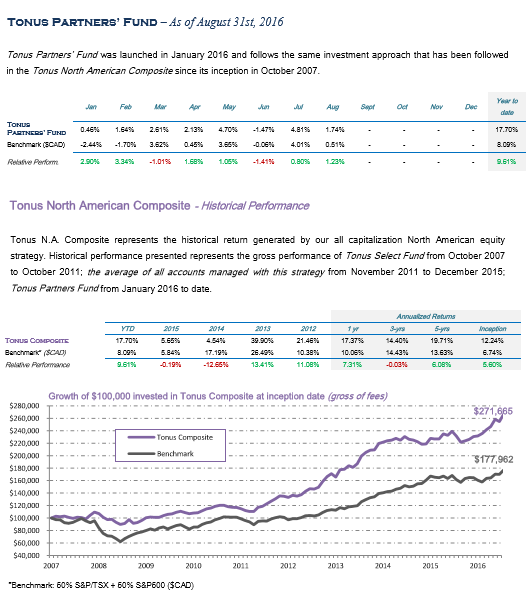
Philippe told me his objective is to return 50% to 100% over a three year investment horizon and if he has strong conviction, he will invest up to 10% in one company. Currently, he is 30% cash and researching which companies he wants to scale into.

[Note: Whenever you are talking to a long only or L/S equity fund, be careful to make sure the benchmarks they use to evaluate their performance matches the market cap and risk of the stocks they invest in.]

He told me he looks at IPOs of companies that are not tracked and looks at stocks making 52-week lows that fit his strict criteria to invest in and that can turn around nicely. Some examples of stocks he invested in include Sleep Country Canada (ZZZ.TO), a leading specialty mattress retailer in Canada, and Blue Bird (BLBD), the main manufacturer of school buses in North America.

I told him that I trade these markets, focus mostly on biotech but I screen over 2000 stocks in 100 industries and thematic portfolios I created for free on Yahoo Finance over the last ten years (thank you Neil Cunningham!), and I must admit, contrarian investing isn’t for the faint of heart.

I honestly prefer the approach of Martin Lalonde at Rivemont who looks at stocks making 52-week highs or breaking out to get ideas of which companies he wants to scale in and out of.

But the beauty of these investment cap intro conferences is you get to meet different individuals with different approaches and styles. Diversity is a good thing and just because a style doesn’t work for one manager, it doesn’t mean it can’t work for another who takes a longer term approach.

Let me give you another example, a couple of weeks ago, Fred Lecoq and I went to Old Montreal to visit a stock trader at Jitney who used to work with me at the National Bank. This trader is a very good trader, probably one of the best in Canada, and I know this because out of 100 + prop traders at the National Bank back in 1999, he is one of the only ones left doing this for a living, eating what he kills. He told me he has never had a losing month in over 20 years.

What’s his secret? He trades boring Canadian companies that aren’t always very liquid and he has mastered the art of reading trading action on the stocks he follows closely and will cut his losses quickly when he is wrong (he will hold positions overnight but not often).

I told him I love trading volatile biotech stocks that swing like crazy and are very liquid but I have to endure gut wrenching swings that make me puke at times (I prefer upside volatility). Not for him but he told me something good: “It doesn’t matter what you trade, trade what you’re comfortable with but cut your losses early” (I don’t but use big biotech dips to add to positions I have conviction on).

In other words, there is no one way to approach these markets. Some like trading boring stocks, others prefer trading highly volatile and risky stocks, some buy the breakouts, others look at buying 52-week lows. You need to be very comfortable trading what you are trading and be true to your nature.

Now, after those two manager meetings, the person I was replacing showed up and I was excused and asked to go upstairs to mingle. There, I hooked up with Karl Gauvin and Paul Turcotte of OpenMind Capital.

Unlike many other emerging managers, Karl and Paul come from an institutional background. They are extremely bright and nice and have developed a few adaptive smart beta and L/S equity strategies for US stocks which you can read about here.

Karl shared with me the actual returns of OpenMind Capital’s Adaptive Smart Beta US Equity strategy as of September 30th (click on image):
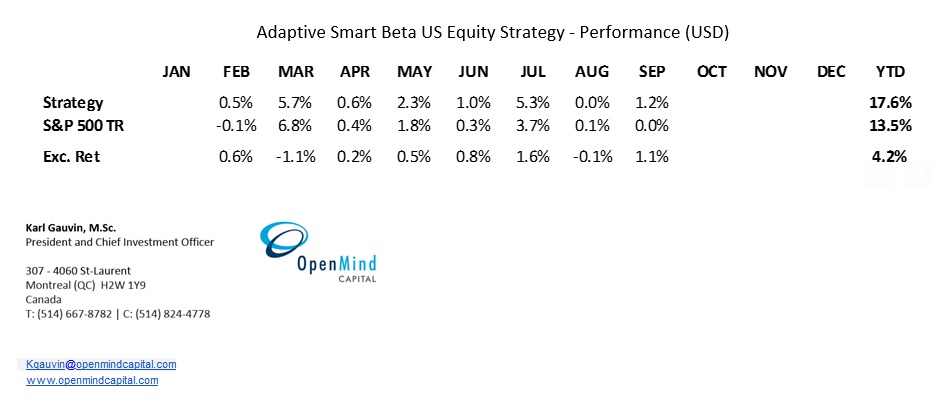
These aren’t pro forma returns, these are actual returns of a strategy delivering in excess of 400 basis points over the S&P 500. And this is a highly scalable strategy (they calculated $5 billion capacity).

Their active smart beta portfolio will be adapted based on the type of volatility regime. They use their smaller cap tilt model during regime of good volatility and our larger cap tilt model during regime of bad volatility. Overlap between these two model range between 60 and 70% on average.

Now, Karl and Paul aren’t the flashy sales types, far from it, they will admit they are the worst salesmen. They are also brutally honest and tell you under which vol regime they can outperform and when they will underperform.

If you want to meet smart people who can offer you a lot more than just money management, these are the type of partners you want by your side. You should definitely talk to Karl and Paul and you can contact them here (like others I cover, they are francophone but speak English).

Speaking of super smart and nice people you want to partner up with, after Karl and Paul, I hooked up with Jacques Lussier, President and CEO of Ipsol Capital. It was Sean Sirois who introduced us (Sean used to work at Deutsche but recently joined Ipsol).

Jacques is very well known in Quebec and the rest of Canada. An academic with impeccable credentials, he used to run a mammoth fund of hedge funds portfolio at Desjardins which suffered devastating losses during the financial crisis and was eventually shut down (at the time, this fund of funds was bigger than the one at Ontario Teachers and was running beautifully for many years, until the financial crisis hit it) .

As he told me, that was a very humbling experience, but even before this happened, he was questioning why they paid hedge funds 2 & 20 for strategies they can develop cheaply internally (and started doing internally).

It was the first time I met Jacques Lussier and he really impressed me because he is humble, wickedly brilliant and has an insatiable thirst to continue learning about markets and research new strategies.

We talked about his two books but he told me he enjoyed writing his second one, Successful Investing Is a Process: Structuring Efficient Portfolios for Outperformance. You can read a book review from Mark Kritzman here.

What I like about Jacques Lussier and Ipsol Capital is they have a research driven approach to everything and despite being stacked with PhDs, they are humble enough to admit on their presentation that Return = Alpha + Beta + Luck (see a copy of their presentation from October 2015 here).

Jacques and I talked at length about smart beta, risk parity, and behavioral factors (like animal spirits) impacting markets. He told me a lot of people are doing smart beta but many models are wrong or out of date. On risk parity, he said while people make a big fuss, claiming it causes a lot of volatility in markets, the truth is risk parity strategies are not very popular with big investors (concerned with leverage in these strategies).

He also told me that while financial practitioners are good at listing risk factors, very few are good at forecasting risk factors (with exception of volatility which he said Garch models forecast with a 30-40% accuracy rate).

He also told me that unlike other large funds, Ipsol is very technology and research driven and enjoys partnering up with clients they can learn and interact with. He does not believe in 2 & 20 and he and his team are developing a platform where investors will be able to gauge the performance of all their alpha strategies very quickly (will be ready by June 2017).

Look, I am going to be honest with you, Jacques Lussier is no emerging manager, he is well known which is why Ipsol Capital manages in excess of $300 million. But if you’re looking for scale, brains, and a more fruitful relationship, you should definitely contact them here (Jacques is fluently bilingual but I must warn you, just like Karl and Paul, he’s not the ‘salesy’ type and told me “sales bore him”).

At lunch, we all sat at the same table and listened to another panel discussion featuring three panelists:

  • François Rivard, President and CEO of Innocap 
  • Marie Helène Noiseux, professor of finance at UQAM
  • Ian Fuller, Managing Director at Westfuller Advisors  

This too was an excellent panel and there were some great insights from all panelists (if possible, they should record all these panel discussions). 

Everyone impressed me and they all talked about staying focused, realistic and developing good meaningful relationships with investors. They all said managers need to stick to what they know best: “If you’re good at long only, stick to that, don’t try shorting stocks to charge heftier fees.”

They mentioned that running a hedge fund requires business acumen, not just investment acumen, and if you don’t take care of business, you will fail.

At one point, Ian Fuller talked about how he’s seen smart but abrasive and arrogant managers who rubbed him the wrong way and so even if he liked their strategy and thought they were very good, he would pass from recommending them to the family offices he works with (couldn’t agree more, seen my fair share of arrogant hedge fund jerks, who needs them?).

Marie Helène Noiseux talked about the need to develop good long term relationships with your clients and I agreed with her on that front.

But it was François Rivard of Innocap who really struck a chord with all his comments. This guy knows what he’s talking about and it shows. He told emerging managers in the room that many of them need a “reality check” and to ask themselves tough questions on whether they truly are “institutional quality funds.”

He rightly noted “institutional clients are not for everyone” and quite often, especially when starting off, you are better off focusing on high net worth and family offices who are not as onerous in their demands. 

He is absolutely right. There are so many emerging managers out there wasting their time focusing on institutions which are never going to invest with them right off the bat. Unless you’re Chris Rokos or Scott Bessent and possibly have one up on Soros, forget institutional money, they will not invest in your new fund. They will choose established hedge funds and put them on Innocap’s managed account platform (or invest through the traditional fund route).

Having said this, François Rivard did mention that they were approached by a large US pension which wanted to invest $500 million in 10 niche emerging managers ($50M allocation for each) and these are mandates he and his team at Innocap are more than happy to assist clients with (I highly recommend you contact François here and talk to him about such mandates and other ways they can assist you in managing your hedge fund allocations).

During the Q & A, I asked the panelists about the importance of developing incubator funds and what they thought of operational risks and slippage costs at smaller funds and whether sliding performance fees make sense for some strategies where returns are lumpy.

Again, François Rivard answered all my questions nicely. He said incubator funds exist but your need a sponsor. As far as operational risks and slippage at smaller funds, he noted many big prime brokers are cutting smaller managers, not dealing with them (even if they have $100M or $200M under management) and this impacts their performance (Innocap has ways to address this issue).

As far as fees, he said there is a “repricing revolution” going on in the industry and many big investors are fed up with paying 2 & 20 and refuse to even with marquee names. “They are seeing managers get extremely rich but little benefits to their plan members.”

I couldn’t agree more which is why in my comment on Rhode Island meets Warren Buffett,  I expressly stated hedge funds and private equity funds, many of which are underperforming and have a misalignment of interests with their limited partners, are effectively buying allocations and collecting fees no matter how well or poorly they perform.

This comment was suppose to be brief and it’s way too long. Let me end by thanking Geneviève Blouin of Altervest, Charles Lemay of Addenda Capital, and many others who helped organize this conference.

I am also glad I ran into former colleagues of mine like Simon Lamy who was previously a VP, fixed income at the Caisse. Simon hooked up with Keith Porter, previously AVP, emerging markets at the Caisse and CIO and emerging markets portfolio manager at Altervest, and along with Vincent Dostie, they just launched an emerging markets funds (Mount Murray Investment) which I truly hope will be a huge success. All great guys with solid experience.

I did my part in bringing exposure to emerging managers and hopefully the following conferences will be just as interesting with great insights from respected panelists.

Some advice for follow-up conferences. First, please put panels between tables during those speed dating sessions because if the tables are too close, it gets chatty and hard to hear each other in the room.

Second, if possible, please tape panel discussions with guest experts and put them on a dedicated YouTube channel. It would also be nice if managers discuss their fund and strategy in a five minute clip on this YouTube channel (to my surprise, very few emerging and existing managers harness the power of social media).

But Geneviève told me she hates running after managers and I don’t blame her one bit. In fact, I reached out to a few I met last night asking them to provide me with 3 key insights they learned from the conference and only Philippe Hynes of Tonus Capital came back to me:

  1. Importance of keeping true to our style
  2. Importance to understand the supply and demand dynamics of the industry and see if the product the manager is supplying is competitive and in demand
  3. It is very hard for small managers to penetrate the pension plan circle, especially in Quebec as they are very conservative, but the product needs to be differentiated

Anyways, I hope you all enjoyed reading this comment. You can find a list of all the members that participated in the conference here.


NYC Pension Asks Facebook, Other Giants for Diversity Data

New York City Comptroller Scott Stringer, on behalf of the city’s pension fund, is asking Goldman Sachs, Facebook, and a handful of other giant corporations to disclose data on the diversity of their vendors and suppliers.

New York City’s pension system is a significant shareholder of all the companies.

More from Bloomberg:

The letter campaign, which also targets Starbucks Corp., Google parent Alphabet Inc. and Alcoa Inc., extends a 2014 initiative that asked for similar details from 20 more of the $163 billion city pension funds’ largest investments. Eight of those companies, including Apple Inc and Qualcomm Inc., have since agreed to release the value and percentage of total spending they do with minority vendors, the comptroller’s office said Thursday in a statement.

New York’s letter, which was the same for all recipients, asks companies to disclose the number of their diverse suppliers and their goals for increasing such contracts. Stringer also asks for senior management and board oversight of the process, and suggests compensation-related incentives for employees and managers.

[…]

“A more diverse supply base helps our portfolio companies to create sustainable competitive advantage and long-term shareowner value,” he wrote. The comptroller’s office increased funds managed by minority and women business enterprises to $14.4 billion this year from $5.5 billion in 2010.

Institutional investors also seek boardroom and employee diversity. This year, nine companies in the S&P 500 — the most ever — faced demands from shareholders that they adopt new diversity plans, according to ISS Corporate Solutions, a corporate-governance consultancy. Only 12.8 percent of companies currently giving specific details about directors named in their annual filings, according to a report released last month by researcher Equilar Inc.

CPPIB Chief to Testify at Parliament?

Leo Kolivakis is a blogger, trader and independent senior pension and investment analyst. This post was originally published at Pension Pulse.

Josh Wingrove, Greg Quinn and Scott Deveau of Bloomberg report, Canada Pension chief to testify amid trillion-dollar boost:

The head of the Canada Pension Plan Investment Board will face lawmakers for the first time in 14 years as Prime Minister Justin Trudeau’s government finalizes a trillion-dollar cash expansion of one of the world’s largest public pension funds.

Mark Machin, who took over as president and CEO of the arm’s-length investment board in June, will speak to the House of Commons finance committee Nov. 1 at its request. His testimony comes as Trudeau prepares to amend the law governing both the Canada Pension Plan and CPPIB, which manages the $287-billion fund, to formalize a deal to expand benefits.

The new plan, rolled out from 2019 to 2025, will leave the fund on pace to reach $2 trillion by 2045 — doubling the value of the original program. Enacting legislation will be made public “shortly,” Finance Minister Bill Morneau said Tuesday after British Columbia signed on to the deal, clearing the way for the government to move forward.

Morneau has said he and his provincial counterparts are still finalizing pension expansion changes and will meet in December. A departmental official said CPP “policy actions” could still be forthcoming as part of a triennial review, while Morneau spokeswoman Annie Donolo ruled out “major changes.” All modifications must be approved by seven provinces representing two-thirds of Canada’s population.

“We need to make sure we get all the details right,” Morneau said Sept. 6. “We see the CPPIB vehicle as a respected and effective vehicle for managing Canada’s pension assets.”

Lower for longer

The Canada Pension Plan is the mandatory workplace retirement savings program for 19 million Canadians. Its expansion will substantially increase the investment board’s portfolio at a time when pension funds are coping with an era of low global interest rates that threaten returns.

Board officials, excluding Machin, met informally with lawmakers earlier this year, according to finance committee chairman Wayne Easter. “We enthusiastically look forward to engaging with members of the House finance committee based on good dialogue held so far,” CPPIB spokesman Michel Leduc said.

Trudeau’s expansion will, in effect, create a two-stream plan managed by the investment board. Government officials refer colloquially to “CPP 1” and “CPP 2,” each distinct from an accounting perspective. The independent new program is considered to be fully funded and therefore will rely more heavily on future returns. Benefits for each generation will “depend on their own contributions and the associated investment returns,” finance department spokesman Jack Aubry said. That leaves fund directors under pressure to deliver.

‘Strong’ performance

The investment board’s track record is solid. It had a net return of 16 per cent on its investments for the calendar year in 2015, and a 7.5 per cent net return on an annualized basis for the past decade, according to a spokesman.

That compares to a 9.1 per cent net return in 2015 at Canada’s second-largest pension fund, Caisse de Depot et Placement du Quebec, according to its website. The Caisse returned about 5.96 per cent on an annualized basis over the past decade. Ontario Teachers’ Pension Plan had a 13 per cent net return in 2015 and an annualized return of 8.2 per cent over the past decade, according to its website.

CPPIB invests in private and public equities, fixed income products and real assets around the globe. Trudeau’s government isn’t considering “using other vehicles” to manage the new cash influx, Donolo said.

The Office of the Chief Actuary, in a report last month, found the fund’s investment income was nearly 250 per cent higher over the past three years than originally expected due to its “strong investment performance.” The investment board has been concentrated on diversifying across asset classes and geographies in an effort to reduce risk, in effect turning its eye away from Canada.

Political autonomy

The investment board is a world-renowned model, according to Michel St-Germain, a vice-chairman at the Association of Canadian Pension Management. “We have managed to create a governance structure that’s very autonomous, independent of political pressure. I’m quite confident that we will be able to maintain this,” he said. “Having said that there is a challenge. There will be a lot of money there.”

Machin, an Englishman who spent years in Asia for Goldman Sachs Group Inc., may shed light on how CPPIB will handle the cash influx. His appointment was announced in May along with the departure of former president and CEO Mark Wiseman to BlackRock Inc. At the urging of lawmakers, Machin’s hearing date was moved up to Nov. 1 from an initial date later in the month. It will be the first finance committee appearance by the head of the investment board since 2002.

“With the very rapid succession, I think it was important that parliamentarians and Canadians hear from the new CEO of the CPPIB,” Liberal lawmaker and committee member Steven MacKinnon said in an interview. “Ideally it would have been better to have had him earlier, but it’s now very timely with the announced expansion.”

I was busy with an emerging manager conference today but I wanted to quickly cover this story.

First, I think it is a great idea to invite Mark Machin, CPPIB’s new CEO,  to speak to parliamentarians and Canadians on what CPPIB does and why it is well equipped to handle the explosive growth that will come after the provincial and federal governments ratify the law to enhance the Canada  Pension Plan (CPP).

On Monday, I wrote a comment, “Long live the CPP!!” where I stated Canadians are very fortunate to have the Canada Pension Plan, its stewards, and the astounding and highly qualified professionals at the Office of the Chief Actuary, as well as the senior managers and board of directors running and overseeing the Canada Pension Plan Investment Board (CPPIB).

I also stated absent some new public defined-benefit plan which will manage and better protect existing corporate defined-benefit plans that are dwindling, the CPP is really all Canadians can rely on with certitude to retire in dignity and security.

Sadly, as I write this comment, another story appeared in the CBC today on a pension decision looming for thousands of former Nortel workers. Basically, a lot of nervous former Nortel employees are meeting across the country at gatherings meant to help them figure out what to do when the company’s pension plan finally winds down. Decisions have to be made by the end of the year.

The article quotes a 95 year old man, former Nortel executive Dave Stevenson, stating the following: “I thought the pension was good for life, like most pensions should be.”

Unfortunately, most private pensions are not good for life which is why I’ve been arguing all along to enhance the CPP and go even further to make sure we bolster existing private defined-benefit pensions or start offering them with new funds backstopped by the federal ad provincial governments.

Basically, my philosophy is private defined-benefit pensions are dying, being replaced by defined-contribution plans which are not real pensions for life, so we need to rethink this whole business of private companies managing pensions.

In an ideal world, working Canadians pension contributions would be matched by their employers but the retirement assets would be managed by the CPPIB or one or several other large, well-governed public pensions backstopped by the federal or provincial governments.

This way if when a company goes belly-up, like Nortel, the pensions are safe and not impacted in any meaningful way because the money is part of pooled assets of several thousand companies and every employee can be reassured they can still retire in dignity and security.

This is all very logical to me and I really hope Justin Trudeau who was my brother’s classmate in high school and Bill Morneau think long and hard about continuing to improve pension policy once they finish with enhancing the CPP. There is still a lot more work left to be done and as I keep harping on my blog, good pension policy is good economic policy.

On this note, I end with a news release from CARP, CPP Enhancement to Proceed, with BC Reconfirming Support:

Vancouver, BC: CARP members will be pleased to learn that the Province of British Columbia has confirmed their support of the agreement in principal to enhance the Canada Pension Plan, allowing all the provinces and the federal government to proceed with legislation enabling CPP enhancement.

Over the last week CARP members had engaged in an email writing campaign to BC Minister of Finance, Michael de Jong, asking him to support CPP enhancement without delay.

An agreement in principal was signed by the majority of provincial Ministers of Finance on June 20th, but in mid-July, Minister de Jong called for consultations with stakeholders in BC, before proceeding with ratification.

Today, the Government of British Columbia formalized their support of the agreement, citing strong support for CPP enhancement among the over 2000 comments received, with 65% supportive and 32% unsupportive. In contrast, over 90% of CARP members polled were supportive of CPP enhancement, even though they themselves would not benefit from the updated pension plan.

CARP COO & Vice President, Advocacy, Wanda Morris, who is currently in British Columbia meeting with volunteer Chapter leaders and government officials said, “Minister de Jong made the right decision to support CPP enhancement in June and we are glad that he has reiterated that support today, after hearing from British Columbians who are supportive of a strengthened national pension plan for Canadian workers.”

“Increases in CPP contributions from employees and employers are modest and affordable and will be phased in over a period of several years in the proposed plan, but the end result will be of significant benefit to future retirees and Canada will be a better country for it,” said Wade Poziomka, CARP Policy Director.

I agree with Wade Poziomka, the end result will be great for the entire country for years to come.

As far as Mark Machin testifying in Ottawa, all I can say is he is a very nice, smart and transparent leader and I’m sure he looks forward to answering all the questions parliamentarians want him to address.

One question I would ask him is do you think CPPIB can handle the growth which is a direct consequence of enhancing the CPP or should we create another CPPIB, say a CPPIB2 to handle the needs of CPP2?

Anyways, I am not worried about Mark Machin, he’s a consummate professional who will address all their questions in a very direct and open manner. There is a reason why China signed a deal to learn from CPPIB, it’s because its leaders want to emulate its success and that of other large, well-governed Canadian defined-benefit pensions.

Rhode Island Meets Warren Buffett?

Leo Kolivakis is a blogger, trader and independent senior pension and investment analyst. This post was originally published at Pension Pulse.

Mary Childs of the Financial Times reports, Rhode Island cuts its hedge fund programme by two-thirds:

Rhode Island’s pension plan has decided to cut its investment in hedge funds by two-thirds, as retirement systems across the US re-evaluate their strategies for generating the returns they need to pay participants.

Over the next two years, the $7.7bn Employees Retirement System of Rhode Island will cut its allocation to hedge funds to 6.5 per cent from the 15 per cent it set in 2011 — joining a growing list of large investors who are dissatisfied by performance and pulling money from the sector.

“This wasn’t something we woke up one day and decided to do — it wasn’t something we did in response to headlines or political pressure,” said Seth Magaziner, general treasurer for the US state.

“We put a lot of work into this, a lot of modelling, a lot of testing and retesting of assumptions, and this was the result that the process led to,” he said: “We came to the conclusion that Rhode Island and many other states have been doing the process backward by starting with an assumed rate of return and trying to hit it.”

Instead, he said, Rhode Island set a risk tolerance “defined by real economic factors” such as the odds that certain costs may spike or that the fund would drop to less than 50 per cent funded. From there, it chose allocations designed to generate the most money possible at that risk level, and, working with the Pension Consulting Alliance, tested its conclusions against “thousands” of scenarios.

Many pension funds adopted alternative investment managers like hedge funds and private equity as high valuations across markets and low interest rates threatened returns from conventional long-only mutual funds. But hedge funds have struggled to generate returns in volatile markets, and their high fees have prompted some investors including the New Jersey and the New York City retirement systems to scrap or reduce their programmes.

Investors have already pulled more than $50bn from hedge funds this year, according to eVestment.

The total assets under management of the hedge fund industry exploded in size from $500bn at the turn of the millennium to almost $3tn by 2015. As assets have grown performance has suffered, with hedge funds as a whole failing to beat the S&P 500 over the past four years.

Rhode Island — which has less than 60 per cent of the assets it needs to pay its liabilities — is turning to passive trend-following strategies and private equity to help it claw back to a level where it can pay out its obligations. It is boosting its allocation to private equity from 7 to 12 per cent, over five years or more, to spread out exposure across different fund years and to avoid being forced to choose managers in a hurry, Mr Magaziner said.

Rhode Island will jettison its equity-focused hedge funds, but keep strategies categorised as “absolute return” with managers who have demonstrated that they are not correlated to the broader markets, and who will generate positive returns, he said.

“We’re going to stay passive when it comes to long public equity,” Mr Magaziner said. “We just didn’t have faith that active management could consistently achieve equity-like returns, so that’s that.”

Eight per cent of the plan has also been dedicated to a new strategy called “crisis offset” or “crisis protection” — long-duration Treasuries and passive momentum or trend-following strategies, assets that historically have made money in downturns.

“This is the part of our portfolio that we think is going to help us control against risk better than the bulk of our hedge funds have,” Mr Magaziner said. “If there really are strategies out there that will achieve positive performance at a time when everything else is dropping, that can be tremendously valuable.”

Things are not going well in Rhode Island. Edward Siedle recently wrote a comment for Forbes, Rhode Island Politicians’ Billion-Dollar Pension Hedge Fund Gamble Loses $500 Million:

Yesterday Rhode Island General Treasurer Seth Magaziner announced that the state pension would cut its $1 billion hedge fund investments– made under former Treasurer, now-governor Gina Raimondo– after losing big over the past five years. Neither Raimondo nor Magaziner ever heeded warnings that these high-cost, high-risk investments were inappropriate for the pension. A version of this article was published in GoLocal Prov yesterday.

***********

Do Rhode Island Governor Gina Raimondo and General Treasurer Seth Magaziner really believe they are smarter than Warren Buffett, considered to be one of the most successful investors in the world?

Of course not.

How could they?

The wreckage related to Raimondo’s failed stint as a small-time venture capitalist is finally out in the open for all Rhode Islanders to see.  The Point Judith II fund she pitched to the Employees Retirement System of Rhode Island (in which the pension risked $5 million) has returned a pathetic -1.1 percent over the past almost ten years—after paying her rich fees of 2.5 percent. If making money off your investors defines success, then Raimondo’s a superstar.

Magaziner, on the other hand, can boast a summer internship at Raimondo’s Point Judith Capital and two years as a portfolio associate, then research analyst at a small money management firm in Boston. Is this 31-year old qualified to manage $7.7 billion in state pension assets? Hardly.

Ignoring Warren Buffett and Other Questions

So why did Raimondo ignore Warren Buffett’s warning that public pensions should not gamble on hedge funds?

(As I advised Rhode Islanders approximately 4 years ago, Buffett made a million-dollar bet at the start of 2008 that a low-cost S&P 500 index fund would beat hedge funds over the next ten years. After eight years, as Buffett gloated at his company’s recent annual meeting in Omaha, the S&P 500 is crushing it. The fund Buffett picked, Vanguard 500 Index Fund Admiral Shares is up 65.67%; the high-cost, high-risk hedge funds are up, on average, a dismal 21.87%.

Also, when asked by a public pension trustee, Buffett advised that public pensions should avoid hedge funds and should prefer index funds.)

Worse still, why has Kid Magaziner stuck with Raimondo’s billion dollar-plus losing hedge fund bet and only yesterday announced plans to dump half the pension’s hedge fund investments for lower-cost, more traditional assets?

Why is it going to take Magaziner two years to exit hedge funds, even now?

The Answer to the Mystery

The answer to this longstanding mystery: Raimondo and Magaziner’s gambling state pension assets in hedge funds has never been about investing or prudent pension practices. It’s always been about politics.

These Rhode Island elected officials blatantly ignored credible warnings (by Buffett and, yes, me) and used $1 billion of public pension assets for their own political objectives. This week Magaziner even boasted that he gave my dire warnings about the dangers of high-cost, high-risk hedge funds “zero consideration.”

(Kid Magaziner should be sat down and told by a grown-up that when pension fiduciaries gamble and lose hundreds of millions of workers retirement savings, it’s probably not smart to admit having ignored the warnings of experts.)

Steering public monies to Wall Street has dramatically increased Rhode Island politicians’ campaign coffers to unprecedented levels. On the other hand, according to the General Treasurer’s office, the pension has lost 10 percent or approximately $100 million a year by investing in hedge funds. Over five years, that amounts to $500 million.

Any “savings” related to cutting workers’ 3 percent Cost of Living Adjustment (COLA) benefits over the past five years have been squandered. So much for Raimondo’s “pension reform” that was supposed to resolve the underfunding crisis. Further benefit cuts, or taxpayer infusions, will be required to restore funding.

The Bottomline

Workers’ benefits were slashed 3 percent to pay massive 4 percent fees to Wall Street hedge fund billionaires (who lost half a billion in workers’ retirement savings)—all in exchange for a measly few million dollars in political contributions. Talk about a deal with the devil. Was this foreseeable, and indeed foreseen, sleight of hand worth it?

Maybe to Raimondo and Magaziner the $500 million price paid by the pension to further their political ambitions is acceptable, but I doubt any state workers or taxpayers would agree.

That’s precisely the question the SEC, FBI (and, for that matter, Rhode Island’s sleepy Attorney General Peter Kilmartin) should be investigating.

Ted Siedle, the pension proctologist, is definitely not the type to tiptoe around issues. In this short comment, he rips into the former Treasurer of Rhode Island for using public money to invest in hedge funds in exchange for political contributions.

You’ll recall Gina Raimondo, the now governor of Rhode Island, was one of the heroes in Jim Leech and Jacquie McNish’s book, The Third Rail, for having the courage to implement tough pension reforms in that state.

Now we see Mrs. Raimondo may not be such a pension hero after all; she comes off as another cunning and opportunistic politician who went to bed with hedge fund sharks in order to advance her political career.

[Note: To be fair, if you read The Third Rail, you will see Raimondo implemented much needed and tough pension reforms but she’s obviously no angel and used her hedge fund contacts to get elected as governor.]

And who is this 31-year old Seth Magaziner, the current General Treasurer? At 31, he definitely doesn’t have the experience or qualifications to hold such a position. In fact, at 31, nobody should be in charge of $7.7 billion state pension fund, this is a complete travesty and farce.

Siedle is right, pensions and politics are not a good mixture, and he explains why. Hedge funds and private equity funds, many of which are underperforming and have a misalignment of interests with their limited partners, are effectively buying allocations and collecting fees no matter how well or poorly they perform.

But let me take a step back here because while I enjoy reading Ted Siedle’s hard hitting comments, he he too comes off sounding like a self-righteous and arrogant jerk who thinks he has a monopoly of wisdom when it comes to pensions and investments.

Well, he doesn’t, none of us do, and it’s high time I expose some of his blatant and biased nonsense against hedge funds. Yes, Warren Buffett is going to win that famous and silly $1 million bet against hedge funds which he made back in 2008 with Ted Siedes, co-founder of Protégé Partners.

So what? Who cares? I am sick and tired of reading about this epic and dumb bet Warren Buffett made against hedge funds right before markets tanked and came roaring back to make record highs. Buffett can thank Ben Bernanke, Janet Yellen, Mario Draghi, and Haruhiko Kuroda for unleashing a liquidity tsunami (in their misguided and feeble attempt to stop the coming deflationary tsunami) which helped thrust all risk assets much higher as everyone chases yield.

Comparing hedge funds to low cost exchange traded funds (ETFs) is just stupid, period. And by the way, most long only funds charging fees are going through their own epic crisis, and let’s not kid each other, this radical shift into exchange traded funds is one huge beta bubble which is making life miserable for all active managers.

In a recent comment of mine going over why  Ontario Teachers’ Pension Plan is cutting computer-run hedge funds, I stated the following:

[…] we can argue whether we are on the verge of a hedge fund renaissance or whether active managers could be ready to shine again but the point I’m making is most large pensions and sovereign wealth funds are more focused on directly or indirectly investing huge sums in illiquid alternatives and I don’t see this trend ending any time soon.

In fact, I see infrastructure gaining steam and fast becoming the most important asset class, taking over even real estate in the future (depending on how governments tackle their infrastructure needs and entice public pensions to invest).

I will end with a point Ron Mock made to me when I went over Teachers’ 2015 results. He stressed the importance of diversification and said that while privates kicked in last year, three years ago it was bonds and who knows what will kick in the future.

The point he was making is that a large, well-diversified pension needs to explore all sources of returns, including liquid and illiquid alternatives, as well as good old boring bonds.

And unlike other pensions, Ontario Teachers has developed a sophisticated external hedge fund program which it takes seriously as evidenced by the highly trained team there which covers external hedge funds.

Why does Ontario Teachers’ invest roughly $11 billion in external hedge funds through an overlay strategy? Are they dumb as nails? Haven’t they learned anything from Warren Buffett and Charlie Munger about how stupid investing in hedge funds truly is and what a waste of money it is?

I can guarantee you one thing, even though I don’t have the performance figures and fees paid to external hedge funds at Ontario Teachers’, there is no doubt in my mind (none whatsoever) that Ron Mock, Jonathan Hausman and the team covering external hedge funds there know a lot more about alpha managers than the Oracle of Omaha, Munger, Siedle and many other so-called experts of hedge funds who make blanket and often erroneous statements.

Trust me, I am no fan of hedge funds, think the bulk (90%++) of them stink, charging outrageous “alpha” fees for leveraged beta, or worse, sub-beta performance. Moreover, I agree with Steve Cohen and Julian Robertson, there is too much talent in the game, watering down overall returns, but there are also plenty of bozos and charlatans in the industry which have no business calling themselves hedge fund managers.

But all these self-righteous investment experts jumping on the bash the hedge funds bandwagon make me sick and if we get a prolonged deflationary cycle where markets head south of go sideways for a decade or longer, I’d love to see where they will be with their “keep buying low cost ETFs” advice (Buffett, Munger and Bogle will be long gone by then but Siedle and Seides will still be around).

I believe in the Ron Mock school of thought. When it comes to hedge funds and other assets, including boring old long bonds, always diversify as much as possible and pay for alpha that is truly worth paying for (ie. that you cannot replicate cheaply internally).

I will repeat what Ron told me a long time when we first met in 2002: “Beta is cheap. You can swap into any equity or bond index for a few basis points to get beta exposure. Real uncorrelated alpha is worth paying for but it’s very hard to find.”

Unlike other pensions, Ontario Teachers has developed a very sophisticated and elaborate program for investing in external hedge funds. Is it perfect? Are they hedge fund gods? Of course not, they experienced harsh lessons along the way but they were first movers in this area and always staffed this team with talented individuals who properly understand the risks of various hedge fund strategies.

In other words, they got the governance and compensation right and kept politics out of their investment decisions. That is why Ontario Teachers’ Pension Plan is fully funded and why Ontario’s teachers are in a great position when it comes to their retirement security.

I can’t say the same for Rhode Island’s public pension and many other US public pensions which are crumbling and facing disaster as the pension Titanic sinks. As long as they ignore the governance at their plans, they are doomed to fail and will keep succumbing to undue political interference which will only benefit a handful of hedge funds and private equity funds, not their members.

On Wednesday, I am off to cover the first ever emerging managers conference in Montreal which will feature emerging long only and hedge fund managers. I am looking forward to meeting managers I’ve already met in the past and new ones I have yet to meet. I will cover them on my blog.

I also wanted to cover parts of the AIMA Canada Investor Forum 2016 going on tomorrow and Thursday in Montreal but James Burron, AIMA Canada’s chief operating officer, told me that at the request of speakers, no press (I guess bloggers fall into this category) are allowed to cover this conference and only AIMA members can attend (I think this is silly and self-defeating but these are the rules they set).

Let me end by plugging Brian Cyr, Managing Director of bfinance Canada. I typically don’t plug investment consultants on my blog (quite the opposite, think most of them are useless), but over lunch yesterday, Brian explained the bfinance approach and how they get mandates from small to mid sized pensions for manager searches and I came away impressed with him and the approach.

Interestingly, unlike other consultants who put managers in a box, bfinance will take the time to understand its client’s needs, then go cast a wide net asking managers who can fulfill their search for a request for proposal. If the client chooses one of the managers, it’s the investment manager, not the client, that pays a fee to bfinance on assets obtained (a one time fee in the first year).

Amazingly, Brian told me that some clients think there is a conflict of interest in this model but they obviously don’t have a clue of what they’re talking about. The big conflicts of interest happen when consultants recommend funds they invest in or trade with or when they are used as “outsourced CIOs” to invest in funds they do business with.

No matter how big or small your organization is, I highly recommend you take the time to meet Brian Cyr and talk to him about their approach and what they can offer you in your search for traditional and alternative investment managers.

On that note, let me end by plugging yours truly. Please remember to support this blog (PensionPulse.blogspot.ca) via your PayPal contributions on the right hand side under my picture and show your appreciation for the work that goes into reading, researching and writing my comments.

Lastly and importantly, I am actively looking for a new gig, a job that compensates me properly for my knowledge, experience, qualifications and connections. For personal reasons, I am stuck here in Montreal, which is a beautiful city but not exactly a hotbed of financial activity. If you know of someone who is looking for someone with my background, please let me know (my email is LKolivakis@gmail.com).

Court Rejects Pension Cut Challenge by Detroit Retirees

A federal appeals court this week rejected a lawsuit, brought by a group of Detroit retirees, challenging cuts made to their pension benefits as part of the city’s bankruptcy proceedings last year.

Retirees at the time voted to cut their pensions by 4.5 percent, and have their COLAs eliminated; the alternative, city officials said, would be even deeper cuts.

But not everyone was happy with that deal, and so a group of 160 retirees sued the city over the cuts. But the appeals court ruled 2-1 in favor of Detroit.

To paraphrase one judge: the ruling wasn’t even close.

From the Detroit Free Press:

“This is not a close call,” said Judge Alice Batchelder at the 6th U.S. Circuit Court of Appeals.

The court noted that Detroit’s exit from bankruptcy in 2014 was the result of a series of major deals between the city and creditors, including people who receive a pension or qualify for one.

Altering the pension cuts, the judges said, would be a “drastic action” that “would unavoidably unravel the entire plan, likely force the city back into emergency oversight and require a wholesale recreation of the vast and complex web of negotiated settlements and agreements.”

In dissent, Judge Karen Nelson Moore said retirees at least deserve their day in court. She said Batchelder and Judge David McKeague were citing a “questionable” legal standard to dismiss the case, 2-1.

[…]

Jamie Fields, an attorney for about 160 retirees, said he wanted the court to consider the merits of his argument. He contends that the bankruptcy judge had no authority to override the Michigan Constitution, which protects public pensions.

“A lot of retirees are making choices between groceries and medicine,” he said.


Pension Pulse: Long Live the CPP

Leo Kolivakis is a blogger, trader and independent senior pension and investment analyst. This post was originally published at Pension Pulse.

Last week, the Department of Finance Canada released a statement, Canadians Can Count on a Stronger, Financially Sustainable Canada Pension Plan:

Helping Canadians achieve a safe, secure and dignified retirement is a core element of the Government of Canada’s plan to help the middle class and those working hard to join it. The Canada Pension Plan (CPP) enhancement agreed to by Canada’s governments on June 20, 2016 will give Canadians a more generous public pension system, which will support the conditions for long-term economic growth in Canada.

Minister of Finance Bill Morneau today tabled in Parliament the 27th Actuarial Report on the Canada Pension Plan. The Report concludes that the existing CPP is on a sustainable financial footing at its current contribution rate of 9.9 per cent for at least the next 75 years. CPP legislation requires that an actuarial report be prepared every three years to support federal and provincial finance ministers in conducting financial state reviews of the CPP as joint stewards of the Plan.

The CPP enhancement will build on this strong record of financial management: The Chief Actuary will conduct an actuarial assessment of the enhancement once legislation implementing the enhancement is introduced in Parliament.

You can read the latest triennial actuarial report on the Canada Pension Plan here. Jean-Claude Ménard, Canada’s Chief Actuary, and his team did a wonderful job explaining the state of the CPP and why its on solid footing.

I agree with Bill Morneau, Canada’s Minister of Finance, who sums it up well in this statement:

The CPP enhancement agreement that Canada’s governments reached in June means that Canadian retirees will enjoy a more secure retirement and a better quality of life. This Actuarial Report confirms that the agreement will build on a rock solid financial foundation. I would like to thank Chief Actuary Jean-Claude Ménard and his Office on behalf of Canadians for their hard work and dedication, and look forward to their continued efforts in helping to ensure that Canadians can count on a stronger CPP well into the future.”

Let me first publicly thank Michel Leduc, Senior Managing Director & Global Head of Public Affairs and Communications at CPPIB, for bringing this to my attention last week (click on image below to see him):

Unfortunately, I was busy last week covering why Ontario Teachers is cutting computer-run hedge funds, why these are treacherous times for private equity providing a follow-up guest comment from an insider who revealed the industry’s misalignment of interests, and ended the week discussing the ongoing saga at Deutsche Bank.

But I think it’s important Canadians step back and realize how fortunate we are to have the Canada Pension Plan, its stewards, and the astounding and highly qualified professionals at the Office of the Chief Actuary, as well as the senior managers and board of directors running and overseeing the Canada Pension Plan Investment Board (CPPIB).

Michel Leduc’s initial email to me started like this:

If you’re open to topics for your blog, the Chief Actuary of Canada’s report was tabled by the Minister of Finance yesterday – looking into the sustainability of the CPP. This only happens once every three years. It is a deep dive into the program. It is a big deal and no one really places enough attention to it, remarkably.

In any event, it is astounding to see that, since the last report (2012), investment income (CPPIB) is nearly 250% above what the Chief Actuary had projected three years ago. The report indicates that this allows a lower minimum contribution rate. For those detractors of active management – this slams the misguided view that it is mere experiment.

Michel followed up by providing me some key findings from the latest triennial actuarial report:

  • Despite the projected substantial increase in benefits paid as a result of an aging population, the Plan is expected to be able to meet its obligations throughout the projection period.
  • With the legislated contribution rate of 9.9%, contributions are projected to be more than sufficient to cover the expenditures over the period 2016 to 2020. Thereafter, a portion of investment income is required to make up the difference between contributions and expenditures.
  • Total assets are expected to grow from $285 billion at the end of 2015 to $476 billion by the end of 2025.
  • The average annual real rate of return on the Plan’s assets over the 75-year projection period 2016 to 2090 is expected to be 3.9%.
  • The minimum contribution rate required to finance the Plan over the long term under this report is 9.79%, compared to 9.84% as determined for the 26th CPP Actuarial Report.
  • Investment income was 248% higher than anticipated due to the strong investment performance over the period. As a result, the change in assets was $70 billion or 175% higher than expected over the period. The resulting assets as at 31 December 2015 are 33% higher than projected under the 26th CPP Actuarial Report.

A few key points I’d like to mention here:

  • Strong investment performance obviously matters for any pension plan. The stronger the investment performance, the better the health of the plan as long as liabilities aren’t soaring faster than assets, and this this translates into less volatility for the contribution rate (ie., less contribution risk).
  • Unlike HOOPP or OTPP, however, the Canada Pension Plan is not a fully-funded plan (it is partially funded) and assets are growing very fast, which effectively means the managers at CPPIB can use comparative advantages over most other pensions to take a really long view and invest in highly scalable investments across public and private markets.
  • I think it’s critically important that Canadians realize these advantages and why it sets CPPIB apart not only from other (more mature) pensions but more importantly, from long only active managers, hedge funds, and even private equity funds, all of which are struggling to deliver the returns pensions need.
  • In particular, the crisis in long only active management is a testament to why the CPPIB is so important to the long-term health of the Canada Pension Plan and more importantly, why large, well-governed defined-benefit plans are far superior to defined-contribution plans or registered retirement and savings plans.
  • Not only this, the success of the Canada Pension Plan should make our policymakers rethink why we even allow private defined-benefit plans at all and why we don’t create a new large public defined-benefit plan that amalgamates the few corporate DB plans remaining in Canada to backstop them properly with the full faith and credit of the Canadian federal government.

In other words, I’m happy we finally enhanced the CPP but we need to do a lot more building on its success and that of other large Canadian defined-benefit plans.

I mention this because I read an article from Martin Regg Cohn of the Toronto Star, Death of private pensions puts more pressure on CPP:

It’s human nature to ignore pension tensions. Until the money runs out.

Full credit to our political leaders for coming together to expand the Canada Pension Plan this summer, recognizing that a looming retirement shortfall requires a long-term remedy.

Their historic CPP deal came just in time, for time is running out on conventional pensions in the private sector.

Long live the CPP. Private pensions are on life support, and fading fast.

If anyone still doubts the need for concerted action, or ignored the high stakes negotiations over the summer, here are two bracing wake-up calls from just the past week:

First, unionized autoworkers at GM made an unprecedented concession to relinquish full pensions (which pay a defined benefit upon retirement) for newly hired employees. The agreement, ratified by Unifor members over the weekend, marks the end of an era in retirement security.

Like virtually all other private-sector workers, new hires at car factories will be given a glorified RRSP savings account. These so-called “defined contribution” plans (I prefer not to call them pensions) get matching employer contributions but remain at the mercy of the stock market for decades to come, without the security of annuitized payments upon retirement.

It’s hard to fault Unifor for throwing in the towel after long insisting on pension parity among all workers. They were among the last major private-sector unionists to cling to full-fledged pensions that have been phased out across North America.

Why continue to burden your own employer with legacy pension costs that disadvantage them against competitors? For example, Air Canada has faced major pension liabilities in recent years, while upstart start-up airlines like Porter were free from such legacy costs and financial risks because their newly hired workers weren’t getting “defined benefit” (DB) plans backstopped by the company.

A second development last week tells the story of our pension peril from a different angle: While autoworkers were surrendering full pensions for new hires, steelworkers were fighting to rescue and reclaim their full defined benefit pensions.

But the way in which their pensions are being salvaged portends a losing battle. When U.S. Steel Canada filed for creditor protection, after taking over Stelco’s assets, it revealed a pension shortfall of more than $800 million. Upon insolvency, that liability would land in the lap of the province’s little-known Pension Benefits Guarantee Fund.

It has always been something of a Potemkin pension fund, with little to prop up its facade of protection. Like an undercapitalized bank, the pension fund could not withstand a run on its assets if too many private pensions failed — requiring replenishment by the provincial government and all other employers in the province.

That’s why Queen’s Park has long been loath to see a big bankruptcy deplete the fund. Behind the scenes, it recruited former TD Bank CEO Ed Clark to find a way to rehabilitate what remains of the old Stelco operations so that those pension liabilities could somehow be avoided.

After drawn-out court hearings and closed-door negotiations, a New York investment firm signed a deal last week with the provincial government to invest hundreds of millions of dollars to save 2,500 jobs — and prop up those pensions a little longer. The United Steelworkers union, which had been deeply skeptical of previous bidders, likes this proposal because it provides a pension infusion.

While that may sound like good news for pensioners and workers, it is surely just a stop-gap — neither a sure thing for the former Stelco workers, nor a safe bet for the taxpayers who could be on the line if it all unravels.

We don’t know how the story will end. The only certainty is continued uncertainty for private-sector pensions, no matter how much union muscle is brought to bear. Private DB pensions are dying, and our only recourse is a reliable, diversified public DB pension in the form of the CPP.

All the more reason to herald the CPP expansion agreed to this summer after nearly a decade of drawn-out negotiations and foot-dragging by the previous Conservative government in Ottawa. A strong push by Ontario’s Liberal premier, Kathleen Wynne, and national leadership by the new federal Liberal government, helped persuade other premiers to accept a pan-Canadian compromise.

Details of the CPP reform, announced this month, will take years to phase in. In truth, it is a relatively modest and staged increase after a half-century of virtual stasis since the plan’s creation.

It is a promising start. But decades from now, as more private sector plans die off and today’s young people grow older, Canadians will wake up to the need for a more robust round of CPP expansion to pick up the slack.

It’s only human.

Indeed, it’s only human and I’m glad that our policymakers finally decided to enhance the CPP but a lot more needs to be done.

In particular, the Department of Finance Canada should immediately study a proposal to create a new large, well-governed public pension which will absorb the few remaining Canadian private DB plans and staff this new organization properly using the existing pool of talented pension fund managers in Montreal.

I mention Montreal, not Toronto, because Montreal is where you will find the head offices of CN, Bell and Air Canada, all of which have talented pension fund managers managing legacy and active DB pensions. And this city desperately needs a new large public pension plan (Toronto has the bulk of them).

But absent this initiative, I agree with Cohn, “long live the CPP!!!”, it’s our only hope to bolster Canada’s retirement system and the economy over the long run.

S&P Cuts Illinois Credit Rating For “Weak Financial Management” of Pension Liabilities

S&P Global Ratings on Friday downgraded Illinois’ credit rating to BBB — two steps above junk — for its “weak financial management” in general, as well as its “lack of ability or willingness” to adopt a long-term plan to deal with pension liabilities.

From CNBC:

“The downgrade reflects our view of continued weak financial management and increased long-term and short-term pressures tied to declining pension funded levels,” said S&P analyst John Sugden in a statement.

S&P said another downgrade could follow “should the state continue to demonstrate a lack of ability or willingness to adopt a long-term structural budget solution that also incorporates a credible approach to its long-term liabilities.”

The credit rating agency added that continued political gridlock could affect Illinois’ ability to pay off its debt.

“Although we don’t foresee this in the immediate future, challenges to the state’s debt payment priority could emerge should liquidity dwindle to the point where it affects the state’s ability to provide essential services,” S&P said.

The downgrade to just two notches above the junk level came as the nation’s fifth-largest state prepares to sell as much as $1.7 billion of new and refunding general obligation (GO) bonds in October despite having to pay a hefty penalty in the U.S. municipal market.

Governor Bruce Rauner’s office said S&P’s report underscores the need for “tangible” pension reform.

“It’s time for the super majority in the legislature to recognize the current pension system is fatally flawed and requires immediate action,” his office said in a statement. “Governor Rauner continues to fight for pension reform and other fundamental, structural reforms that will free up resources to help balance the budget.”

Alaska Lawmakers Weigh Pension Bond Plan

Alaska lawmakers last week weighed Gov. Bill Walker’s plan for a $3.5 billion pension bond, proceeds from which would be used to pay down the state’s pension debt.

Lawmakers were lukewarm on the plan due to the risk involved.

But it may not matter what lawmakers think; in Alaska, an entity called the Pension Obligation Bond Corporation Board can issue a pension bond without a vote from the legislature.

More from the Juneau Empire:

One week ago, the three-member Pension Obligation Bond Corporation Board voted to borrow up to $3.5 billion from bond markets from Asia. Proceeds from that bond sale would be invested in global markets, and any difference between the interest earnings and the interest paid on the bonds would go toward the state’s unfunded pension debt.

The board is assuming 8 percent average earnings, deputy commissioner of revenue Jerry Burnett told the Senate Finance Committee on Thursday afternoon.

It expects to be able to borrow money from Asian pension funds at 4 percent interest.

“It’s a gamble,” Sen. Mike Dunleavy, R-Wasilla, declared.

“It’s a gamble to have an unfunded pension system and assume we’ll have enough” money when payments come due, Burnett responded.

[…]

Several analyses presented Thursday, including one by the independent reporting firm ProPublica, have found pension obligation bonds a risky option.

The nonpartisan Government Finance Officers Association also opposes pension obligation bonds, calling them “complex instruments that carry considerable risk.”

While lawmakers also appeared skeptical, their ability to stop the plan seems limited. The bond corporation board was empowered by a 2008 law and has the authority to issue up to $5 billion in bonds without approaching the Legislature again.

In A First, CalPERS May Cut Small Town’s Pensions

Reporter Ed Mendel covered the Capitol in Sacramento for nearly three decades, most recently for the San Diego Union-Tribune. More stories are at Calpensions.com.

A CalPERS crackdown on employers that have not been paying into the pension fund could cut the pensions of all four retirees of a small Sierra County city, Loyalton, which stopped making its payments more than three years ago.

It would be the first time that CalPERS used its power to cut pensions, in proportion to the payment not made by the employer, after a plan is terminated and closed to new members, a CalPERS spokesman said.

The city council of financially troubled Loyalton voted unanimously to stop making payments to CalPERS in March 2013. The city had a population of 769 in the last census and is about a 45-minute drive from Reno.

Four Loyalton retirees have continued to receive full California Public Employees Retirement System pensions. Another former Loyalton employee is vested in a city pension but has not yet retired and applied for it.

To avoid deep pension cuts, Loyalton owes CalPERS a $1.66 million lump sum payment that cannot be made over time with installments. The city has talked about trying to get back into CalPERS or possibly obtaining a loan.

According to a state controller’s report for 2015, Loyalton had revenues of $1.17 million, expenditures $1.68 million, liabilities $6.16 million, assets $11.1 million, fund equity $4.8 million, and population 733.

In a “final demand letter” on Aug. 31, CalPERS gave Loyalton 30 days to “bring its account to current.” If the city does not pay the amount owed, the CalPERS board will be asked to declare Loyalton in default, which could trigger the pension cuts.

Loyalton city council members and their lawyer plan to meet with CalPERS officials this week. The CalPERS board is not expected to act on the issue until its regularly scheduled meeting in November.

CalPERS also sent a 30-day demand to two other employers that are inactive but not yet terminated: the California Fairs Financing Authority, a joint powers authority of the state and fairs owing $360,958, and the Niland Sanitary District, owing $23,795.

If the Fairs authority and the Niland district do not make the payment, CalPERS staff will begin termination proceedings and ask the CalPERS board to terminate their contracts at the November meeting.

The CalPERS plan for the Fairs authority, now operating as a private organization, would face a $9.4 million lump sum payment if terminated, according to its valuation report. It has 20 retirees, 14 transferred members, and 24 separated.

The Niland district, located at the south end of the Salton Sea, would face a lump sum payment of $88,000 if terminated, said its CalPERS valuation report. It has one retiree, one transferred member, and two separated.

Last week, the CalPERS board was told that a new policy has been drafted to speed up collections. The task also has been placed under new top-level supervision in the CalPERS bureaucracy.

“The whole contract area was just recently moved into the finance area because we recognize that there was some breakdown in making sure we get these collections sooner,” Cheryl Eason, CalPERS chief finance officer, told the board.

tombstone

The deeply divided current members of the Loyalton city council agreed on one thing in telephone interviews last week: Two stone signs costing $10,000 each, telling motorists they are entering Loyalton, were not a good use of scarce city funds.

Some call them the “headstones.” Loyalton, which had a population of 1,030 in 1980, lost its main employer when the century-old Sierra Pacific lumber mill closed in 2001. An article in the Sierra County Prospect this year asked: “Is Loyalton dead?”

Loyalton is the largest and only incorporated city in Sierra County, population 3,240. A county history says it was carved out of Yuba County in 1852 because administration from Marysville in the Central Valley was too difficult.

The Sierra County seat is Downieville, population 282, about an hour drive (per Google maps) west of Loyalton on Highway 49. The county supervisors hold half of their meetings in Downieville and the other half in Loyalton.

A city council member who voted to terminate the CalPERS plan, Patricia Whitley, said a 50 percent pay raise that may not have been legitimate increased the cost of unaffordable pensions.

A city council member retired with a pension, John Cussins, who addressed the CalPERS board last week, said pay had been substandard before the pay increase, which was followed by a pay cut during the recession.

Some issues mentioned by Whitley and Cussins and Mayor Mark Marin: missing money, embezzlement, misuse of enterprise funds, illegal contracting, understaffing, employee turnover, a city museum building, and a city lawsuit over a troubled waste water project.

Cussins said he retired five years ago with a disability after more than 21 years as maintenance foreman playing a versatile role for the shorthanded city. He acted at times as a city manager or public works director, plowed snow, and dug graves.

Since retiring, Cussins said he has aided the city with drinking water maintenance and the use of his water and sewer licenses. His CalPERS pension last year was $36,034, according to Transparent California.

The large lump sum termination payment charged by CalPERS for five modest pensions, $1.66 million, results from a recent policy change. When a plan is terminated, CalPERS must pay the lifetime pensions with no more money from employers and employees.

CalPERS had used its investment earnings forecast, now 7.5 percent, to discount the terminated plan debt. Then in 2011, CalPERS dropped the terminated plan discount to a risk-free bond level (3.25 percent recently), causing the debt and termination fee to soar.

During the Stockton bankruptcy, a federal judge said a CalPERS termination fee that boosted the city’s pension debt or “unfunded liability” from $211 million to $1.6 billion was a “poison pill” if the city tried to move to another pension provider.

Several small cities that considered leaving CalPERS did not after looking at the high termination fee, among them Pacific Grove, Villa Park, and Canyon Lake. CalPERS has included a hypothetical termination fee in annual local government plan valuations since 2011.

Terminated CalPERS plans go into a pool that paid $4.7 million to 716 retirees and beneficiaries from 93 plans in the fiscal year ending June 30. The Terminated Agency Pool was 261.9 percent funded as of June 30, 2014.

CalPERS likes to keep a healthy surplus in the terminated pool for the same reason, some would say, that it lowered the discount rate and has the power to cut the pensions of underfunded plans that go into the pool.

If the Terminated Agency Pool falls short, the funds of all of the state and local government plans in CalPERS could be used to cover the shortfall — a big bite if a large plan entered the pool, which some feared in 2011 as the recession widened pension funding gaps.

A staff report to the CalPERS board last week said an underfunded plan that has not paid the fee can, after reasonable efforts to collect, enter the terminated pool with little or no cut in pensions if there is no impact on the pool’s “actuarial soundness.”

Whether Loyalton qualifies for this type of “limited” entry into the terminated pool is not clear. Sticking points for the CalPERS board might be the voluntary termination, years of ignoring collection demands, setting a precedent, and maintaining equal treatment of plans.

Putting a lien on Loyalton assets or attaching its revenue stream were mentioned at the CalPERS board last week. But taking revenue would further harm the financially distressed city, the board was told, and cities often are able to block attempts to attach their revenue.

Pension Pulse: Private Equity’s Misalignment of Interests?

Leo Kolivakis is a blogger, trader and independent senior pension and investment analyst. This post was originally published at Pension Pulse.

Sebastien Canderle, author of The Debt Trap: How leverage impacts private-equity performance, sent me a guest comment (added emphasis is mine):

It usually takes a financial crisis of the magnitude witnessed in 2008 for glitches within an economic system to come to light.

It has been widely known and reported that private equity dealmakers could at times be ruthless when dealing with their portfolio companies’ management, employees and lenders. But at least these PE fund managers (general partners or GPs) were treating one party with all the respect it deserved. Their institutional investors (the limited partners or LPs) could feel appeased in the belief that the managers’ interests were aligned with their own. According to a report recently issued by research firm Preqin and entitled Investor Outlook: Alternative Assets, H2 2016, 63% of PE investors agree or strongly agree that LP and GP interests are properly aligned.

One of the most prevalent urban legends perpetuated by GPs and their PR machine is that their actions are vindicated by their sole concern to serve their investors’ interests. After all, given the 2% of annual management commissions limited partners pay to cover the GP executives’ salaries and bonuses, this argument of perfect alignment seems to make sense. But it is emphatically not the case.

Let’s review some of the many tricks that financial sponsors use to serve their own interests rather than (often to the detriment of) their LPs’. Note that the following is not meant to be an exhaustive list; just a few pointers that some LPs have come across in the past.

First, just to remind the reader, quick exits and dividend recapitalizations have one key advantage: they boost the internal rate of return (IRR), the key performance yardstick in private equity. You might think that it is a good thing for LPs, since it delivers strong performance. But actually, it is not always ideal. Upon receiving their money back, LPs then need to find a new home for the capital that has been returned to them earlier than expected.

Let me expound. What institutional investors like pension funds and university endowment departments aim to do when they commit capital to the PE sector is to yield a higher return on their money than if it was allocated to lower-risk securities. But another crucial decision criteria is to put money to work for several years (typically 6 to 10 years).

When I state ‘higher return’, there are two ways to look at it: either through the IRR or via a money multiple. The difference is that an IRR is expressed as a percentage whereas cash-on-cash return is shown as a multiple of the original investment. And the difference matters enormously.

If a GP exits after two years (via a quick flip), a 1.5-times return yields a 22.5% IRR. It is massively above the hurdle rate (usually 8%, although many larger GPs do not bother with offering any preferred return to their LPs, or they offer a lower rate). So this 22.5% yield would enable the GP to look forward to carried-interest distribution (assuming of course that the rest of the portfolio does not contain too many underperforming assets and that there is no clawback clause in the LP agreement).

But a similar 1.5-times return after six years only yields an internal rate of return of 7%, which is below the standard hurdle rate, so it will not give right to carry for the GP since it did not give LPs an adequate return for the risk they were exposed to. A six-year holding period represents a higher-risk investment for a GP. Yet, an LP would receive 1.5 times its original capital and would still be satisfied, especially if that capital had delivered lower returns in a low-coupon bond environment like the one witnessed since 2009.

Because GPs know that the time value of money affects the likelihood of their investment performance falling below the hurdle rate, they have every incentive to partially or fully realise (that is, exit) their investment as quickly as possible. Quick flips are therefore preferable to GPs, even if the LP wished to see its capital remain deployed in order to accrue further value. GPs do not care if LPs then struggle to find a new home for the capital returned too early. All a GP cares about is whether its strategy will deliver carried interest, which is why quick flips and dividend recaps are so prevalent. The time value of money explains why GPs do not always serve their LPs’ interests.

Conversely, at times GPs prefer to hold on to investee companies longer than warranted, even when they receive approaches from interested bidders. In some instances fund managers can make more money from the annual fees they charge their LPs than by selling an asset. Imagine that a portfolio company is given a value by third parties that would grant an IRR of less than 8%. It might be totally acceptable to the LP, but because it falls below the hurdle rate, it will not enable the financial sponsor to receive carry. However, if the latter retains the company in portfolio, it will continue to charge annual management fees (of 1% to 2%) on the LPs’ capital invested in that company. You understand now why some LBOs turn into long-term corporate zombies or end up spending a while in bankruptcy. As long as their financial sponsors retain ownership of the companies, they keep charging management commissions to their LPs, but as soon as control is transferred to the creditors, fees stop coming in because the investment is deemed ‘realised’.

This strategy, as old as the industry itself, was adopted by very many GPs in the years following the Credit Crunch; especially GPs who failed to raise a follow-on fund. These PE managers (themselves becoming zombie funds) simply decided to milk the assets the only way advantageous to them, even if it meant extending the life of the fund beyond the typical 10-year period. For the LPs, realising the portfolio would have been clearly preferable in order to reallocate the recovered capital to higher-yielding opportunities. But they had few means to force their fund managers to comply (since they had already refused in most cases to up their commitment in a subsequent vintage). For the GPs, charging these fees enabled the senior managers to make millions in annual bonuses for several more years without having to sell the assets.

There is more. Consider the following practice, which most GPs are guilty of. When a fund is relatively recent (say, less than five years old since its original closing), it contains a fair share of unrealised assets in its portfolio. By this I mean that a lot of acquired companies are still held in portfolio. The implication is that, when valuing the unrealised portion of the portfolio at the end of each quarter, the GP managers need to use estimates. There is a guideline issued by national trade associations to define these estimates, but there is quite a bit of wiggle room here. What prevents a GP from taking out ‘outliers’ that do not show a pretty enough comparable multiple? Many GPs tend to be quite carefree (who wouldn’t be when doing his/her own self-assessment?) by mostly using comparable multiples that grant a high valuation (and therefore a high unrealised IRR) to the portfolio.

Why do GPs bother acting that way? For several reasons, but here is the key one: imagine that the GP wants to raise a subsequent vintage to its current fund. Its existing LPs will certainly be more interested in taking part in the new vehicle if they see a high IRR (even if unrealised) as a likely outcome of the current fund. You might argue that LPs are not that gullible and will not commit further capital unless a significant portion of the portfolio has been exited and has shown good results. Yet in 2008 several funds were raised even though the 2005/06 vintages had not been fully utilised, let alone materially realised. We know what happened to these 2005/06 funds. Their performance was far from stellar.

Recent years have seen a vast number of GPs raise new vintages even though their previous funds had seen no or very few portfolio realisations. North American energy specialist investor Riverstone launched a fresh fundraise in 2014 only one year after closing its previous vehicle (Riverstone Global Energy and Power Fund V) and before having exited any investment from that vintage. Admittedly, the fundraising process lasted more than two years. This month, tech specialist Thoma Bravo closed its latest fundraise at $7.6 billion, exceeding its $7.2 billion hard cap even though it was set at practically twice the size of the $3.65 billion fund raised in 2014. British outfit Cinven raised its sixth vintage in the first half of 2016 – after just four months on the road – when it had only divested one company (out of 15 portfolio companies) from its fifth fund of 2013. Cinven VI was reportedly twice oversubscribed. French mid-market firm Astorg had exited none of the seven companies acquired out of its fund V (raised in 2011) before reaching the hard cap of its fund VI in June 2016. Similarly, Australian shop Quadrant raised its fifth fund in August 2016 (on its first close) only two years after raising the previous vehicle. Quadrant PE No4 had exited none of its five investments. All these GPs had to use interim IRRs in order to raise fresh vintages despite the lack of meaningful exit activity from their previous vehicles. Time will tell whether the reported unrealised IRRs were realistic, but LPs do not seem too bothered by the very high-risk profile of immature vintages.

There is another reason why, traditionally, GPs artificially inflated their unrealised IRRs. In the early days of the sector’s history, PE managers used to be able to raise funds without granting LPs any right to the aforementioned clawback. Clawbacks are ways for institutional investors to recoup previously distributed carry if the GP manager’s performance at the end of the life of the fund falls below the hurdle rate. Nowadays, the vast majority of PE funds’ agreements include a clawback clause, but years ago it wasn’t always so, which explains why GPs tended to ‘tweak’ IRR calculations to their advantage and distribute themselves carried interest on the basis of high unrealised returns. Why not do it if you can get away with it.

Anyone telling you that GPs only care about maximising returns is just a scandalmonger. In truth, GPs care even more about charging fees, primarily because two-thirds of GPs never even perform well enough to receive any carried interest. Thus, I cannot possibly draw a list of LP/GP interest misalignment without raising the issue that has made front-page news (at least in the specialised press) in the years following the financial crisis.

The debate that has been taking place around management and monitoring fees and the double-charging by GP managers is not new, but it looks like even the foremost LPs committing billions of dollars to the sector failed to keep track of how much they were being charged annually by their GPs. Perhaps this is why, according to the aforementioned Preqin report, two-thirds of investors consider that management fees remain the key area for improvement and more than half of respondents are asking for more transparency and for changes in the way performance fees are charged.

In 2015, high flyers KKR and Blackstone were fined by the Securities and Exchange Commission $30 million and $39 million respectively for, allegedly, failing to act in the interest of their LPs in relation to deal expenses and fee allocation. Similarly, following another S.E.C. investigation, in August of this year their peer Apollo was slapped with a $53 million fine for misleading investors on fees. The issue of fee transparency and conflicts of interest is unlikely to be restricted to the mega segment of the industry. So there might be more bad news to come if the regulators choose to pursue the matter further.

Again the foregoing list is not meant to be exhaustive, but it serves to demonstrate that the alignment of interests between private equity GPs and LPs is kind of a myth. It took a financial crisis to remind everyone of this evidence, though based on Preqin’s research, not all investors seem aware of it.

You will recall Sebastien Canderle has already written another guest comment on my blog, A Bad Omen For Private Equity?, which I published in November last year.

Sebastien was kind enough to forward me this comment after he read my last comment on why these are treacherous times for private equity. I sincerely thank him as he is a PE insider who worked for four different GPs during a 12-year stretch, including Candover and Carlyle in London.

In other words, he knows what he’s talking about and doesn’t mince his words. He raises several important issues in the comment above and while some cynics will dismiss him as wanting to sell his book, I would buy his book, read it carefully and take everything he writes above very seriously.

We talk a lot about risk management in public markets but what about risk management in private markets where too many LPs don’t devote enough resources to really take a deep dive and understand what exactly their private equity and real estate partners are doing, what risks they’re taking, and whether they really have the best interests of their investors at heart.

I used to invest in hedge funds at the Caisse and saw my fair share of operational screw-ups which could have cost us dearly. When I moved over to PSP, I worked on the business plan to introduce private equity as an asset class and met GPs and funds of private equity funds. I used my due diligence knowledge in hedge funds to create a due diligence questionnaire for private equity GPs. It’s obviously not the same thing but there are a lot of issues which they have in common and I really enjoyed meeting private equity GPs.

Unlike hedge fund managers — and I’ve met some of the very best of them — top private equity GPs are all very polished, and when they’re good, they can close a deal with any LP. I remember a presentation given by fund managers at Apax Partners at our offices at PSP in Montreal. When they were done, Derek Murphy, the former head of private equity at PSP looked at me and said: “Man, they’re good, they covered all the angles. You can tell they’ve done this plenty of times before.”

Interestingly, Derek Murphy is now the principal at Aquaforte Private Equity, a Montreal company he set up to help Limited Partners (LPs) establish “aligned, high-performing, private equity partnerships” with General Partners (GPs). You can read all about what they do here.

I don’t mind plugging Derek’s new firm. Someone told me he’s “too scared” to read my blog which made me chuckle but if you’re an LP looking to improve your alignment of interests with private equity GPs, you should definitely contact him here (rumor has it his boxes were packed the minute PSP announced André Bourbonnais was named the new CEO and he quit shortly after knowing their styles would clash).

Anyways, I really hope you enjoyed reading this comment even if it shines a critical light on deceptive practices private equity GPs routinely engage in. Trust me, there are plenty more but Sebastien’s comment above gives many of you who don’t have a clue about private equity how private equity’s alignment of interests with LPs are often totally screwed up.

Those of you who want to learn more on private equity can read Sebastien’s books here as well as the links on my blog on the right-hand side. I also recommend you read Guy Fraser-Sampson’s book, Private Equity as an Asset Class (first edition is available for free here), as well as other books like Private Equity: History, Governance, and Operations, Inside Private Equity, and one of my favorites, Thomas Meyer’s Beyond the J Curve: Managing a Portfolio of Venture Capital and Private Equity Funds. Lastly, Jason Scharfman has written a decent book, Private Equity Operational Due Diligence: Tools to Evaluate Liquidity, Valuation, and Documentation.

The problem these days is too many so-called experts are too busy to read and learn anything new. They think they know a lot but they’ve only scratched the surface. My philosophy is to never stop reading, learning and sharing. And if you have expert insiders like Sebastien Canderle offering you something worth publishing, you take it and run with it.

Hope you enjoyed reading this comment, please remember to kindly show your financial support for the work that goes into this blog by subscribing or donating via PayPal on the right-hand side under my picture.


Deprecated: Function get_magic_quotes_gpc() is deprecated in /home/mhuddelson/public_html/pension360.org/wp-includes/formatting.php on line 3712