California Gov. Jerry Brown to Approve Secure Choice

California Governor Jerry Brown will approve legislation creating the Secure Choice retirement program for private workers, according to a report from the Sacramento Bee.

The bill, passed by the state Senate last month, enrolls private workers without a retirement plan into a state-run 401(k)-style account.

More from the Bee:

Gov. Jerry Brown will sign Senate Bill 1234, which enacts the Secure Choice program, at 9:30 a.m. in his Capitol office. The measure is a priority of Senate President Pro Tem Kevin de León, who has said it will bring stability in old age to the increasing number of workers who are not offered a retirement plan through their employers.

Secure Choice is an opt-out system that will take a portion of participants’ incomes and invest it as a fund, similar to California’s public employee pensions, but without a guarantee from taxpayers. It requires $134 million in up-front expenses from the state, which will be paid back over time.

Backed by organized labor and opposed by business and financial groups, SB 1234 advanced through the Legislature along largely partisan lines. Critics argue that the program will create new risks for a state that already faces hundreds of billions in unfunded pension liabilities, particularly if the Secure Choice investments take a hit in the stock market and pressure mounts to cover the losses.

Treacherous Times For Private Equity?

Leo Kolivakis is a blogger, trader and independent senior pension and investment analyst. This post was originally published at Pension Pulse.

Devin Banerjee of Bloomberg reports, Blackstone’s Top Dealmaker Says Now Is The Most Difficult Period He’s Ever Experienced:

Joe Baratta, Blackstone Group LP’s top private equity dealmaker, can’t be too cautious right now.

“For any professional investor, this is the most difficult period we’ve ever experienced,” Baratta, Blackstone’s global head of private equity, said Tuesday, speaking at the WSJ Pro Private Equity Analyst Conference in New York. “You have historically high multiples of cash flows, low yields. I’ve never seen it in my career. It’s the most treacherous moment.”

Private equity managers have tussled with a difficult reality for several years. The same lofty valuations that created ideal conditions to sell holdings and pocket profits have made it exceedingly difficult to deploy money into new deals at attractive entry prices. Several executives, including Blackstone Chief Executive Officer Steve Schwarzman, have pinned those conditions squarely on the Federal Reserve’s near-zero interest rate policies.

Baratta, 45, said Blackstone isn’t finding value in large leveraged buyouts of publicly traded companies. Instead, the New York-based asset manager is targeting smaller companies with low leverage, he said.

‘Net Sellers’

The firm is still selling more assets than it’s buying, according to President Tony James.

“We’re net sellers on most things right now — prices are high,” James said in a Bloomberg Television interview Tuesday. “Interest rates are so low and there’s so much capital sloshing around the world.”

Blackstone finished gathering $18 billion for its latest private equity fund last year. The firm also has an energy private equity vehicle, which finished raising $4.5 billion last year.

Blackstone is close to striking its first deal by a new private equity fund, called Blackstone Core Equity Partners, Baratta said. The vehicle will have a 20-year life span, double the length of a traditional private equity fund.

The core equity fund, which has gotten $5 billion so far, will deploy $1 billion to $3 billion per deal, said Baratta. The transaction the firm is working on is valued at about $5 billion including debt, he said, without elaborating.

Blackstone, founded by Schwarzman and Peter G. Peterson in 1985, managed $356 billion in private equity holdings, real estate, credit assets and hedge funds as of June 30.

No doubt, these are treacherous times for private equity, hedge funds and especially active managers in public markets.

Facing dim prospects, Jon Marino of CNBC reports the barons of the buyout industry are now looking to buy each other out:

The barons of the buyout industry may need to buy one another out next.

KKR, the private equity firm co-founded by Henry Kravis, reportedly sought to tuck lender and investment firm HIG Capital under its growing corporate credit wing. That would mean adding about $20 billion in assets to Kravis’ company. Neither firm responded to a request for comment.

That’s not all; HarbourVest Partners, perhaps looking to take advantage of the discounted pound in the U.K., submitted a bid to buy SVG Capital, a British firm, but was rebuffed late last week. SVG Capital told HarbourVest, which is based in Boston, that it felt the bidder’s offer came up short — and revealed it has had talks with other “credible parties,” as well.

For some, it’s the right move, in order to beef up assets under management.

Public markets haven’t been too friendly to private equity firms’ initial public offerings, and as their senior leaders consider ways to exit long-held positions in their companies, options to net a return are dwindling. Tacking on other businesses could at least help juice management fees for buyers.

But for other private equity firms, it may be the only other option, beyond becoming zombie funds or winding down in the long run.

“The bloom has come off the rose for many big private equity firms,” said Richard Farley, chair of the leveraged finance group at law firm Kramer Levin.

The urge to merge in the private equity industry should be growing, and it comes at a tough time for the private equity industry. Funding could become scarcer, as general partners leading top leveraged buyout firms are weighing whether to do deals. Some of their primary sources of cash — public pensions — are withdrawing from the business, in part because of abusive fee practices at certain firms.

Beyond the secular industry pressures faced by private equity firms, their returns have been compressed by a number of legislative and regulatory measures in the U.S.

In the wake of the global financial crisis, Washington regulators forced banks that fall under the purview of the Treasury Department and the Federal Reserve to scale back how much they lent to private equity buyers’ deals, relative to the earnings before taxes, depreciation and amortization of those companies. Broadly speaking, banks are not permitted to lend more than six times a company’s Ebitda to get a deal done.

Further, leading up to this election there has been a great deal of hand-wringing by private equity executives that carried interest taxation, which allows them to be taxed at around half the going rate ordinary Americans face, may rise in coming years, further crimping profits. One legislative expert, asking to not be quoted, suggested it will remain difficult to pass legislation targeting carried interest, in part because other financial services sector businesses beyond private equity count on the tax break.

“Washington probably isn’t private equity’s biggest enemy,” the source said. “The real pressures are that the industry can’t generate the same kinds of returns their investors got used to.”

Indeed, the (not so) golden age of private equity is long gone and investors better get used to the industry’s diminishing returns. Just look at the private equity returns at CalPERS and other large pensions I cover in this blog, they have been declining quite significantly.

Moreover, the industry faces increased regulatory scrutiny and increased calls to be a lot more transparent on all the fees levied on investors, not that these initiatives are going anywhere.

In April of last year, I warned my readers to stick a fork in private equity. The point I made in that comment was the industry is far from dead but it’s undergoing a major transformation and facing important secular headwinds in a low yield/ high regulatory environment.

Even the best of the best private equity firms, like Blackstone, realize they need to adapt to the changing landscape or risk major withdrawals from clients.

In response, private equity’s top funds are looking to merge and they’re discovering Warren Buffett’s approach may indeed save them from extinction or at least help them navigate what is increasingly looking like a prolonged debt deflation cycle.

There’s a reason why Blackstone’s new fund, called Blackstone Core Equity Partners, will have a 20-year life span, double the length of a traditional private equity fund. Blackstone is implicitly telling investors to prepare for lower returns ahead and it will need to adopt a much longer investment horizon in order to produce better returns over public markets.

This isn’t a bad thing. In fact, by introducing new funds with longer life spans, private equity funds are better aligning their interests with those of their investors. They are also able to garner ever more assets (at reduced fees) which will help them grow their profits. And the name of the game is always asset gathering but it helps when these funds outperform too.

Let me end by informing my readers that Canada’s West Face Capital is aiming to raise $1.5 billion for a new private equity fund to make larger investments:

“We believe attractive market dislocations could occur over the next few years and we are making preparations with our investing partners,” Greg Boland, the head of Toronto-based West Face, said in an e-mail, declining to comment on the details of the fundraising. “The new committed draw fund will augment our ability to respond to large opportunities.”

West Face has reached out to potential investors about the new fund, which will invest in private and public securities and seek control through distressed transactions, said the person, who asked not to be identified because the matter is private.

The hedge fund is touting a 14 percent year-to-date return on its open-ended core fund in the fundraising efforts, the person said.

West Face focuses on event-oriented investing, specializing in distressed situations, private equity, public market investments and other transactions. The fund has been involved in several high-profile investments in recent years, including leading a group who acquired wireless carrier Wind Mobile in September 2014. That business was sold about 15 months later for C$1.6 billion ($1.2 billion) to Shaw Communications Inc., netting a sixfold return for the acquirers.

Not bad at all, while most hedge funds are struggling, some are still delivering exceptional returns and I like reading about Canadian hedge funds that are doing well.

By the way, a friendly reminder that the first ever cap intro conference for Quebec and Ontario emerging managers is taking place next Wednesday, October 5th, in Montreal. Details can be found here.

Also, another conference taking place in Montreal next week (October 5 and 6) is the AIMA Canada Investor Forum 2016. You can find details on this conference here.

I have decided to do my part to cover the first conference as it’s important to help emerging managers get the decent exposure they deserve and I haven’t decided whether I will attend the AIMA conference but there are some very good panel discussions taking place there.

Rhode Island Pension Slashes Hedge Fund Allocation in Half

The Rhode Island Investment Commission — the entity that manages investments for Rhode Island’s pension system — on Wednesday voted to slash the system’s hedge fund allocation by more than 50 percent.

The vote changes the pension fund’s investment policy to allow for a 6.5 percent allocation to hedge funds; previously, the number was 15 percent.

The recommendation was made by state Treasurer Seth Magaziner.

More from NPR Rhode Island:

The change will begin to take effect immediately.

Magaziner said the pension plan’s hedge fund stake has had a 4.85 percent rate of return since Governor Gina Raimondo, then the state’s treasurer, spearheaded a move in 2011 to increase the state’s allocation in hedge funds.

“I mean, this is not something that we just woke up and decided to yesterday,” Magaziner said during a briefing with reporters. “This was the process of a very intense, very thorough review process that has lasted for several months, has involved some of the state’s leading investment experts and national investment experts. This was a very deliberate process, and we are making these changes because it is the right thing to do for the strength of pension system and the state’s finances. That’s it.”

[…]

The treasurer said Raimondo had a positive reaction when he shared the final version of his recommendation with her last week.

Magaziner also indicated he’s leaning toward recommending lowering the 7.5 percent rate of return for the pension fund, because it is unrealistically high.

“I think that over time it is going be harder to justify the 7.5 percent rate,” he said. “With inflation the way it is, with persistently low interest rates the way they are, the equity markets had a good rally from 2010 to 2014 as we came back from the financial crisis. That’s over now.”

Teachers’ Cuts Computer-Run Hedge Funds?

Leo Kolivakis is a blogger, trader and independent senior pension and investment analyst. This post was originally published at Pension Pulse.

Maiya Keidan of Reuters reports, Canada public pension plan ditches 10 computer-driven hedge funds:

Canada’s third-largest public pension plan has halved the number of computer-driven hedge funds in its investment portfolio and put more money into the funds its sticking with, sources with knowledge of the matter told Reuters.

The Ontario Teachers’ Pension Plan this summer pulled cash from 10 of the 20 hedge funds in its portfolio which use computer algorithms to choose when to buy and sell, two of the sources said.

Ontario Teachers’ allocates $11.4 billion to hedge funds, making it the fourth-largest North American investor in the industry, data from research house Preqin showed.

Hedge funds worldwide are under increasing pressure in the wake of poor or flat returns as well as investors’ efforts to cut costs. Data from industry tracker Eurekahedge showed that investors have pulled money from hedge funds globally every month in the four months to end-August.

One of the hedge funds that received more funds from the Ontario Teachers’ Pension Plan said it had told them it was looking for funds which offered a different strategy from other funds.

“They expressed that a lot of strategies today you can mimic with a few exchange-traded funds or create synthetic products and there is no reason to pay management or performance fees,” the source said.

Another hedge fund which the Canada fund dropped said the pension scheme had said it wanted to avoid funds invested in similar underlying assets.

Some of the computer-driven hedge funds the Ontario Teachers’ pulled money from followed market trends, such as Paris-based KeyQuant, which has more than $200 million in assets under management, according to its website.

The Ontario scheme also withdrew $65 million in June from trend-follower Cardwell Investment Technologies, a move which ultimately led to it shutting its doors this summer, one of the sources said.

Those funds to receive a boost offered a more specialist set of skills, such as London-based computer-driven currency hedge fund Sequoia Capital Fund Management, in which the pension fund doubled its investment, a second source said.

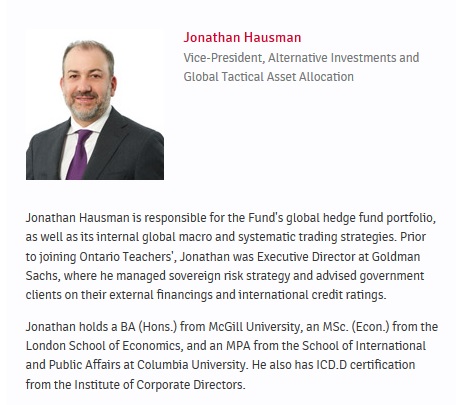
I reached out to Jonathan Hausman, Vice-President, Alternative Investments and Global Tactical Asset Allocation at Teachers’ in an email earlier today to discuss this latest move and copied Ron Mock on it.

But knowing how notoriously secretive Ontario Teachers’ gets when it comes to discussing specific investments and investment strategies, especially their hedge funds, I doubt either of them will come back to me on this matter (if they do, I will edit my comment).

Those of you who never met Jonathan Hausman, there is a picture of him now sporting a beard on Teachers’ website along with his biography (click on image):

Jonathan is in charge of a very important portfolio at Ontario Teachers. While most pensions are exiting hedge funds after a hellish year or seriously contemplating of exiting hedge funds, Teachers invests a hefty $11.4 billion in hedge funds, representing roughly 7% of its total portfolio.

While the absolute amount is staggering, especially relative to its peer group, you should note when Ron Mock was in charge of external hedge funds, that portfolio represented roughly 10% of the total portfolio and it had a specific goal: obtain the highest portfolio Sharpe ratio and consistently deliver T-bills + 500 basis every year with truly uncorrelated alpha (overlay strategy).

[Note: When Teachers had 10% invested in hedge funds and hit its objective, this portfolio added 50 basis points+ to their overall added-value target over the benchmark portfolio with little to no correlation to other asset classes. The objectives for external hedge funds are still the same but the overall impact of this portfolio has diminished over the years as hedge fund returns come down, other more illiquid asset classes like infrastructure, real estate and private equity take precedence and Teachers expands its internal absolute return strategies where it replicates these strategies internally, foregoing paying fees to external managers.]

So why is Ontario Teachers’ cutting its allocation to computer-run hedge funds? I’ve already discussed some reasons above but let me go over them again:

  • Underperformance: Maybe these particular hedge funds were underperfoming their peers or not delivering the return objectives that was asked of them.
  • Strategy/ portfolio shift: Unlike other investors, maybe the folks running external hedge funds at Teachers think the glory days of computer-run hedge funds are over, especially if volatility picks up in the months ahead (read this older comment of mine). Maybe they see value in other hedge fund strategies going forward and want to focus their attention there. Teachers has a very experienced hedge fund group and they are very active in allocating and redeeming from external hedge funds.
  • Internalization of absolute return strategies: Many popular hedge fund strategies can be easily replicated internally at a fraction of the cost of farming them out to external hedge funds, foregoing big fees and potential operational risk (I used to work with a very bright guy called Derek Hulley who is now a Director of Data Science at Sun Life who developed such replication strategies for his former employer and since he traded futures, he had intimate and detailed knowledge of each contract when he programmed these strategies, which gave his replication platform a huge advantage over other more generic ones.)
  • Cut in the overall allocation to hedge funds: Let’s face it, it’s been a hellish few years for hedge funds and all active managers. If you’re a big pension or sovereign wealth fund investing billions, do you really want to waste your time trying to find hedge funds or active managers that might outperform or “add alpha” in public markets or are you better off directly investing billions in private equity, real estate and infrastructure over the long run?

That last question is rhetorical and I’m not claiming Teachers is cutting its allocation to hedge funds (obviously not) but many of its peers, including the Caisse, have drastically cut allocations to external hedge funds to focus their attention on highly scalable illiquid asset classes.

Now, we can argue whether we are on the verge of a hedge fund renaissance or whether active managers could be ready to shine again but the point I’m making is most large pensions and sovereign wealth funds are more focused on directly or indirectly investing huge sums in illiquid alternatives and I don’t see this trend ending any time soon.

In fact, I see infrastructure gaining steam and fast becoming the most important asset class, taking over even real estate in the future (depending on how governments tackle their infrastructure needs and entice public pensions to invest).

I will end with a point Ron Mock made to me when I went over Teachers’ 2015 results. He stressed the importance of diversification and said that while privates kicked in last year, three years ago it was bonds and who knows what will kick in the future.

The point he was making is that a large, well-diversified pension needs to explore all sources of returns, including liquid and illiquid alternatives, as well as good old boring bonds.

And unlike other pensions, Ontario Teachers has developed a sophisticated external hedge fund program which it takes seriously as evidenced by the highly trained team there which covers external hedge funds.

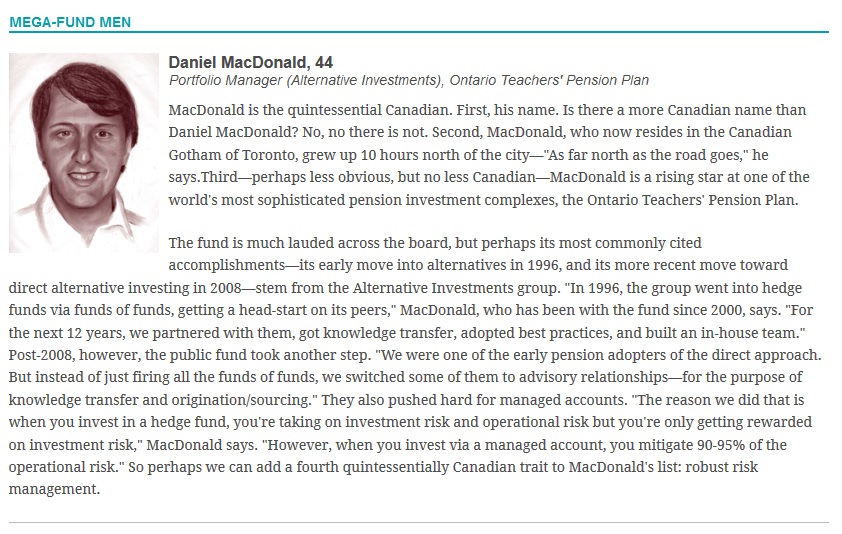
I was saddened (and surprised) to learn however that Daniel MacDonald recently left Ontario Teachers to move to San Diego where he now consults institutions on hedge funds (his contact details can be found on his LinkedIn profile).

Daniel is unquestionably one of the best hedge fund analysts in the world and one of the sharpest and nicest guys I ever met at Teachers. aiCIO even called him one of the most influential investment officers in their forties (click on image):

He’s even won investor intelligence awards for his deep knowledge of hedge fund investments and none of this surprises me. His departure represents a huge loss for Ontario Teachers’ external hedge fund group.

Dallas Police Officers Leaving Amid Pension Concerns

The Dallas Police and Fire Pension System is one of the most troubled pension funds in the country. It’s 45 percent funded, but has lost 15 percentage points from its funding status since 2009.

As other funds raked in solid investment returns post-recession, Dallas Police and Fire has struggled; the fund returned -12 percent in 2015.

Those struggles have been well-publicized, and it’s beginning to have an effect on the workforce as public safety workers wonder whether they should retire now to ensure money is left for their pension.

From Bloomberg:

More than 200 workers have decided to retire or leave, about double the normal rate, said Mayor Pro Tem Erik Wilson, who sits on the Dallas Police and Fire Pension System’s board. That’s threatening to put further pressure on the fund as benefits come due, including lump-sum payouts to older employees who’ve been drawing a paycheck while earning a guaranteed 8 percent return on their pensions.

“I’ve had 40 to 50 officers in my office this week asking what they should do,” said James Parnell, 52, secretary-treasurer of the Dallas Police Association and 25-year veteran. “They’re very nervous about what is going to happen, they’re fearing a run on the money.”

[…]

The squeeze on Dallas’s fund is even more acute because of a decision to divert money from stocks and bonds into Hawaiian villas, Uruguayan timber and undeveloped land in Arizona, among other non-traditional investments. The strategy, put in place under prior managers, backfired. The fund lost 12.6 percent in 2015 and 0.7 percent over the past three years.

The public-safety system has just 45 percent of the assets it needs to cover benefits, down from 64 percent at the end of 2014 and half what it was a decade ago. The pension could be out of cash in 15 years at the current rate of projected expenditures, according to a Segal Consulting report in July.

Caisse Bets Big On India’s Power Assets?

Leo Kolivakis is a blogger, trader and independent senior pension and investment analyst. This post was originally published at Pension Pulse.

Abhineet Kumar of India’s Business Standard interviewed Prashant Purker, Managing Director & CEO of ICICI Venture Funds, who said they will acquire power assets worth $3.5 billion:

This month, came up with a new investment platform to acquire conventional power assets. The fund comes at a time when capital goods maker Bharat Heavy Electricals (BHEL) is seeing 45 per cent of its Rs 1.1-lakh core order book face the challenge of stalled or slow moving projects. A large number of this are stuck due to financial constraints that ICICI Venture’s power platform plans to benefit from. Prashant Purker, managing director and CEO of ICICI Venture Funds, spoke to Abhineet Kumar on his plans for that. Edited excerpts:

What is the worth of assets you are targeting to acquire with your $850-million power platform?

We’re targeting to acquire $3-3.5 billion worth of (enterprise value) assets in the conventional power segment across thermal, hydel (hydro electric) and transmission businesses.

Clearly, there are a lot of power assets just getting completed or stuck in the last mile of completion with over leveraged situations at company or sponsor level. They need someone who can buy the assets out, inject equity to complete the project and have the capability to operate these assets on a long-term basis. This platform provides that — Tata Power bring operating capabilities and ICICI Venture provide fund management service as sponsors for the fund.

In return, these assets benefit those investors who need long-term yields. This is ideal for our investors such as Canadian pension fund CDPQ (Caisse de depot et placement du Quebec) as well as sovereign funds Kuwait Investment Authority and State General Reserve Fund of Oman.

As a funds-house, what is your strategy for platforms? Can we expect more such platforms to come in the future?

In 2014, we collaborated with Apollo Global Management to raise first special situation funds for India. We raised $825 million under our joint venture AION Capital Partners. Unlike funds, platforms are dedicated to some sort of investments where assets can be aggregated. Our strategy is to identify situations or opportunities in the market that require certain things to be brought together and then bring it with whatever it takes.

With the pedigree and group linkage, ICICI Venture is in a unique position to achieve this. Among domestic institutions, it is the only one which is truly multi-practice with four investment teams across private equity (PE), real estate, special situation and power assets. Across these four, we have $4.15 billion assets under management and it does not include the fund we raised in the venture capital era. Today, we have the largest dry powder of $1.5 billion across these funds.

It has come with our ability to spot opportunity earlier, and bring together whatever it takes. We will continue to look for new platform opportunities.

What is the update on your PE and real estate funds?

For real estate, we’ve total assets under management of $625 million with two funds fully invested. Now we plan to raise our third fund and have applied to the regulator for approval.

For PE, we are in the process of raising our fourth fund and have concluded interim closing as well as the first two investments. We have also started investing from our fourth fund with a couple of investments — Anthea Aromatics and Star Health Insurance — already made. Our PE fund will remain sector-agnostic and look for growth capital investment opportunities coming from rising consumption. In terms of exits, we have returned nearly half of our third fund to investors from various exits with Teamlease being the latest one where we used the IPO (initial public offering) route. Exit from the rest of the investee companies from the third fund is in the process of using multiple routes of IPOs, secondary sale, or strategic sell-off.

What is the sense you get on limited partners’ view for investments in India as you raise your fourth PE fund?

Limited partners are today happier with exits position than they were a couple of years ago. Obviously, markets can’t just keep absorbing the capital; it has to return. With IPO markets opening up and given the increasing number of secondary deals, the sentiment for investments has improved. We are also seeing larger traction for strategic buy-outs as Indian promoters are fine with giving up controls. Is it that people are hundred per cent convinced to come to India – we are not in that position. People are looking for quality managers. Many funds would not be able to raise money as investors now want to gravitate to a few who have delivered returns and have a track record to show.

As disruption affects businesses across industries, how prepared are your investee companies to face it?

Today, every company has to be on its toes to look at technology – be it health-care or banking. At every company’s board, directors with grey hair are asking about social media presence and how customers are being acquired. So, technological disruption has become truly mainstream.

It is an ongoing process, and they are today definitely more prepared than they were two years back.

Good interview with a bright person who is obviously very well informed on what is going on in India and the opportunities that exist there across private markets.

I bring this particular interview to your attention not because I know Prashant Purker or want to plug but because they have some very savvy investors on board including the Caisse and Kuwait Investment Authority. 

Why are these two giant funds investing in India’s power assets? Because it’s an emerging market that is growing fast and if pensions find the right partners, they can benefit from this growth investing in public and private markets. 

Power assets are in line with the Caisse’s philosophy under Michael Sabia’s watch, ie. slow and steady returns, which is why it doesn’t surprise me that they opted to invest in this new platform which will invest in power assets that provide a steady long-term yield. 

And the Caisse isn’t the only large Canadian pension fund investing in India. Many other Canadian pension funds invest in India, including the Canada Pension Plan Investment Board (CPPIB) which opened a new office in Mumbai last year to focus on investment opportunities across the Indian subcontinent.

Are there risks investing in India? Of course there are. Extreme poverty, gross inequality, rampant corruption and war with Pakistan are perennial concerns, but this emerging market has tremendous long-term potential even if the road ahead will undoubtedly be very bumpy. And unlike China, India is a democracy with favorable demographics but its infrastructure is nowhere near as developed as it is in China.

Court: Kentucky Pension Systems Can Be Sued For Investment Flops

Kentucky’s retirement systems aren’t immune from lawsuits related to “illegal or imprudent” investments, according to a court ruling last week.

[Read the ruling here.]

The class action suit, filed in 2014 by the city of Fort Wright, claims the Kentucky Retirement Systems (KRS) made excessively risky investments in alternatives which demanded high fees and under-performed.

KRS claimed it had sovereign immunity.

From the Lexington Herald-Leader:

The suit, filed as a class action in 2014 by the Northern Kentucky city of Fort Wright, alleges that KRS violates the law with risky investments in hedge funds, venture capital funds, private equity funds, leveraged buyout funds and other “alternative investments” that have produced small returns and excessive management fees.

In its defense against the suit, KRS said it could not be sued because of sovereign immunity — a legal concept that generally protects governments from legal liability.

A Franklin Circuit Court judge rejected KRS’ defense, a decision the Court of Appeals upheld on Friday. Among the flaws in KRS’ argument, the appeals court said, the law establishing the KRS board of trustees explicitly says the board can sue and be sued in return.

“As a contributor to (KRS) on behalf of its employees, the city has an interest in requiring the board to act in accordance with the law,” Judge Christopher Shea Nickell wrote for a unanimous three-judge panel.

The city’s suit now proceeds in Franklin Circuit Court.

CPPIB to Aid China With Pension Reform?

Leo Kolivakis is a blogger, trader and independent senior pension and investment analyst. This post was originally published at Pension Pulse.

Rob Kozlowski of Pensions & Investments reports, CPPIB to aid China with pension reform, other issues:

Canada Pension Plan Investment Board, which manages the assets of the C$287.3 billion ($217.4 billion) Canada Pension Plan, Ottawa, signed a memorandum of understanding with the National Development and Reform Commission of the People’s Republic of China to offer its expertise to the country on a variety of issues, a CPPIB news release said Thursday.

The memorandum of understanding includes the CPPIB assisting China’s policymakers “as they address the challenges of China’s aging population, including pension reform and the promotion of investment in the domestic senior care industry from global investors,” the news release said.

“As we continue to deploy capital in important growth markets like China for the benefit of CPP contributors and beneficiaries, there is significant value for a long-term investor like CPPIB in sharing information, experience and successful practices with policymakers as they work toward improving policy frameworks,” said Mark Machin, CPPIB’ president and CEO, in the news release. “We are (honored) to have the opportunity to share our perspective and expertise with Chinese policymakers to tackle the issues of providing for an aging population.”

CPPIB will offer joint training, workshops and pension reform research as well, the news release said.

The memorandum was signed Thursday as part of bilateral agreements between China and Canada. In January, the CPPIB was designated by the China Securities Regulatory Commission for renminbi qualified foreign institutional investor status, granting it broad access to China’s capital markets.

Jacqueline Nelson of the Globe and Mail also discusses this agreement here (subscription required). You can read the news release on CPPIB’s website here.

What are my thoughts? I generally think any bilateral trade agreement with China is a good thing, and the fact the Chinese seized this opportunity to forge stronger ties with Canada’s largest pension fund speaks volumes on the respect they have for Canada’s large, well-governed pensions.

A couple of weeks ago, I discussed the global pension crunch, highlighting the problems Chinese policymakers face with their state pensions, many of which are chronically underfunded and need to be shored up as the population ages and benefits need to be paid out.

And this at a time when China has a $2 trillion black hole to deal with.

In April, I discussed China’s pension gamble, criticizing the use of pensions to inflate stock prices higher as an irresponsible policy which will hurt the Chinese market in the long run.

What can the Chinese learn from CPPIB? A lot. First and foremost, they cam learn the benefits of good governance and why it’s crucial for their state pensions’ long-term success. Admittedly, good governance isn’t something that comes easily in China where the government interferes in everything but this is something that needs to be changed.

Second, they can learn all about the benefits of three major structural advantages that are inherent to the CPP Fund – long horizon, scale, and certainty of assets; and three developed advantages that result from strategic choices they have made – internal expertise, expert partners, and Total Portfolio Approach (click on image below).

Together, these advantages provide CPPIB with a distinct perspective for investment decision-making.

Most importantly, China’s large pensions can forge ties with CPPIB and invest alongside it in big private market deals in China, Asia and elsewhere. This is a win-win for all parties which is why I’m glad they signed this memorandum of understanding.

Unfortunately, all is not well between Canada and China. In particular, I’m a bit concerned when I read Joe Oliver, the former Conservative minister of finance, writing a comment in the National Post saying, We have no choice but to slap a tax on Toronto houses being bought by foreigners.

Really? Apart from being discriminatory against foreigners (ie., Chinese), these taxes don’t address the root cause of lack of affordable housing in Vancouver and Toronto — the lack of supply!! — and they were hastily implemented to appease the poor and middle class without careful consideration how they will negatively impact the economies of British Columbia and Ontario.

A friend of mine who lived in Vancouver and moved back to Montreal put it succinctly when he read CIBC said that Ontario will need to implement foreign buyer tax on housing:

No surprise. This is now a political issue. It is about fighting for the poor rather than protecting the wealth generated by the influx of Chinese. The government has now started the snowball and it will be difficult to reverse.

Very shortsighted thinking. There were many ways to tackle the problem which could have accomplished both objectives (protect wealth and restore some balance to the market). It would have taken longer and been less dramatic.

Everyone outside of Vancouver assumes that this is simply a demand-side issue and that by curbing “Chinese” demand, the problem will go away.  It won’t. It will certainly cause a temporary haircut at the upper end of the market but even after a 50% haircut, the average Joe will not have the means to buy property.

The only way to solve this is to create supply and to do this, the government needs to release land from the agricultural land reserve for development of affordable single family housing.  They have done it before (in White Rock).

They also need to allow construction up and over the mountains on the North Shore. Yes this means cutting down trees and laying havoc to the landscape but there really is not a lot of choice here.

What they are doing now is basically driving away the Chinese and their investment dollars. When you look at the BC economy, they really cannot afford to do this.

No kidding. Bloomberg reports, Foreign Buying Plummets in Vancouver After New Property Tax:

Foreign investors dropped out of Vancouver’s property market last month after the provincial government imposed a 15 percent surcharge to stem a surge in home prices:

Overseas buyers accounted for less than 1 percent of the C$6.5 billion ($5 billion) of residential real estate purchases between Aug. 2 to 31 in Metro Vancouver, according to data released by British Columbia’s Ministry of Finance on Thursday. In the roughly seven weeks prior to that, they’d represented 17 percent of transactions by value.

The Canadian city, nestled between the water and soaring mountains, has long been a favored destination among global property investors, who have been blamed for fomenting escalating prices. The new tax went into effect Aug. 2 amid public pressure in the region, where home prices are almost double the national average of C$473,105.

The plunge in foreign participation joins other signs of a slowdown in Canada’s most expensive property market. Vancouver home sales fell 26 percent in August from a year earlier, while the average price of a detached property declined to C$1.47 million, the lowest price since September 2015, according to the Real Estate Board of Greater Vancouver.

The latest data shows that overseas buyers snapped up C$2.3 billion of homes in the seven weeks before the tax was imposed, and less than C$50 million in the next four weeks. The government began collecting data on citizenship in home purchases on June 10. The ministry said auditors are checking citizenship or permanent residency declarations made by buyers and also reviewing transactions to determine if any were structured to avoid tax.

Across the province, the participation of foreigners dropped to 1.4 percent of transactions by value in August, from 13 percent in the preceding seven weeks.

British Columbia has raised C$2.5 million in revenue from the new levy since it took effect. Budget forecasts released last week indicated that the Pacific coast province expects foreign investors to scoop up about C$4.5 billion of real estate through March 2019.

I bring this issue up because while critics love pointing the finger at Chinese policymakers when they make dumb decisions, maybe we Canadians need to reflect more on the bonehead moves our policymakers take to “defend the poor and working class” (exactly the opposite will happen as Chinese move to Seattle but maybe this will boost Calgary and Montreal’s real estate market).

Anyways, enjoy your weekend and remember, behind the trade agreement with China, there’s an equally important agreement on the pension front which will also benefit Canadians and the Chinese. This is undeniably great news for both countries.

Retirement Plan Costs Hit New Low As Sponsors Renegotiate Fees: Survey

The vast majority of plan sponsors have renegotiated record-keeping fees since 2013, according to a survey conducted by consulting firm NEPC.

Retirement plan costs are lower than at any point in the survey’s history.

Details from PlanSponsor:

Since 2013, 81 percent of the 117 plan sponsor respondents report having renegotiated their recordkeeping fees; 51 percent of the plans in the survey, which had an average size of $1.1 billion in assets, now apply a per-participant fee for recordkeeping.

Total investment management fees averaged 42 basis points, down from 57 basis points in 2006 and 46 basis points in 2014.

Average recordkeeping costs were $57 per participant last year, down from $92 in 2011.

An NEPC partner mused whether, at some point, the lower fees would affect service levels. From PlanSponsor:

Ross Bremen, a partner at Boston-based NEPC, expected fees to show some leveling in this year’s report.

“While lower fees reflect the good work sponsors have done to reduce fees on participant’s behalf, at some point service levels could suffer,” said Bremen in a statement accompanying the report. “A race to the bottom, at the risk of sacrificing service and innovation, is not in the participants’ best interests.”

[…]

The trend to a strict per-participant fee structure for recordkeeping services is removing flexibility from plan design as a growing consensus of retirement experts, policymakers and participant advocates say savers need more personalized savings and decumulation strategies.

“The idea that recordkeeping is a commodity is just not the case,” said Bremen, who noted that 21 percent of surveyed plans do not use any revenue-sharing agreements to help shoulder the cost of plan services.

In California, New Ruling Called ‘Existential Threat’ to Pensions

Reporter Ed Mendel covered the Capitol in Sacramento for nearly three decades, most recently for the San Diego Union-Tribune. More stories are at Calpensions.com.

The views of two CalSTRS attorneys show how an appellate court ruling weakening the “California rule,” which prevents changes in the pension promised at the date of hire, has alarmed and perplexed public pension officials.

Reformers hailed the decision in a Marin County case last month as a long-sought way, if upheld by the state Supreme Court, to control runaway costs by cutting pension amounts current workers earn in the future, while protecting pension amounts already earned.

But last week, the CalSTRS board was given a broader interpretation of the ruling by its fiduciary counsel, Harvey Leiderman. He seemed to suggest the ruling might open the door for cuts in pension amounts already earned.

“This ruling in my opinion poses an existential threat to the defined benefit (pension) plan,” Leiderman said.

The CalSTRS general counsel, Brian Bartow, outlined a case-by-case rebuttal of the appellate court ruling, calling it an “abomination,” a biased “result-oriented opinion,” and a view of 61 years of California jurisprudence through “a fun-house mirror.”

Bartow said the appellate court ruling that a comparable new benefit is not needed to offset reasonable cuts in pensions “undermines the entire theory of pensions” and is causing confusion.

“People like me, and even other lawyers who are more steeped in vested rights jurisprudence, are shocked, don’t know what to do,” he said. “It comes out of left field.”

Bartow said the ruling by a three-justice appellate court panel can only be appealed to the state Supreme Court by the parties in the case, the Marin County pension system and several unions. He said the deadline for an appeal is Sept. 26.

Meanwhile, Bartow said, the appellate court ruling has been “published,” which means lower courts can cite it as a precedent. He said anyone can ask the state Supreme Court to “depublish” the decision before the deadline on Oct. 16.

Leiderman said the CalSTRS board should watch the case carefully and possibly take legal action on behalf of the members. He said there is a CalSTRS precedent for similar action.

Bartow said he thinks the only correct role for CalSTRS would be to avoid taking sides in the local dispute and seek “depublishing,” leaving the court decision in force in Marin County but not as a legal precedent for pension systems throughout the state.

After a suggestion from Leiderman, the California State Teachers Retirement System board went into closed-door session to further discuss possible legal strategies and impacts on the pension system.

CalSTRS attorneys Harvey Leiderman, left, and Brian Bartow

Leiderman told the CalSTRS board that the ruling in the Marin County cases is an “existential threat” to public pensions because it has the effect of taking the word “defined” out of the phrase “defined benefit.”

For example, he said, the pension formula covering a teacher for nearly 30 years might, in the year before retirement, be changed to a lower formula if the Legislature thinks it’s is a reasonable benefit.

“That means COLAs are at stake, that means formulas are at stake, that means the entire defined part of a defined benefit would no longer be valid,” Leiderman said. “So this is a threat to the entire membership’s benefit structure, if this case were to become final or if the Supreme Court were to uphold it.”

(Pensions are a “defined benefit” guaranteeing a monthly payment for life. A “defined contribution,” like the 401(k) plan common in the private sector, is a payment into a worker’s retirement investment fund that, depending on the market, can gain or lose money.)

Grant Boyken, state Treasurer John Chiang’s board representative, asked for a clarification of Leiderman’s suggestion that pensions already earned might be cut. He said the Marin case was about “prospective” pension amounts to be earned in the future.

“I think the court went out of its way in the language in the decision to limit its holding to prospective changes for existing members,” said Bartow. Leiderman did not reply to Boyken’s question in open session.

Under a series of court decisions known as the “California rule,” a key one in 1955, the pension promised at hire is widely believed to become a “vested right,” protected by contract law, that cannot be cut unless offset by a comparrable new benefit.

So, most cost-cutting pension reforms only apply to new hires, who have not yet attained vested rights. That can take decades to yield significant saving for employers, which is why reformers want to cut pensions earned by current workers in the future.

Marin unions contended the vested rights of current workers were violated when the Marin County Employees Retirement Association imposed state legislation enacted in 2012 to prevent “spiking” pension boosts from stand-by duty, in-kind health care, and other things.

Three similar union suits filed against the Contra Costa, Alameda, and Merced county pension systems were consolidated. Leiderman, also an attorney for the Contra Cost and Alameda systems, said arguments are scheduled to begin soon.

Bartow speculated that if the Marin ruling is appealed, as he expects, the state Supreme Court may await the outcome of the three consolidated suits in the appellate court before acting on the issue.

CalSTRS followed the “California rule” in legislation two years ago that will raise the rate school districts pay to CalSTRS from 8.25 percent of pay to 19.1 percent by 2020, while the rate for teachers was limited to an increase from 8 percent of pay to 10.25 percent.

The comparable new benefit offsetting the 2.5 percent rate hike for current teachers vested a routine annual 2 percent cost-of-living adjustment, which previously could have been suspended, though that rarely if ever happened.

Part of the Marin appellate court ruling is that a key 1955 state Supreme Court decision said pension cuts “should” be accompanied by a comparable new benefit, which is advisory, and only one high court ruling since then has used the mandatory word “must.”

Bartow argued that in several of the cases where the Supreme Court said “should,” the pension cuts were overturned because there was no comparable new advantage. He said the Marin ruling ignores the “actual and complete analysis in each of those cases.”

In what Bartow said he would “describe as a face-palm inducing aside,” the Marin ruling said that if reasonable cuts are made in pensions, the comparable new advantage or benefit is more money in paychecks because the lower pension results in lower employee rates.

Leiderman said a different panel of justices in the same appellate court cited the same cases as the Marin ruling, but made the opposite decision about vested rights in a case about cost-of-living adjustments in San Francisco pensions.

“That was last year — same appellate court, 180 degrees different view of vested rights,” Leiderman told the CalSTRS board. “The Supreme Court didn’t accept the petition (to review the appellate court decision). It’s hard to know.”

Deprecated: Function get_magic_quotes_gpc() is deprecated in /home/mhuddelson/public_html/pension360.org/wp-includes/formatting.php on line 3712