Another Suit Targets Excessive 401(k) Fees

A newly-filed lawsuit accuses a small 401(k) plan of offering excessively expensive, actively-managed investment options.

[Read the complaint here.]

The suit is against Checksmart Financial and its 401(k) plan, as well as its investment advisor Cetera Advisor Networks.

From Plan Sponsor:

The lawsuit accuses Checksmart; its plan committee, which only has one member; and the plan’s investment adviser, Cetera Advisor Networks, of only offering expensive and unsuitable actively managed mutual funds as investment options in the plan without an adequate or appropriate number of passively managed and less expensive mutual fund investment options. According to the complaint, most investment options have expense ratios of 88 to 111 bps, which the document says are four or more times greater than retail passively-managed funds—which were not made available to the plan and its participants during the class period. In addition, the average expense of all funds is 104 bps.

The complaint points out there are virtually no Vanguard index funds offered in the plan, and mentions that retail shares of the Vanguard S&P 500 Index Fund have an expense ratio of 16 basis points, while Admiral Shares (which requires a minimum $10,000 investment—an amount the plan would easily cover) has an expense ratio of 5 basis points.

The lawsuit specifically calls out the plan’s ‘Lifestyle Portfolios’—risk-based investment options that hold $13.25 million, or 52.63%, of the approximately $25 million in plan assets—saying not only are they the most expensive plan investments, but they materially underperformed the S&P 500 total return under every benchmark.

Defined Contribution Access Swells in Japan

Beginning in 2017, millions more Japanese citizens will be able to set up private 401(k) plans. It’s estimated that nearly $10 billion will flow into the country’s private defined-contribution space over time.

From Reuters:

Starting next January, 27 million Japanese, including housewives and civil servants, will be newly eligible to set up private defined-contribution pension accounts. Currently, only the self-employed and workers who don’t have corporate-sponsored pension plans can set up private pension accounts.

It’s already proven something of a hit with the public. Since the law reform passed parliament in May, monthly web access to the 401k Educational Society, a non-profit that promotes defined-contribution pension plans, has surged seven-fold to 42,000, said Kayo Oe, the group’s chief researcher.

The change has the potential to attract as many as 9.4 million new users over time from 257,000 now, and generate an annual capital flow of up to 1 trillion yen ($9.46 billion) into the private-pension sector, according to Nomura Research Institute (NRI).

Many who wish to grow their plans do so by investing in both domestic and foreign stocks.

“How I see it is that the government won’t be able to pay that much in pensions anymore, so it’s telling us, ‘Go take care of it yourself. We can’t do it for you,'” a Japanese woman told Reuters.

Poland Officials Try to Calm Market After Pension Overhaul Announcement

Poland announced earlier this month a complete overhaul of its private pension industry, and markets subsequently fell to 5-month lows.

Now, officials are trying to quell investors’ fears about the overhaul as they move forward.

From Bloomberg:

Investors worry that the cash-strapped government will find meddling too tempting to resist. In the last overhaul, the government canceled the government bonds held by the pension funds — 51 percent of their assets at the time — to cut its debt load. Since the end of 2013, Warsaw’s main stock index has plummeted 43 percent in dollar terms, while emerging stocks dropped 13 percent.

The other risk this time is that all the portfolio shifts the plan envisions will swamp the Warsaw Stock market, where daily volume averages about 700 million zloty.

“We’re relieved that nationalizing the fund’s Warsaw stock assets isn’t being considered, but this proposal doesn’t eliminate all risks,” said Ryszard Rusak, a money manager at Union Investment TFI mutual fund in Warsaw. “Without proper regulations, the bourse may be overrun by supply as funds managing individual retirement accounts diversify away from stocks.”

[…]

The new plan, for which legislation hasn’t yet been drafted, calls for taking a quarter of current pension fund assets for the government. Those assets — foreign stocks, local corporate debt as well as bank deposits — will be transferred to the FRD, the government’s rainy-day fund. The remaining 75 percent — mainly the pension funds’ holdings of local stocks — will go into the individual accounts, to be managed by private investment companies.

CalPERS Returns 0.6% in Tumultuous FY 15-16

Credit: CalPERS release

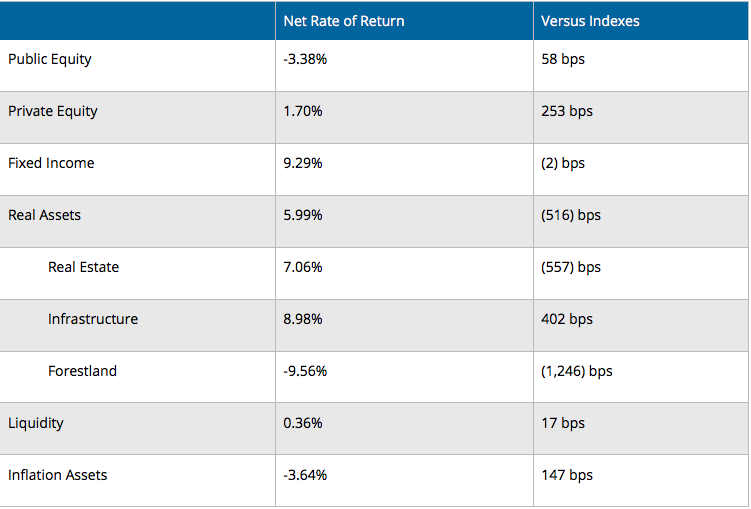
The portfolio of the U.S.’ largest pension fund returned 0.6% in fiscal year 15-16, marking CalPERS’ worst return since 2009 and the second consecutive year of underperformance relative to its 7.5 percent discount rate.

From Reuters:

Speaking at a CalPERS meeting, Chief Investment Officer Ted Eliopoulos said performance for the year was driven primarily by global equity markets, which represent a little over half of the fund’s portfolio. Equities delivered a return of negative 3.4 percent.

“When 52 percent of your portfolio is achieving a negative 3.4 percent return, that certainly sets the main driver for the overall performance of the fund,” said Eliopoulos, who had projected flat returns for the year in June.

Inflation assets returned a negative 3.6 percent return, helping drag down the fund’s overall performance, Eliopoulos said.

Fixed income and real estate investments were bright spots in the portfolio, posting 9.3 percent and 7.1 percent returns respectively.

In response to the drop from previous years, Eliopoulos said CalPERS would reduce risk from its portfolio and have simpler investments that do not require paying fees to money managers.

New CalPERS CEO Eyes Private Equity Boost

New CalPERS CEO Marcie Frost, who was picked on Thursday amid strong endorsements from colleagues, didn’t waste time revealing bits of her thinking on the fund’s investment strategy.

Frost said private equity is an important part of the fund’s portfolio in this environment, and CalPERS might consider increasing its PE allocation to meet return targets. She also acknowledges valid criticisms of the asset class, including fee disclosure.

Frost takes her post on October 3.

From Bloomberg:

The new chief executive officer of the California Public Employees’ Retirement System said the largest U.S. pension fund may look to add more investments in private equity and real estate to increase returns and close its unfunded liability.

“When you’re looking at the low rate of return environment in the public markets, I don’t think you can ignore private equity,” Marcie Frost, who was named Thursday as the pension fund’s next CEO, said in a telephone conference with reporters. “This could be a low-rate environment for a period of time and we have to factor that in when we do our allocation work.”

[…]

Private equity managers, Frost said, have faced valid criticism in recent years for high fees and lack of transparency.

“The transparency — the full disclosure — is a very important piece of that,” she said. “Calpers has been a very strong leader in that area.”

As CalPERS Exits Hedge Funds, CalSTRS Adds More

Reporter Ed Mendel covered the California Capitol in Sacramento for nearly three decades, most recently for the San Diego Union-Tribune. More stories are at Calpensions.com.

The two big California public pension funds, CalPERS and CalSTRS, are going opposite ways on a controversial investment strategy, hedge funds, that is under fire from a powerful teachers union.

CalPERS announced two years ago that it was eliminating its $4 billion hedge fund program, citing their cost, complexity and one of its own investment principles: “Take risk only when we have a strong belief that we will be rewarded for it.”

CalSTRS adopted a “risk mitigation strategy” last November that will move 9 percent of its investment portfolio into long-term U.S. Treasury bonds and hedge funds with strategies designed to lose less value during recessions.

The different views of hedge funds is one of the biggest separations of investment strategy since CalSTRS, under legislation 34 years ago, took control of the teacher pension fund that had previously been managed by CalPERS.

Both funds have similar investment categories — stocks, bonds, private equity, real estate, liquidity, inflation — but with differing ratios and applications of the “ESG” screens (environmental, social and corporate governance) often used by large investors.

When the California State Teachers Retirement System became the manager after the legislation in 1982, the teacher pension fund was $10.9 billion. Now CalSTRS manages a $190 billion fund from its own new 13-story office tower.

It’s across the Sacramento River from the four-block complex where the California Public Employees Retirement System manages a fund worth $301 billion last week. With two of the largest and most impressive state buildings, the pension systems look prosperous.

But both are underfunded, with roughly 70 to 75 percent of the projected assets needed to pay future pensions. They are phasing in painful employer rate increases, while critics say overly optimistic earnings forecasts hide the need for even higher rate hikes.

Both funds have investments with money managers that follow the modern trend of institutional investors to “maximize shareholder value” (recently criticized here) by streamlining businesses, outsourcing jobs and cutting other costs.

As pension funds focus on cutting their own costs in what many expect to be a period of low investment earnings, the 1982 decision creating duplicate staffs and facilities for the two largest U.S. public pension funds may not look like a way to “maximize taxpayer value.”

CalPERS complex covers four city blocks

Hedge funds, typically open only to large investors, use a variety of strategies aimed at out-performing the market and reducing risk. They are known for charging investors high fees and creating a class of wealthy hedge fund managers.

For some, hedge funds are the face of Wall Street greed. One hedge fund strategy, buying defaulted debt at a low price and relentlessly pushing for full repayment, made news this year with huge profits in a $4.65 billion settlement of a 15-year battle with Argentina.

In another debt squeeze, Bernie Sanders, the former Democratic presidential candidate, said last month “billionaire hedge fund managers on Wall Street are demanding that Puerto Rico fire teachers, close schools, cut pensions, and lower the minimum wage so they can reap huge profits off the suffering and misery of the American citizens on that island.”

The distressed debt strategy may be getting much of the attention. But the broader criticism of the thousands of hedge funds, which have a wide range of strategies and nearly $3 trillion in assets, is high costs and poor performance since the financial crisis.

“Hedge funds have underperformed, costing us millions,” Letitia James, an elected public advocate said as the New York City Public Employees Retirement System voted in April to end its $1.7 billion hedge fund program. “Let them sell their summer homes and jets, and return those fees to their investors.”

A Financial Times story in April said public pension funds in several states are considering dumping their hedge funds, nearly two years after CalPERS became the first big pension fund to eliminate hedge funds.

“At the time, many thought it would trigger a wave of redemptions,” the Financial Times said of the CalPERS announcement, “but with public boards tending to be deliberative, it is only now that the wave seems ready to break, hedge fund managers say.”

CalSTRS tower at dusk

The CalSTRS decision last fall to increase hedge fund investments caught the eye of Randi Weingarten, president of the American Federation of Teachers, who is in a long-running battle with hedge fund managers, the Wall Street Journal reported last month.

Dozens of wealthy hedge-fund managers are said to have contributed millions to the promotion of charter schools (often opposed by teacher unions if they are not part of a public school system) and the reform of public pensions (often by advocating a switch to 401(k)-style plans common in the private sector).

Three years ago, Weingarten’s union published a list of roughly three dozen Wall Street asset managers that have donated to causes opposed by the union, the Journal said. Teacher pension funds with $1 trillion in assets were advised to use the list when making investment decisions.

“Why would you put your money with someone who wants to destroy you?” Weingarten told the Journal.

A hedge-fund manager who got himself removed from the union’s list, Cliff Asness of AQR Capital Management, remained on the board of the Manhattan Institute, a think tank said by the union to support charter schools and pension reform. The Journal said Weingarten viewed the CalSTRS hedge fund expansion as a chance to apply pressure last fall.

“Dan Pedrotty, an aide to Ms. Weingarten who runs the hedge-fund effort, spoke to a CalSTRS official about Mr. Asness’s continued service on the Manhattan Institute’s board,” the Journal reported. “The official then called Mr. Asness.”

Asness had already decided to leave the Manhattan Institute before receiving the CalSTRS call, his spokesman told the Journal, after reassessing the time that he was spending on non-profit boards.

Last week, a CalSTRS spokesman did not confirm or deny that a CalSTRS official called Asness at the request of the union, pointing instead to an Asness letter on July 4 replying to the Journal story.

“This article implies I left the Manhattan Institute’s board under such pressure, which is false,” Asness wrote. He said, among other things, that he is a supporter of public pensions and the mission of the Manhattan Institute, but not everything written under its banner.

Weingarten’s union published a report last fall, “All That Glitters Is Not Gold,” that criticized hedge funds for high fees and poor performance in recent years. CalSTRS was not among the 11 public pension funds analyzed in the report.

The CalSTRS chief investment officer, Chris Ailman, told CNBC in May that CalSTRS is “not a big fan” of hedge funds and invested in them in 2009-10, after many other pension funds rushed in during 2004 to 2007. He said CalSTRS invested in two hedge fund strategies, not 22 strategies like some of its peers.

Now CalSTRS is looking at a handful of hedge funds that are “counter-cyclical to growth,” Ailman said, and expected to provide some balance during recessions. He said “2 and 20 is dead,” referring to the traditional hedge fund fee of 2 percent of assets and 20 percent of profits as an incentive.

With a long-term risk management strategy to invest 9 percent of its portfolio, Ailman said, CalSTRS has a size advantage in fee negotiations that have already begun. “Our staff has put on their boxing gloves and gone in there and just laid it out, what we are looking for,” he said.
New York Pension “Severely Understaffed”, Says Review

An outside review of the New York Common Retirement Fund – the second such review in 2016 – found the $178 billion fund is being managed well but is understaffed.

The review also suggested it pay its existing staff higher wages, and continue trying to cut investment costs associated with external managers.

The pension fund is being reviewed periodically after a pay-to-play scandal years ago.

From ABC:

In the latest review, released Thursday, Funston examined 96 investment transactions approved by the comptroller from April 1, 2012, through March 31, 2015, concluding that they all followed policies and legal requirements.

“We did not identify any instances of inappropriate or unethical behavior,” the report said.

Funston said most of its recommendations from three years ago, such as better documentation and computer support, were implemented. But the fund remains “severely understaffed for its scale and complexity, with underdeveloped risk analysis and management capabilities and an over-reliance on outsourced investment management and support functions.”

The reviewers noted the pay levels were in the bottom quarter among similar public pension funds, raising concern about staff turnover and recruiting. They again recommended adding staff and raising pay, anticipating lower overall costs by keeping more work in-house.

The fund, with 37 investment staff and 21 other employees, paid $561 million in outside management fees last year. That was up from $552 million a year earlier and $454 million in 2013.

“The reality is, in this environment, the fund doesn’t generate much of a return where the markets have been up and down and basically flat lately. The alternatives are where we’ve gotten the extra returns. So while there are more fees there, there’s been a benefit in terms of returns,” DiNapoli said. “We agree with the need to reduce fees. By having more staff, you could do more of this in-house.”

New York City Pension Drops Gun Retailer Holdings

The New York City Employees’ Retirement System voted on Thursday to divest from its holdings in three big retailers who sell firearms.

The fund is also pushing Walmart to stop selling guns in its stores.

The campaign was led by trustee Leticia James.

From the New York Times:

The $59 billion New York City Employees’ Retirement System voted to divest itself of the shares on Thursday at its board of trustees meeting. The fund is selling shares in Dick’s Sporting Goods, Cabela’s and Big 5 Sporting Goods. The holdings, worth $10.5 million as of mid-June, are about 0.02 percent of the pension’s portfolio, according to a letter to the board of trustees from the city’s public advocate that was reviewed by The New York Times.

However small the divestment is on behalf of New York’s city employees, the move culminates a yearlong effort by some in city government to take action against the gun industry. The public advocate, Letitia James, proposed last July that the city’s pensions sell their holdings of Walmart. She has also filed complaints with the Securities and Exchange Commission about disclosures made by the gun makers Sturm, Ruger & Co. and Smith & Wesson, in addition to putting pressure on local banks to stop lending to gun makers.

Mayor Bill de Blasio has also called on New York’s pension funds to sell their holdings of companies that make assault rifles.

[…]

Ms. James has also been trying to pressure Walmart. Last August, the retailer, based in Bentonville, Ark., said it would stop selling certain types of semiautomatic rifles. In her letter to the pension’s board earlier this month, Ms. James said the board should continue to talk to Walmart about its sale of handgun ammunition and other issues.

Indiana Gov. Mike Pence Wants State Pension to Invest $500 Million in Local Startups

Indiana Governor Mike Pence on Wednesday introduced several proposals that would direct money to the state’s growing businesses – including a proposed $500 million total investment (over 10 years) from the Indiana Public Retirement System to Indiana-based startups.

From the Indianapolis Star:

[Pence is seeking] a $500 million investment over 10 years by the Indiana Public Retirement System on what the IEDC refers to as “early-stage and midmarket Indiana companies.” The state pension fund has about $30 billion in assets.

[…]

INPRS, the system that handles retirement investments for public workers, would have to agree to push more money toward Indiana-based companies — and then find enough worthy, relatively safe companies to invest in.

Micah Vincent, director of the state Office of Management and Budget, said investing $500 million over 10 years would be a target for INPRS rather than a mandate.

“You want to chase the right investments,” Vincent said. “That’s a huge part of this, and we’re going to continue to use the same due diligence we do in all our investments.”

The goal of investing pension money in Indiana companies, he said, is to encourage growing companies to move to the state and spur local companies to compete for that money.

The Big CPP Clash?

Leo Kolivakis is a blogger, trader and independent senior pension and investment analyst. This post was originally published at Pension Pulse.


Charles Lammam and Hugh MacIntyre of the Fraser Institute wrote an op-ed for the National Post, The big CPP clash: Who’s fuelling pension myths now?:

The “agreement in principle” to expand the Canada Pension Plan (CPP) is a major change to one of the key pillars of Canada’s retirement income system. While we encourage an informed debate about the costs and benefits of the change, it’s disappointing that a respected pension expert such as Keith Ambachtsheer has fuelled further misunderstanding over CPP expansion.

In a memo published by his consulting firm, which was covered by the Financial Post (“Fresh take on CPP myths,” by Barry Critchley, July 7, 2016), Ambachtsheer, director emeritus of the Rotman International Centre for Pension Management, criticized a column we wrote summarizing a longer report and numerous studies that dispelled common myths surrounding the arguments for CPP expansion. Like the myths we dispel in our report, Ambachtsheer puts forth arguments that rely on incomplete analyses or flat out incorrect assumptions.

For starters, the best available evidence shows most Canadians are well prepared for retirement. While Ambachtsheer agrees this is true for current retirees, he claims that future retirees will suffer a different fate, though he provides no evidence to support his assertion. Presumably Ambachtsheer bases his assertion on model projections. However, many of these projections suffer from several important problems.

For one thing, they tend to consider only the savings accumulated in the formal pension system such as the Canada and Quebec pension plans, registered retirement savings plans (RRSPs), and registered pension plans (RPPs). This narrow focus on pension assets overlooks the substantial non-pension assets that Canadians accumulate in stocks, bonds, real estate, and other investments. In 2014, savings in non-pension assets totalled $9.5 trillion, dwarfing the $3.3-trillion worth of assets in the formal pension system. Moreover, consumption needs tend to decline as a retiree ages and retirement income adequacy depends on individual circumstances and preferences.

There are other problems. Ambachtsheer raises concern about those people who lack a workplace pension. But that does not doom someone to a financially insecure retirement. Research from Statistics Canada shows that, relative to their pre-retirement income, retirees without a workplace pension have a higher average retirement income than those with a workplace pension (although the median is slightly lower).

A point that Ambachtsheer does concede is that higher mandatory CPP contributions will be offset by lower private savings. In the end, the overall amount that workers save won’t change but there will be a reshuffling, with more money going to the CPP and less to private savings such as RRSPs, TFSAs, and other investments. This is exactly what happened the last time mandatory CPP contributions increased in the 1990s and 2000s.

Ambachtsheer calls this a “plausible outcome” but then asserts that the CPP offers a higher “quality” of savings than other forms of retirement savings. This is not a foregone conclusion. While the CPP does provide a defined benefit in retirement, lower private savings mean Canadians will lose choice and flexibility. For example, all money saved privately can be transferred to a beneficiary in the event of death. In the case of RRSP savings, Canadians can pull a portion of their funds out for a down payment on a home, to upgrade their education, or if they need it in case of a financial emergency. These benefits are not available through the CPP.

Ambachtsheer’s assertion that the CPP is a superior investment vehicle hinges on the rate of return earned by the CPP Investment Board (CPPIB), which manages CPP assets. But here Ambachtsheer makes the fundamental mistake of suggesting that future retirees will benefit from the strong investment performance of the CPPIB. This simply isn’t true.

There’s no direct link between the investment performance of the CPPIB and the retirement benefits received by eligible Canadians. In fact, the rate of return under the current system for Canadians born after 1956 is a meagre three per cent or less — declining to 2.1 per cent for those born after 1971. We re-calculated the new rate of return based on the limited details available on the proposed CPP expansion. While the results point to a slightly higher comparable long-term rate of return (2.5 per cent), this rate is still well below three per cent and hardly the great investment deal Ambachtsheer suggests.

Given the important changes being made to the CPP and the wider implications for Canada’s retirement income system, it’s unfortunate that an expert of Ambachtsheer’s stature has fuelled misunderstanding over CPP expansion.

The folks at the Fraser Institute are worried. Now that Canada’s finance ministers have wisely agreed to expand the CPP, they’re desperately trying to publish one paper after another trying to make the case against such an expansion.

The problem? These experts from the Fraser Institute are completely biased and are missing the much bigger picture in order to focus on an ideological stance that favors “less big government” (even though expanding the CPP isn’t expanding the government, something they misunderstand).

And what is the bigger picture? Without a doubt, Canadians are much better off in the long run with an expanded CPP because most of them aren’t saving enough for retirement and they’re living longer and risk outliving their meager savings soon after retirement.

What else are these Fraser Institute policy analysts missing? When we expand the CPP, more Canadians will be able to retire in dignity and security, allowing them to spend accordingly in their golden years because they can count on their CPP payments no matter how well or poorly the market is performing. Governments will be able to collect more in sales taxes and the deficit and debt will be lower because they won’t have to spend as much money on social welfare programs to take care of seniors living in poverty.

It all boils down to something I’ve long argued in my blog, regardless of your political or economic views, expanding the CPP is a winning retirement strategy for Canadians and for the Canadian economy over the long run.

The crucial points these Fraser Institute analysts are missing are the following:

  • They conveniently overlook the benefits of defined-benefit plans and the brutal truth on defined-contribution plans, namely that the latter are an abysmal failure in terms of providing safe, secure pension benefits for life, leaving many people exposed to the vagaries of markets which is why pension poverty is on the rise.
  • They claim that Canadians are well prepared for retirement, stating there have “substantial non-pension assets,” but the reality is most working Canadians can barely save anything meaningful after they make the mortgage payment on their insanely overvalued house, which is yet another reason to worry about retirement in this country. Canada’s housing crisis is just getting underway and if you think your house is going to save you in retirement, you’re in for a nasty surprise.
  • They claim that Canadians are getting less bang for their CPP buck but fail to realize that interest rates around the world are at record lows and that we should be building on CPPIB’s success. Moreover, the job of pension managers at CPPIB is to ensure they’re properly diversified across global public and private markets in order to make sure the Canada Pension Plan is sustainable over many years and if you look at their long-term results, they’re delivering on their mandate to maximize returns without taking undue risk. The question of raising CPP benefits is up to the federal and provincial governments but in order to discuss this the plan has to be on solid footing to begin with, which it is.
  • The Fraser Institute has published a dubious study on the costly CPP which was thoroughly discredited by yours truly and by the folks at CEM Benchmarking, a firm co-founded by Keith Ambachtsheer, so it shouldn’t surprise you they’re attacking his views. I’m not always in agreement with Keith Ambachtsheer and have openly questioned some of his views on my blog but when it comes to pension policy, I listen to him over anyone at the Fraser Institute.
  • Last but not least, they fail to appreciate the caliber of the pension managers at CPPIB and other large Canadian defined-benefit plans. There’s a reason why Mark Wiseman is leaving CPPIB to join Blackrock, and it speaks volumes about his competencies and those of other senior managers at CPPIB and other large Canadian pensions. They’re very good at what they’re doing and are delivering stellar long-term results.  

These are the key points I want people to remember the next time they read about some biased study from the Fraser Institute claiming that expanding the CPP is a terrible idea which will jeopardize the Canadian economy.

This is total rubbish and if I had a chance to privately meet with the CEOs of major Canadian banks and insurance companies, I would tell them to stop funding such nonsense and support the expansion of the CPP. In the end, it’s in their best interests too but they’re failing to see this which is a real shame.


Deprecated: Function get_magic_quotes_gpc() is deprecated in /home/mhuddelson/public_html/pension360.org/wp-includes/formatting.php on line 3712