CPS Struggles to Pay Teacher Pensions

Chicago Public Schools are facing a major deficit after relying on Springfield to help pay the $676 million payment for teacher pensions due in June. With little word back from the capital, CPS is struggling to function under added financial stress.

The Chicago Sun-Times has more on the subject:

Summer school for 17,450 Chicago Public School students could be scaled back dramatically if the Illinois General Assembly adjourns its spring session without providing pension relief to the nearly bankrupt school system.

The doomsday plan may also require central office administrators and network staffers who normally work through the month of July to take pay cuts or unpaid days off.

“Because of the budget crisis driven by the state’s discriminatory funding, CPS is being forced to seriously contemplate difficult reductions to summer school,” CPS spokeswoman Emily Bittner was quoted as saying in an emailed statement in response to questions from the Chicago Sun-Times.

[…]

Mayor Rahm Emanuel signed off on a school budget that assumes $480 million in pension help from Springfield. CPS has managed to make it through the school year, only after borrowing $775 million at sky-high interest rates and making several rounds of painful budget cuts.

A school funding bill approved by the state Senate this week would provide roughly $375 million in additional help for CPS.

But, the bill Downstate Democratic state Sen. Andy Manar claims will “attack poverty in the classroom” faces an uncertain future, both in the House and, more importantly, with Republican Gov. Bruce Rauner.

At issue is the $676 million payment to the Chicago Teachers Pension Fund due on June 30.

CPS has no choice but to make that payment in full, whether or not Springfield rides to the rescue.

To do otherwise would probably mean losing future access to the credit markets and slipping dangerously further into junk bond status — possibly dragging the city’s bond rating down with it.

But, after making that payment in full, CPS will have just $24 million left in the bank. That’s enough to cover just 1.5 days of payroll.

Since property tax revenues won’t start rolling in until early to mid-August, that means CPS would essentially be forced to operate “bone-dry” through the month of July.

That’s why summer school and summer staffing are being targeted.

Furlough days and pay cuts could also be in store for the roughly 1,000 central and network office staffers who normally work through the month of July.

CPS’s pension payment is due by June 30.


CalPERS Fees Lower than Peers

A study discovered that CalPERS pays slightly below other similar companies in fees. However, the study does not take into account data on private equity. CalPERS was highly criticized last year for its lack of private equity performance fees.

Pensions & Investments discusses the study further:

A CalPERS-commissioned study from CEM Benchmarking shows the $293.6 billion pension fund paid $1.18 billion in fees or 41.1 basis points in calendar year 2014, slightly below its peer group median of 43.2 basis points.

However, the study does not include performance fees for private equity, real estate, infrastructure and natural resource investments. An executive summary of the study was included in the agenda materials for the retirement system’s investment committee meeting scheduled for May 16.

CalPERS’ lack of data on private equity performance fees became a major controversy last year. In June 2015, pension fund officials disclosed it could not account for how much it paid in performance fees for the asset class even though it was CalPERS’ largest external management cost.

In late November, after implementing a new reporting system, the California Public Employees’ Retirement System, Sacramento, reported it paid $700 million in performance fees or carried interest to private equity firms in the 12-month fiscal year ended June 30, 2015.

CEM said in the study that CalPERS was able to achieve overall a slightly lower cost than its peers in 2014 from its equity, fixed income and now-eliminated hedge fund portfolio because of less use of funds of funds and external active management and fewer portfolio overlays. CEM said CalPERS also paid less than its peers in terms of external management and custody fees, and internal management costs. The study did take into account base fees for alternative investments.

CEM says it compared CalPERS to a peer group of 14 global asset owners with assets ranging from $117 billion to $844 billion. The median size of the plans in the peer group was $184 billion.

CalPERS board members are pushing for an amendment to the California Assembly Bill that would require California pension funds to release information on fees charged by annual investment managers. For more on the bill, read the full article here.


NJ Bill Bans Pension Funds from Boycotting Israel

A recent legislation passed by New Jersey’s Senate bans pension companies from investing with any business currently boycotting Israel. The bill passed with nearly complete support from the Senate. NJ officials hope the ban will send a message of support to Israel.

NJ.com discusses the topic further:

The state Senate threw nearly full support Monday behind a bill requiring New Jersey’s public worker pension fund to divest from companies that boycott Israeli goods and businesses.

The bill (S1923) pushing back against businesses participating in the Palestinian-led “Boycott, Divestment and Sanctions” movement against Israel was approved 39-0. The Assembly still needs to take action on the bill.

State Sen. Jim Beach (D-Camden), a sponsor, said on the Senate floor Monday that “I think this bill sends a very clear message to our friends in Israel that New Jersey has your back.”

Under that bill, the state Division of Investments would be barred from investing public workers’ $68.6 billion pension fund in these companies and dump any of these existing holdings within 18 months.

It makes exceptions for companies that provide “humanitarian aid to the Palestinian people through either a governmental or nongovernmental organization unless it is also engaging in prohibited boycotts.”

[…]

“New Jersey cannot support such biased practices as those of the BDS against our sister state,” state Senate Majority Leader Loretta Weinberg (D-Bergen) said in a statement. “Israel has long been a vibrant trading partner, ally and friend with our state, and making sure that we are not investing in any company that seeks to hurt the interests of Israel or its people through boycotts, divestments and sanctions will send a clear message that we stand against this kind of veiled discrimination.”

The bill joins existing New Jersey motions that prohibit pension funds from investing in business that are connected to Sudan, Northern Ireland, or Iran.


San Jose Prevented from Repealing Measure B by Court Decision

The 6th District Court of Appeal prevented San Jose Mayor Sam Liccardo from repealing Measure B. Although previous rulings allowed for Liccardo to repeal the measure, the appeal stops all proceedings and requires that the case be reconsidered.

Mercury News discusses the topic further:

In a victory for former Councilman Pete Constant and a blow to his one-time ally, Mayor Sam Liccardo, an appellate court on Wednesday put the brakes on the city from repealing Measure B — the pension reform initiative voters overwhelmingly approved in 2012.

“I’m happy the court agreed that the council cannot move forward in such a rushed manner — trying to push things through before the court process was completed,” Constant said Wednesday.

Constant, along with the Silicon Valley Taxpayers Association and businessman Charles Munger Jr., have issued legal challenges to the city’s quest to nullify Measure B through a court proceeding.

Constant, who championed Measure B along with Liccardo, said any changes to the initiative must go back out to voters. The city last year reached settlements during closed-door meetings with employee unions who filed numerous lawsuits against the measure, saying it was an assault on their rights.

Liccardo and the current City Council pushed to replace Measure B with the settlement language — but without full consent from voters who approved it.

“All we’ve asked for is that residents be given the right to vote on the settlement between the city and the unions,” Constant said. “We believe that right rests solely with the residents.”

Santa Clara County Superior Court Judge Beth McGowen didn’t agree. She issued two separate rulings, denying Constant’s plea and siding with the city in its attempt to wipe Measure B off the books.

Union leaders applauded the move, saying it allows them to begin rebuilding a workforce that was depleted from hundreds of employees resigning after pension reform.

Constant and his group appealed and the 6th District Court of Appeal on Wednesday granted a temporary stay in the case — stopping all proceedings to reconsider the case.

City and union leaders have until May 23 to submit their comments on the case.

Private Pensions Pull Away from Hedge Funds, Public Pensions Stay Put

Current estimates suggest that companies are taking money away from hedge funds at the highest rate since the recession. Many blame the industry’s high fees for their decision, but those within the industry say that the bad reputation that surrounds hedge funds may be the driving factor. Despite this trend, public pensions are staying firmly rooted in hedge funds.

Reuters elaborates on the issue:

Recent moves by a few large institutional investors were seen as the beginning of a mass exodus. In 2014, the $300 billion California Public Employees’ Retirement System said it was getting out of most hedge funds. Then, this February, the $15 billion Illinois State Board of Investment said it would reduce its target allocation from 10 percent to just 3 percent. In April, the $51 billion New York City Employees Retirement System (NYCERS) decided to exit hedge funds entirely.

Henry Garrido, a worker union leader and NYCERS trustee, cited the industry’s high fees and poor performance in scoring a near-unanimous vote in favor of his proposal to axe about $1.4 billion from hedge funds including Brevan Howard and D.E. Shaw Group, about 3 percent of its portfolio.

“I think it’s insane,” Garrido said in a pension trustee meeting this year, “that we keep pouring money into hedge funds.”

Data, however, suggest that U.S. public pensions are staying put. The number of public pensions that use hedge funds has steadily increased to 282 in 2016 from 234 in 2010, data from research firm Preqin show. The average percentage of pension portfolios in hedge funds has also rose to nearly 10 percent.

Steve Yoakum, executive director of the Public School & Education Employee Retirement Systems of Missouri, said his pensions are sticking with hedge funds despite concerns about high fees and low returns.

“We are parking our money there because we don’t like the alternatives,” Yoakum told Reuters, adding “They are doing what they were hired to do.”

[…]

Mark McCombe, global head of BlackRock’s institutional client business, said pensions will continue to look to hedge funds to help them achieve their financial goals.

“These are very individual decisions,” McCombe said of the CalPERS and NYCERS pull outs. “This is not a systemic move away from hedge funds.”

Many of the companies that are pulling out of hedge funds maybe expecting a stock-like turn around on investment, and may be disappointed when that doesn’t happen. For more on the issue, read the full article here.

Puerto Rico Considers Pension Cuts

U.S. Treasury Secretary Jack Lew indicated the possibility for pension cuts to help diminish Puerto Rico’s debt crisis during a visit to the island earlier this month. Puerto Rico has defaulted hundreds of millions in bonds in recent months due to the financial crisis, and officials agree that a solution must be found to stop the increasing debt. The possibility of pension cuts as a solution is currently hotly debated.

USA Today writes more on the topic:

“That doesn’t mean that all debt is equal. We’ve never said that pensions should be made senior to all debt,” [Lew] said. “But there does have to be a balancing — and at the end of the day you’re going to need to have a functioning economy.”

Puerto Rico — a U.S. territory with 3.5 million residents who are born as American citizens — has accumulated more than $70 billion in bond debt and more than $40 billion in unfunded pension liabilities, according to Treasury’s recent estimate.

[…]

A fiscal oversight board should be formed and given “the discretion to make the trade-off decisions,” Lew said.

But, he added, “the efforts to try to protect any of the interests to the exclusion of all of the others are problematic.”

[…]

Some Republicans have pushed for pension adjustments as part of a restructuring package being considered by Congress, but many Democrats have largely opposed the concept, pushing instead for protections for union interests.

But Lew did not rule out reductions.

“There’s going to have to be a balancing of the interest of creditors and those who get retirement benefits and other bills that the commonwealth has to pay,” Lew said. “If the test is, creditors get paid 100% before anyone else gets paid anything, there’s not going to be a functioning Puerto Rico.”

Puerto Rico Governor Alejandro Garcia Padilla recently declined the concept of pension cuts for the sake of combating debt. He stated that the option would be unconstitutional.

Ontario’s Game Changing Opportunity?

Leo Kolivakis is a blogger, trader and independent senior pension and investment analyst. This post was originally published at Pension Pulse.

Keith Ambachtsheer and Edward Waitzer wrote an op-ed for the Globe and Mail, Ontario’s pension plan presents a game-changing opportunity:

There is evidence that an element of employer compulsion is required to ensure that Canada’s private-sector workers are covered by a functional workplace pension plan. That reality should be tempered by careful thought about strategies to minimize the potential negative impacts of compulsion.

One strategy is to encourage healthy private-sector competition through the “comparable plan” principle that Ontario has adopted in its Ontario Retirement Pension Plan (ORPP) initiative. Competition could foster much-needed innovation in workplace pension design and management in Canada, and is an opportunity for the financial sector to assert its social utility.

A 1994 World Bank study suggested that the ideal national retirement income system has three pillars: a universal pillar providing a basic pension to all, a workplace-based pillar providing supplementary retirement income and an individualized pillar permitting people to create their own “add-on” piece. This model flags a serious Canadian problem. More than three-quarters of Canada’s private-sector work force has no access to a well-designed, cost-effective workplace plan. This means many are undersaving and thus will not achieve their retirement income aspirations. Others will fall short because they are saving inefficiently through high-cost investment vehicles.

These consequences impose significant costs on future generations. One solution is to expand the Canada Pension Plan/Quebec Pension Plan or another provincial version. Specifically, Ontario’s ORPP initiative was announced in 2014 and the ORPP Act was passed in 2015. As an alternative solution, we proposed in 2011 requiring employers to enroll their employees into a qualifying pooled registered pension plan (PRPP) offered by an approved financial institution.

The ORPP Act contemplated these solutions by requiring Ontario employers to enroll workers into the ORPP or offer a “comparable plan.” Current wording leaves room for interpretation of what that is. This window creates a private-sector opportunity for competition with the ORPP. It could also pre-empt the need for future CPP/QPP expansion if other provinces also require “comparable plans.”

What should a 21st-century workplace pension plan look like? It has (a) the ability to compound returns over long investment periods to make a decent pension affordable, (b) the ability to provide lifetime payment assurance and (c) a transition mechanism that shifts plan participant exposure from return compounding emphasis to payment safety emphasis as they age.To date, very few countries have been able to offer access to this kind of workplace plan due to lack of innovation and outmoded legislation and regulation.

Fortunately, there is a global effort under way to address these barriers. Northern European countries, Britain and Australia have already made workplace pension-plan participation mandatory. Ontario leads the way in North America, but Saskatchewan has been offering its Saskatchewan Pension Plan since 1986. (The SPP offers most of the 21st-century plan features set out above, but because participation has been voluntary, it lacks the scale to be truly cost effective.)

Ontario’s commitment to the ORPP can be a game-changer for Canada. It creates the opportunity for financial institutions to offer SPP-type plans from coast to coast, and even beyond Canada’s borders. Let’s call them PRPPs. Here’s how they could compete with the ORPP:

The target pension benefit: A PRPP would be comparable to the ORPP’s target benefit at the ORPP’s 3.8-per-cent contribution rate. However, with the PRPP, the employer would have the option of choosing a higher target benefit with a higher contribution rate.

Risk mitigation: The PRPP design recognizes that the major risk facing workers is lack-of-return compounding risk, and the major risk facing retirees is payment-for-life uncertainty. This leads logically to its two-instrument approach. We understand that the ORPP design will not distinguish between the differing risk preferences of workers and retirees.

Wealth transfers: The PRPP design ensures that no systematic wealth transfers take place between current and future workers, retirees and taxpayers. To date, it is unclear how the ORPP will ensure this.

Open architecture: The PRPP will be able to accept already accumulated retirement savings and move them into the same return compounding-to-safety life-cycle process as will be used for new pension contributions. Our understanding is that the ORPP will not.

Surely employers and employees would benefit from the option of a PRPP with the features sketched out above.

A final thought. Leadership by policy makers and financial institutions can help demonstrate that regulation is about more than protecting consumers from deceptive products and practices. Rather, it is to ensure that society is well served and that consumers get “value for money” – a fair deal. This should encourage financial innovation (as a substitute for government market intervention) and a better articulation of public stewardship responsibilities throughout the financial services supply chain.

*** Keith Ambachtsheer is director emeritus of the International Centre for Pension Management at the Rotman School of Management, University of Toronto. Edward Waitzer holds the Jarislowsky Dimma Mooney Chair in Corporate Governance, is director of the Hennick Centre for Business Law at Osgoode Hall Law School and the Schulich School of Business, York University, and is a senior partner at Stikeman Elliott LLP.

This article is based on a KPA Advisory Services paper.

Keith Ambachtsheer and Edward Waitzer have written an interesting article but I have one big beef with it which I will come to shortly.

First, I agree with them, the Ontario Retirement Pension Plan (ORPP) is a game changer but not for the main reasons they cite. I think it’s a game changer because absent a push by all provinces to enhance the CPP once and for all, Ontario is right to introduce a new supplementary pension plan which can use the same successful model of other large Ontario plans to provide a supplementary pension to all Ontarians.

My biggest beef with this article is that it focuses too much on how the ORPP will encourage more private sector competition, neglecting to mention that when it comes to pensions, there is no private sector pension solution that can effectively compete with Canada’s Top Ten pensions.

Ambachtsheer and Walzer are both very smart, they know their stuff when it comes to pensions, but they missed a golden opportunity here to explain why the ORPP makes great long-term sense and why it will benefit the entire population and economy for years to come.

To be fair, they mention it en passant but then move right away to obsessively focus on how it will promote private competition. No it won’t, the ORPP will kill its private sector competitors over a very long period. Why? Because they won’t be able to do half the things the ORPP will be doing at a fraction of the cost. That is the honest truth and both Ambachtsheer and Waitzer know it.

Go back to read my comment on less bang for your CPP buck where I rip apart the latest study from the Fraser Institute to make the point why enhancing the CPP is the only real option to bolstering Canada’s retirement system.

Absent an enhanced CPP, it makes sense for Ontario to introduce a new supplementary pension plan, but not for the main reason cited by the authors above. We already have something in Canada that works, let’s build on the success of our large, well-governed defined-benefit plans and drop the notion (more like charade) that the private sector can effectively compete against them. It can’t and the sooner we realize this, the better off all Canadians will be.

You can watch a BNN clip of Ontario Finance Minister Charles Sousa discussing why the ORPP is an important initiative at the end of the Globe and Mail article here. Great discussion, listen to his comments.

Below, Ron Mock, CEO of Ontario Teachers’ Pension Plan, Canada’s largest single profession pension plan, talks about the fund’s investment strategy in a recent interview on CNBC.

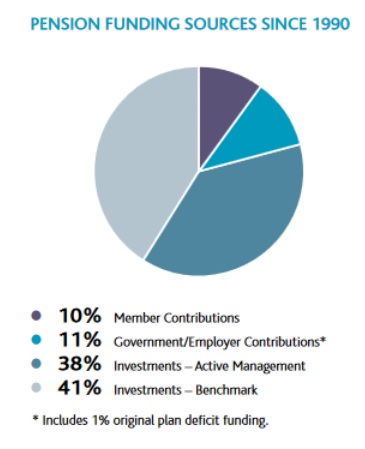
As I stated in my comment when I went over Ontario Teachers’ 2015 results, there is one chart I really like in the Annual Report, one that exemplifies Teachers’ long-term performance (click on image):

When people ask me why I’m such a stickler for large, well-governed defined-benefit plans, I point out charts like the one above to make my case. If you’re looking for a solution to the global retirement crisis, this is it, right there in that chart.

Trust me, no PRPP can compete with OTPP or Canada’s Top Ten when it comes to producing great long-term returns on a cost efficient basis. The sooner we recognize this, the better off all Canadians will be.
Video: Top Pension CIOs Talk Dangers of Short-Termism

At the Milken Institute Global Conference last week, several of the world’s top CIOs talked about taking the long view and the dangers of short-termism.

The panel included Chris Ailman, CIO of CalSTRS; Vicki Fuller and Scott Evans, CIOs for New York State and New York City, respectively; and Hiromichi Mizuno, CIO of Japan’s Government Pension Investment Fund.

Video credit: Milken Institute


Public Pensions Lag Behind Return Targets in 1st Quarter of 2016

The median U.S. public pension fund returned 1.24 percent in the 1st quarter of 2016, according to a report from Wilshire.

That level of return, if annualized, would fall short of most funds’ assumed rate of return. Most of the public pension funds in the study have target returns of 7.25 – 8 percent.

More from Bloomberg:

The results mean that public pensions, which typically target annual returns of 7 percent or greater, will have to make up ground the rest of the year. If they don’t, governments eventually have to pump more taxpayer money into the funds to make up for the shortfall. The modest returns following gains of 2.73 percent during the fourth quarter and a losses of 4.6 percent in the three months through September.

“You’d be going back to the contributor and saying we need to have more funding,” said Robert Waid, a managing director at Wilshire Associates in Santa Monica, California.

The Standard & Poor’s 500 stock index returned about 1.3 percent during the first three months of the year, while the MSCI index of international equities lost 3 percent. The Barclays U.S. Aggregate bond index gained 3 percent.

Public pensions with more than $5 billion in assets, which have more invested with hedge funds and private-equity funds, performed slightly worse than others. Large pensions logged a median 1.15 percent for the quarter, dragged down by their investments in hedge funds. Those investment vehicles lost 3.3 percent before fees for the quarter and 5.9 percent for the year ending March 31, according to Wilshire TUCS.

Pension Pulse: The Death of 2 & 20?

Leo Kolivakis is a blogger, trader and independent senior pension and investment analyst. This post was originally published at Pension Pulse.

Tom DiChristopher of CNBC reports, The 2 and 20 hedge-fund model is dead:

The compensation model that has enriched hedge fund managers for years is not long for this world, CalSTRS Chief Investment Officer Christopher Ailman said Monday.

To find yield in the current low-interest-rate environment, CalSTRS has invested in select hedge funds. But Ailman said the pension fund is not paying the alternative investment class’s notoriously high fees.

“Two and 20 is dead. People have to understand that. That model has been broken,” he said during an interview on the sidelines of the Milken Institute Global Conference on CNBC’s “Squawk on the Street.” Ailman was referring to the typical hedge fund fee structure in which portfolio managers charge 2 percent of total asset value and 20 percent of the portfolio’s returns.

Investors pulled more than $15 billion from hedge funds in the first three months of the year, making it the worst quarter for managers in seven years, the Financial Times reported last month.

To be sure, CalSTRS has considerable heft to negotiate, being the nation’s second-largest pension fund with a portfolio valued at about $186.8 billion as of March 31.

“We have a size advantage,” Ailman said. “We already are negotiating. Our staff has put on their boxing gloves and gone in there and just laid it out, what we’re looking for.”

Ailman acknowledged that new funds will continue to ask small investors to pay 2 and 20, but said in most cases the split has come down.

CalSTRS is currently pursuing a risk-mitigation strategy, but not because it is worried about the broader market, he added.

“It’s all back to that point of having a balanced portfolio, being exposed to GDP growth, but then also having some balance on the other side because we are going to have U.S. recessions and we’re going to have global recessions,” he said.

“This is a low patch, but we think, overall, growth will come through.”

In my last comment on hedge funds under attack, I discussed why I think it’s insane to give any multibillion hedge fund 2 & 20 to manage assets, especially in a deflationary world where ultra low and negative rates are here to stay.

Paying 2 & 20 is even more insulting when hedge fund aren’t delivering on their promise. And when you have brand name fund like Tiger Global’s flagship Onshore fund declining 22% (gross) in the first quarter, it really stings to have to pay these guys any management fee whatsoever (long gone are the days where the Tiger fund was burning bright and I warned you to stop chasing after “Chase Coleman” and other hedge fund superstars getting crushed).

No wonder New York state’s pension leader is calling hedge fund fees ‘unfair’:

The chief investment officer of the New York state pension fund doesn’t like the fees hedge funds charge to manage money.

Vicki Fuller, who oversees the $185 billion New York State Common Retirement Fund, said the hedge fund industry’s “2 and 20” fee model is “unfair.”

“We’re looking at alternative structures,” Fuller told The Post on Wednesday while attending the Milken Institute Global Conference here.

While Fuller declined to provide specifics, some big pensions are feeling pressure to cut costs and have pushed hedge funds to lower their fees. Others including CalPERS, the largest US public pension plan, have pulled their money from hedge funds.

Traditionally, hedge funds pocket a 2 percent annual management fee and take an additional 20 percent of performance gains.

The New York state pension, the country’s third-largest, spent $113 million on hedge fund management fees in the fiscal year ended March 31, 2015. During that period, the pension had 4.5 percent of its assets in hedge funds, which generated a 5.9 percent return.

The hedge funds the pension has investments in include Bridgewater Associates, D.E. Shaw, GoldenTree Asset Management, Paulson & Co., Trian Fund Management and ValueAct Capital.

Unlike New York City’s public employee pension, which voted to exit its hedge fund portfolio, the state pension isn’t planning to yank its money from hedge funds, Fuller said.

Not sure Fuller’s team really knows what they’re doing when it comes to hedge funds. If I were her, I’d seriously consider bailing from hedge funds too and let these billionaires sell their summer homes to pay off the fees they’ve stolen accumulated over the years from their (no longer) patient clients.

I have strong views when it comes to hedge fund and private equity fund fees (at least PE funds have a hurdle rate and a clawback). I believe in paying for performance, not asset gathering. Period. I couldn’t care less who the manager is, how long they’ve been in business, how rich and famous they are. All this is irrelevant to me as I truly believe a lot of the good times are over for the world’s hedge fund and private equity billionaires which got away with murder for many years.

Now that hedge fund managers are losing their swagger, and institutional investors are waking up and redeeming from individual funds and funds of funds charging an extra layer of fees, it’s going to be  a lot tougher for hedge funds to justify their fees.

I will let you listen to Chris Ailman’s remarks below. He’s right, large pensions aren’t paying 2 & 20 anymore (more like 1 or 1.5 & 15 if they have leverage to negotiate hard). This is especially true when it comes to investing in large, multibillion, liquid hedge funds strategies.

However, when it comes to an emerging hedge fund, it only makes sense to give them a 2% management fee to help them get off and running and cover fixed costs. Also, a lot of the less liquid strategies will still charge hefty fees because they won’t grow past a few hundred million dollars of assets under management (typically their investors are large family offices or small endowments looking for very niche strategies).

Lastly, and a bit critically, I don’t consider CalSTRS an expert in hedge funds. They were very late in the game, which is fine, and they certainly don’t have an external hedge fund program that matches more mature ones at Ontario Teachers’ Pension Plan or other large hedge fund investors in Canada who actually know what they’re doing in hedge funds.

I used to invest in CTAs, global macros and L/S Equity funds. I don’t think they’re the best way to generate consistent alpha in hedge funds. In fact, if you look at the last few years, the best hedge funds were multi-strategy funds (this year is much tougher for them). I understand why CalSTRS is investing in CTA and global macro funds for scalable “non-correlated” alpha but I think they need to review their entire hedge fund program which is still in its infancy.

By the way, all of you paying 2 & 20 to any hedge fund should carefully read my last comment on billionaires bearing stock tips.


Deprecated: Function get_magic_quotes_gpc() is deprecated in /home/mhuddelson/public_html/pension360.org/wp-includes/formatting.php on line 3712