Pension Pulse: Are U.S. Public Pensions Doomed?

640px-Blank_US_Map.svg

Leo Kolivakis is a blogger, trader and independent senior pension and investment analyst. This post was originally published at Pension Pulse.

Attracta Mooney of the Financial Times reports, US public pension deficits squeeze city and state budgets:

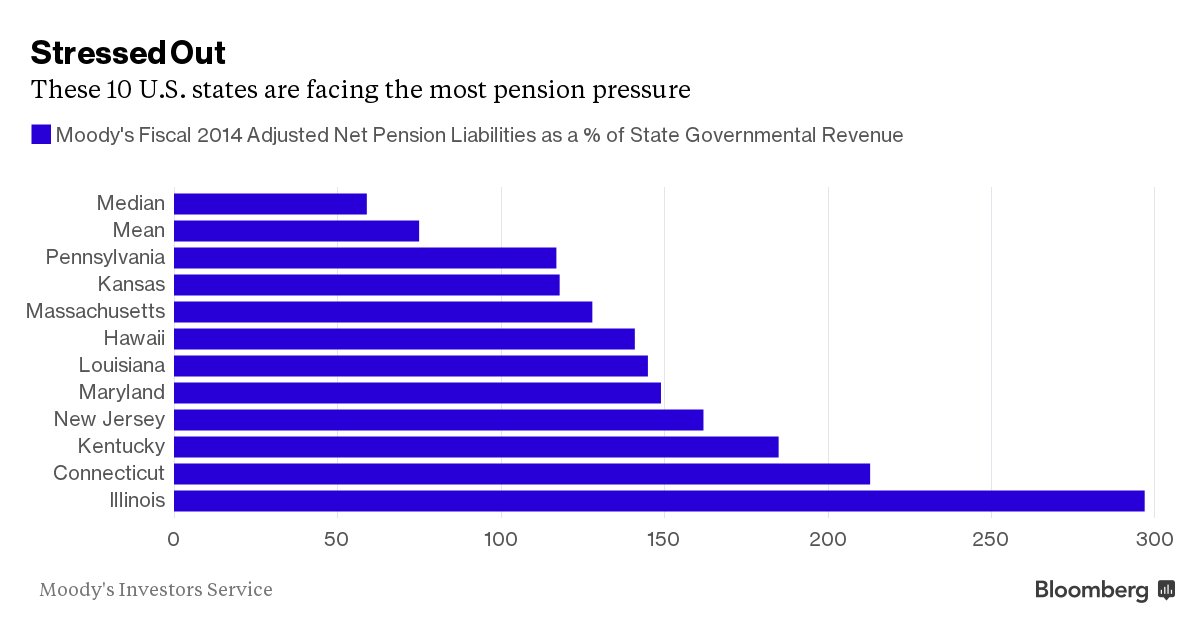
The health of the US public pensions system is deteriorating. The latest figures reveal that retirement plans have less than three-quarters of the assets they need to pay current and future retirees.

The growing pension deficit is putting “enormous” pressure on US cities and states, said Amin Rajan, chief executive of Create Research, a consultancy. It also raises concerns that some public retirement funds might not be able to pay out in future.

According to Wilshire Consulting, an institutional investment advisory company, state-sponsored pension plans in the US had just 73 per cent of the assets they needed in mid-2015, down from 77 per cent in 2014.

“Before the recession, many of these plans were fully funded or nearly fully funded,” said Russ Walker, vice-president of Wilshire Consulting.

In 2007, the state pensions’ funding ratio, a measure of assets to liabilities, stood at 95 per cent. An 80 per cent funding level is generally considered the minimum healthy level for public pension plans.

Large pension funding gaps have caused big problems for many US cities and states, including Detroit, where a $3bn public pension deficit contributed to the city’s bankruptcy.

Josh Rauh, a finance professor at Stanford University, said: “Cities such as Chicago and Philadelphia, and states such as Illinois and Kentucky, are already feeling the pinch as pension contributions are consuming increasing shares of their budgets.”

The full scale of the underfunding problem is likely to be even greater than Wilshire’s figures show, because of how the pension plans measure their funding levels, Mr Rauh added.

City and state officials have tried to take steps to close the pension funding gap, such as requiring new employees to make greater contributions to retirement plans.

Officials at pension schemes are also working hard to close the deficit, said Hank Kim, executive director at the National Conference on Public Employee Retirement Systems, a trade association for public pension plans in the US.

“The plans have learnt greatly from the financial crisis. Risk is a big concern and they have taken steps to mitigate any investment downside,” he added.

However, Tamara Burden, principal at Milliman Financial Risk Management, an investment adviser to pension funds, said many schemes are relying more than ever on making up the funding gap by assuming “exceptional asset returns”.

“Relying on strong asset returns in today’s market is a scary place to be,” she added.

Despite strong stock market performance in the year to mid-2015, many US pension plans found it difficult to meet their return targets, according to Wilshire.

Pension funds are likely to struggle for performance in the year to mid-2016, thanks to volatile trading conditions during the third quarter of 2015 and the start of this year.

Mr Rajan said US public pension schemes are in a difficult place. “Tackling the problem means unpalatable choices: fresh cash injections or reduced retirement benefits or increased retirement age, or some combination of the three.”

When it comes to pension deficits, keep your eyes peeled on bond yields because the lower they go, the more future liabilities and pension deficits rise. And when asset values drop, it adds more pressure on pensions, especially if they’re chronically underfunded like many U.S. state, city, municipal and local pensions are.

Right now, stocks have erased almost all of the 2016 losses but U.S. bond yields remain at historic lows despite bonds posting the biggest weekly selloff since November after Friday’s better-than-expected jobs report. And when it comes to pensions, ultra low rates for years and the new negative normal spell big trouble ahead, especially if deflation sets in.

The critical point to remember is that when rates are at historic lows, every drop in global long bond yields represents a huge increase in future liabilities for pensions. Why? Because the duration of liabilities is a lot bigger than the duration of assets which means that every drop in bond yields disproportionately impacts pension deficits.

This is why you see Canada’s large public pensions scrambling to buy infrastructure assets like London City Airport at a hefty premium. They need to find assets that are a better match to their long dated liabilities. We can argue whether Canada’s mighty pensions are paying too much for these “premium infrastructure assets” (I think so) but this is the approach they’re taking to defy volatile public markets and find a better suitable match for their long dated liabilities.

And unlike the United States, Canada’s large public pensions have the right governance to go out to do these direct investments in infrastructure. Also, unlike their U.S. counterparts, Canada’s large public pensions have realistic investment assumptions and are better prepared for an era of lower returns.

In the U.S., public pensions are delusional, firmly holding on to the pension rate-of-return fantasy. They’re also held hostage by useless investment consultants that shove them in the same brand name private equity funds and hedge funds. This doesn’t always pan out well for these public pensions but it enriches private equity titans and hedge fund gurus who collect outrageous fees no matter how well they perform.

Of course, things might be turning around for pensions. Copper bears are turning into bulls and hedge funds are turning bullish on oil which bodes well for those betting big on a global recovery.

In fact, last week we saw huge moves in energy (XLE) and metal and mining (XME) stocks. There were huge gains in dogs like SeaDrill (SDRL) which I’ve been short since October 2014 but also in many natural gas, steel, copper and coal names like Chesapeake (CHK), U.S. Steel Corp. (X), Freeport McMoRan (FCX), Peabody Energy (BTU) and Teck Resources (TCK).

Last week was a great week for Carl Icahn who loaded up on a few of these names in his portfolio. And this week is starting off great for funds betting big on a global recovery as we even see moribund shipping companies like Eagle Bulk Shipping (EGLE) and Genco Shipping (GNK) take off (click on image to view a sample of stocks I track closely):

But the question remains will it last or is this just another short covering rally destined to fizzle out? I’ll tell you, if I’m an underfunded U.S. public pension, I’d be hoping that assets and bond yields continue to rise from these levels, but given my Outlook 2016, I’d be very careful not to read too much into these explosive countertrend rallies in beaten down energy, commodity and emerging market stocks. These are great rallies to trade but don’t overstay your welcome.

As far as U.S. public pensions, some are already doomed and are now facing very difficult choices ahead.

Caisse Gains 9.1% in 2015

496px-Canada_blank_map.svg

Leo Kolivakis is a blogger, trader and independent senior pension and investment analyst. This post was originally published at Pension Pulse.

The Montreal Gazette reports, Caisse de dépôt posts 9.1% return in 2015:

A weak Canadian dollar ended up being a strong contributor to the Caisse de Dépôt et Placement du Québec’s impressive 2015 results.

With more than a quarter of its assets now in U.S. investments, the provincial pension-fund manager rode a 20-per-cent rise in the U.S. dollar to an annual return of 9.1 per cent last year, extending its solid run under Michael Sabia, chief executive since 2009.

The Caisse beat its benchmark index by a full 2.4 per cent, one of its largest margins of outperformance in the last 20 years. The average Canadian pension fund made about 5.4 per cent last year, according to a recent report from RBC Investor & Treasury Services.

“It’s again an outstanding performance for Sabia. They are very conservative, very focused,” said former Caisse executive Michel Nadeau, now director-general of the Institute for Governance of Private and Public Organizations.

Nadeau said a number of things went right for the Caisse in 2015. More than half of its assets are now invested outside Canada, whose stock market tumbled last year. It had little exposure to the hard-hit oil and gas sector. It has increased its allocation to less-liquid but more stable investments like real estate, private equity and infrastructure. And some of its major Quebec holdings, like convenience-store operator Alimentation Couche-Tard and information-technology company CGI, continued to grow and prosper internationally.

The Caisse, which manages funds for the Quebec Pension Plan and several public-sector pension plans, ended the year with assets under management of $248 billion, $22 billion more than in 2014. Only $2 billion of that was new contributions.

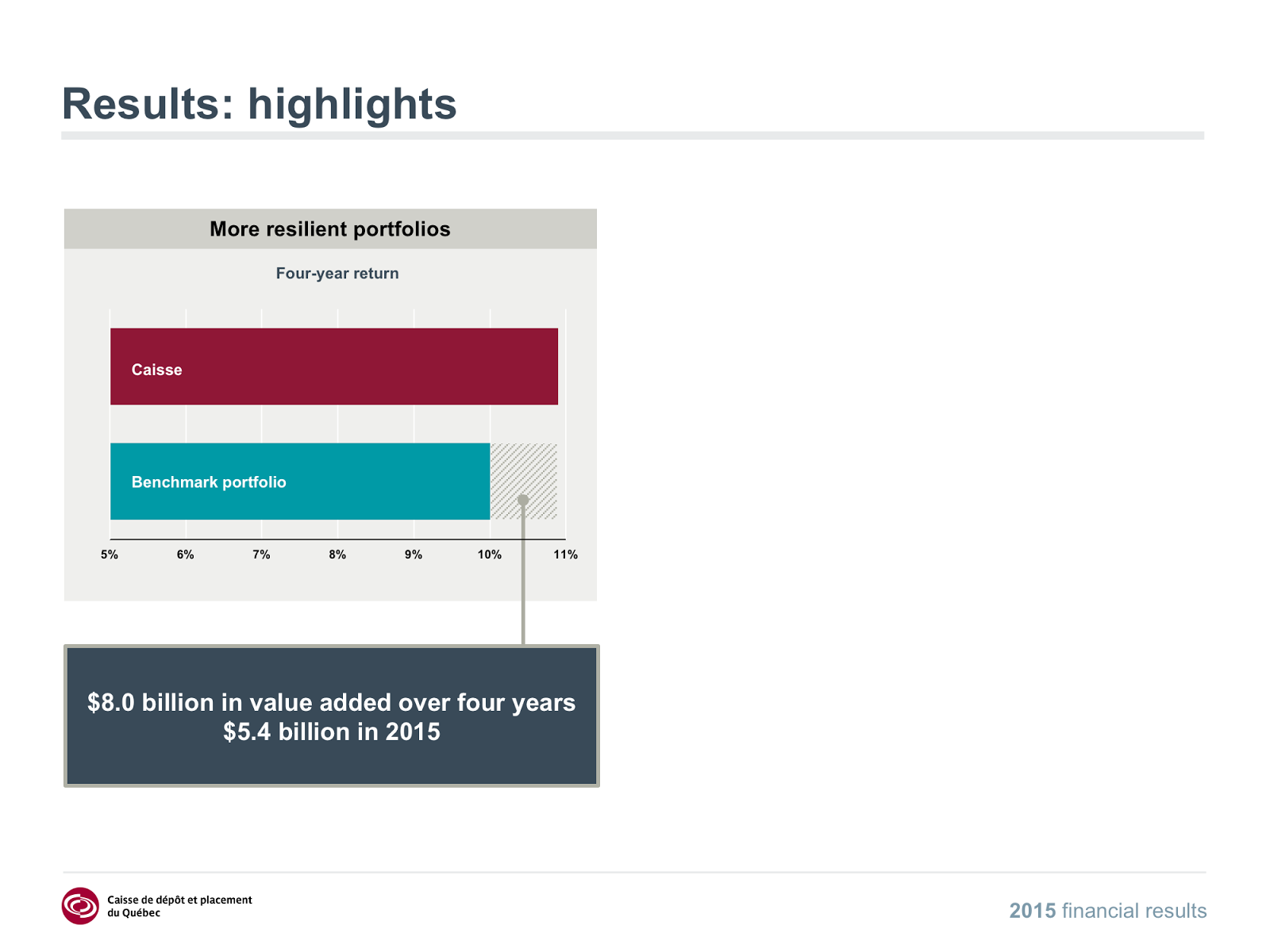
Its rate of return over four years is now 10.9 per cent, almost 1 per cent better than its benchmark. The 10-year number is 6 per cent, roughly what’s needed to meet the long-term needs of its depositors.

Global and U.S. equity investments were key drivers for the Caisse in 2015, both posting returns of more than 21 per cent. “Portfolios benefited from the Canadian dollar’s significant depreciation, particularly against the U.S. dollar,” the fund said in its annual summary.

Its Canadian stock portfolio slipped 3.9 per cent in 2015, about 4 percentage points less than the Toronto Stock Exchange.

Overall, the Caisse’s equity portfolio was up 11 per cent in 2015. It got a 10.6 per cent return from its inflation-sensitive investments and a 3.9 per cent gain from its fixed-income holdings.

Addressing reporters, Sabia called it “a solid year,” not just because of the gains achieved during a period of economic volatility, but because of the way the organization has grown its international expertise and adapted its investment strategies.

“Faced with a turbulent world, I think our strategy works, and works well,” he said.

The Caisse has moved an increasing percentage of its assets into international holdings, and they now account for 54 per cent, up from 41 per cent in 2011. U.S. investments alone total $73 billion or almost 27 per cent. Fully 40 per cent of the Caisse’s $55-billion real-estate portfolio is now south of the border.

The push into the U.S. and other nations including Australia, India and Mexico will continue, because that’s where the best growth opportunities are, Sabia said. In Quebec, it will give priority to companies with global aspirations, because “we have to globalize the Quebec economy.”

Sabia cautioned that future returns may not be as strong, because of the challenging economic environment, but said the Caisse will stay focused on its mission, to generate the annual returns of 6 to 6.5 per cent its depositors need.

“We can outperform the market, but if it falls 10 to 15 per cent, there’s only so much you can do,” he said. “You can’t immunize yourself.”

Frederic Tomesco of Bloomberg also reports, Caisse de Depot Posts 9.1% Return in 2015, Buoyed by Weak Loonie:

Caisse de Depot et Placement du Quebec returned 9.1 percent in 2015 as international equities, boosted by a decline in the Canadian currency, offset negative returns at home.

Net investment income at Canada’s second-largest pension fund manager was C$20.1 billion ($14.5 billion) in 2015 versus C$23.8 billion a year earlier, according to a statement issued Wednesday. Net assets rose to C$248 billion as of Dec. 31 from C$225.9 billion at the end of 2014, the Caisse said.

Results beat the 5.4 percent average increase of Canadian pension funds, as estimated in a January report by RBC Investor Services. Over four years, the Caisse said its weighted average annual return was 10.9 percent — topping the 10 percent average return of its own benchmark.

Under Chief Executive Officer Michael Sabia, who took over in 2009, the Caisse has been increasing investments abroad while steadily boosting its exposure to less liquid assets such as real estate to improve diversification. Today, almost 54 percent of the fund manager’s exposure is outside Canada, with “inflation-sensitive” investments such as property or infrastructure accounting for about 17 percent of net assets.

“While not immunizing our portfolio against market movements, our strategy makes it more resilient in turbulent times,” Sabia said in the statement.

Stocks Outperform

Equities were the best performing asset class for the Caisse last year, returning 11 percent on average. U.S. publicly traded stocks advanced 19 percent while private-equity assets returned 8.4 percent, according to the statement. The Caisse’s C$22.4 billion Canadian stock portfolio declined 3.9 percent, less than the 11 percent decline of the Standard & Poor’s/TSX Composite Index.

Results overall benefited from about a 15 percent decline in the Canadian dollar against its U.S. counterpart.

With net assets of C$282.6 billion at year-end, the Canada Pension Plan Investment Board is the country’s largest pension fund manager.

In their article, Nicolas Van Praet and Bertrand Marote of the Globe and Mail report, Caisse de dépôt backs Lowe’s $3.2-billion takeover of Rona:

The Caisse de dépôt et placement du Québec is backing Lowe’s Cos. Inc.’s $3.2-billion takeover deal for Rona Inc. because the pension fund manager concluded the Quebec hardware retailer was not going to be the industry champion it once hoped.

“We would very much have liked to have Rona emerge [from its turnaround effort as] a consolidator,” Caisse chief executive officer Michael Sabia explained after announcing the pension fund’s 9.1-per-cent return for 2015. “That was just not going to be in the cards.”

The Caisse said on Feb. 3 that it would tender its 17-per-cent Rona stake to U.S.-based Lowe’s, citing the friendly nature of the deal, the significant premium being offered, and the commitments Lowe’s is making to maintain Rona’s headquarters in Quebec and local buying policy. But Mr. Sabia’s comments are the first time the Caisse has articulated in detail its thinking about the takeover. He also clarified how the pension fund sees its role as a catalyst for economic development in the context of protectionist talk swirling in media and political circles.

When Lowe’s made its first offer for underperforming Rona in 2012, the Caisse’s view was that Rona had the potential to be fixed and shouldn’t be sold for an opportunistic price. So the pension fund brokered an agreement with Invesco Ltd., Lowe’s other main shareholder, to replace Rona management and revamp the board. Now, the Caisse has concluded that although Rona is largely fixed – same-store sales have increased six successive quarters while adjusted profit rose 33 per cent in its latest quarter – industry trends are working against the company and selling is the best option.

A push by Home Depot and Lowe’s, both U.S. industry giants, to expand in Canada is one element that weighed into the Caisse’s thinking, Mr. Sabia said. Industry consolidation and Rona’s weakness in e-commerce retail are two others, he said. “Like it or not, Rona was not well positioned.”

Opposition lawmakers in Quebec’s legislature maintain the Caisse should block the deal, which faces a vote by Rona shareholders before the end of the first quarter of 2016. They’ve also suggested that the Couillard government change the pension fund’s dual mandate – which is to generate returns for depositors and stoke provincial economic development – to prioritize its economic duty and defend Quebec companies against takeovers.

Mr. Sabia rejected that view. He framed the pension fund’s role as a supporter of Quebec companies looking to expand and become industry leaders in their field, noting that Montreal-based business consultant CGI Group Inc. and design firm WSP Global Inc. have both parlayed Caisse investments into a much larger international presence. The Caisse’s recent investment in Bombardier’s train business also aligns with this thinking, Mr. Sabia said, while Rona faced competitive roadblocks in its own growth effort.

“Over all, our view is build” the Quebec companies we invest in, Mr. Sabia said. “Build, expand and play offence.”

The Caisse posted a return of 9.1 per cent for 2015, riding a diversification strategy on international stock markets to generate strong returns for its investment in Canadian dollars. Caisse equity portfolios benefited particularly from the loonie’s depreciation against the U.S. dollar, the pension fund said. Its real estate holdings had a strong showing, returning 13.1 per cent.

The overall performance was below the Caisse’s 12-per-cent return for 2014 but beat the 5.4-per-cent average for Canadian pension funds in a January estimate by RBC Investor Services. Net investment income came in at $20.1-billion, shy of the $23.8-billion the year before.

Net assets climbed to $248-billion as of Dec. 31, making the Caisse the country’s second-largest pension fund manager behind the Canada Pension Plan Investment Board. Caisse investments outside Canada now make up about 54 per cent of its total assets, up from 41 per cent five years ago. The plan is to continue ramping up those investments abroad while reviewing strategies to mitigate currency swings, said the Caisse’s chief investment officer, Roland Lescure.

“In 2015, our strategy was put to the test,” Mr. Sabia said. “Uncertainty in the face of monetary policy, disorderly currency movements and collapsing oil prices all fuelled market volatility,” he said, adding that developed countries posted anemic growth and emerging markets slowed.

Average annual returns over the past four years under Mr. Sabia’s watch reached 10.9 per cent. His five-year term as president and CEO was extended in 2013.

Lastly, Matt Scuffham of Reuters reports, Pension fund Caisse open to investing more in Bombardier:

Canada’s second-largest pension fund, Caisse de depot et placement du Quebec, said it was open to further investment in Bombardier Inc after reporting strong returns in 2015.

Quebec’s public pension fund manager agreed to buy a 30 percent stake in Bombardier’s rail business for $1.5 billion in November, providing a bigger cash cushion for Bombardier’s planemaking unit.

Asked if the Caisse would invest further in Bombardier Inc, Caisse Chief Executive Michael Sabia said: “Are we open to the idea of increasing our position? Yes. Are we going to increase our level of investment in Bombardier Inc very soon? Probably not. We have an important investment in a subsidiary of Bombardier. For now, that represents significant exposure.”

Bombardier has struggled to win new orders for its C Series plane with some potential clients looking for more certainty about its financial health before placing orders. It remains in talks over possible federal aid.

Sabia said federal aid would make Bombardier more attractive to investors by providing that certainty.

“If those risks get reduced I think you’ll probably see some change in the valuation of the company so I think that’s the catalyst. It’s a risk reduction story.”

The company last week received the first order in 16 months for its CSeries jets, sending its shares higher and overshadowing news of lower-than-expected results and plans to cut 7,000 jobs.

Sabia backed Chief Executive Alain Bellemare to turn the business around and said he should be given time.

“Alain Bellemare is doing a very good job. Turnarounds take time. Alain’s been there about a year. In the history of a turnaround those are early days so we’ll see how that progresses,” Sabia said.

The Caisse reported weighted average returns of 9.1 percent in 2015, weaker than the average return of 12 percent it achieved in 2014 reflecting volatile equity markets and global economic uncertainty.

However, it beat the average return of 5.4 percent achieved by Canadian pension funds last year, according to research by RBC Investor Services.

Over the past four years, the Caisse said its annualised return was 10.9 percent, 90 basis points ahead of the benchmark portfolio which it compares itself against.

Since Sabia was appointed in 2009, the fund has sought higher returns by investing more funds in alternative assets such as infrastructure and real estate, shifting funds out of equities and low-yielding government bonds.

“While not immunizing our portfolio against market movements, our strategy makes it more resilient in turbulent times,” Sabia said.

The Caisse said its net assets had increased to C$248 billion at the end of 2015, compared with C$226 billion 12 months earlier.

The Caisse provides us with highlights of its results here and a very detailed press release on its results here which I will be referring to in my critical analysis of its 2015 results. Please take the time to carefully read the Caisse’s press release here as it provides a lot of excellent information.

It’s also important to note that the Caisse doesn’t release its 2015 Annual Report at the same time as it releases its results. It typically releases its annual report in April because I think it has to pass Quebec’s Parliament before being made public.

This is extremely annoying and totally unacceptable. I hope the Caisse and Quebec’s government fix this in the future so that Quebecers can receive detailed information that only the annual report covers on the same day the Caisse releases its results (If Ontario Teachers and others do it, so can the Caisse).

As such, in my analysis below, I will be referring to parts of the Caisse’s 2014 Annual Report which you should all take the time to read here. It’s important to understand that a proper analysis of any pension fund’s results requires a proper understanding of benchmarks used to gauge the risks used to add value over those benchmarks.

First, let me be nice and state flat out these are solid results. I even emailed Michael Sabia last night to congratulate him. For a guy with no investment or pension background, he managed to learn very quickly what the game is all about. He’s extremely bright, works like a dog and has surrounded himself with very smart investment people who for the most part know what they’re doing (minus their bearish bond and long emerging markets/ energy/ commodities calls which turned out to be completely wrong!!).

During Sabia’s tenure, the Caisse has managed to deliver very solid results focusing on shifting assets away from public markets into “more stable, less volatile” private markets, especially real estate and infrastructure. There is actually a chart in the press release which highlights this (click on image):

Those inflation-sensitive assets are mostly made up of real estate and infrastructure investments and their returns have been stable, especially when compared to Equities and Fixed Income.

Does this mean that returns in Real Estate and Infrastructure will keep delivering the same results as the recent past? Of course not, in a deflationary world all assets classes except for good old nominal bonds will get hit (just look at Japan). Also, due to stale pricing (private market assets are valued once or twice a year at the Caisse), there is a bit of an illusion going on here in terms of the real value and volatility of these private market investments.

When you read stories of Canadian oil companies which have stopped paying the rent, you know things are getting bad in Alberta’s commercial and residential real estate market. I have warned all of you that real estate as an asset class makes me extremely nervous in a deflationary environment because even though rates are low, debt levels are high, and a prolonged debt deflation crisis will hit rents and real estate values.

You can argue the same thing about infrastructure. In Greece they built these nice highways and nobody is using them because they can’t afford the tolls (it didn’t help that Troika in its infinite wisdom forced the Greek government to hike the gas tax at the worst possible time). People still use the old highways even if they are risking their lives as they are deteriorating and very dangerous.
 
All this to say, in a debt deflation collapse, even real estate and infrastructure can get whacked hard. If you think hiding in real estate and infrastructure is the key to avoiding a prolonged debt deflation cycle, you’re in for a nasty surprise.

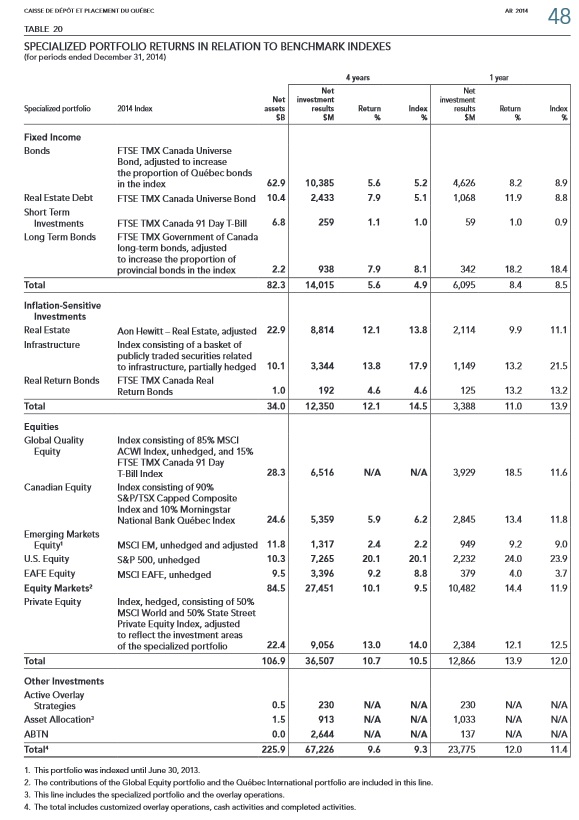
Now, let’s get back to the Caisse’s 2015 results. I want you to look at the returns of each portfolio relative to their index over the last four years and in 2015 (click on image):

You will note that over the last four years, almost every investment portfolio except for Real Estate and Infrastructure beat its benchmark. And this is where most of the money is being invested.

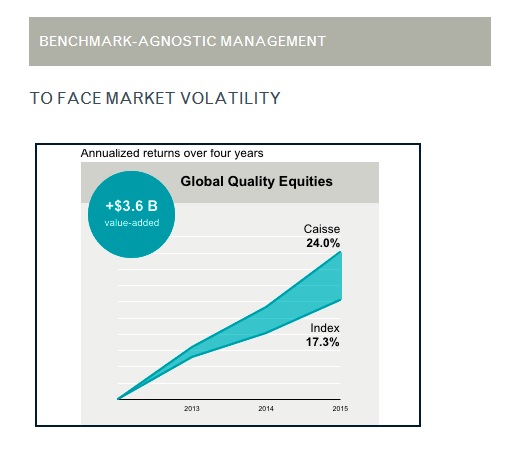
More interestingly, the outperformance in the Global Quality Equities portfolio over the last four years is particularly exceptional, 24% vs 17.3% for its benchmark index.

Wow!!! Warren Buffett, eat your heart out! The Caisse proudly displays this graphic on its site on “benchmark agnostic management” (click on image):

Does this mean that the guys and gals managing Real Estate and Infrastructure at the Caisse aren’t as good as those investing in the Global Quality Equities because the former aren’t able to trounce their benchmarks like the latter seem to be doing?

Of course not. The people managing Real Estate at the Caisse are the best in Canada and among the best in the world. They might not compete with Jonathan Gray over at Blackstone but they’re extremely qualified and excellent real estate managers. The same goes for the Caisse’s Infrastructure group which is staffed by extremely qualified investment professionals.

When it comes to analyzing a pension fund or any fund’s performance, I keep harping, it’s all about benchmarks, stupid! I used to have hedge fund guys come at me with their “unbelievably high Sharpe ratios” and I would tear them to pieces by pointing out the “unbelievably dumb risks” they were taking.

In terms of benchmarks, the Caisse’s Real Estate group has it tough, much tougher than its counterpart over at PSP. I ripped into PSP’s laughable Real Estate benchmark when I went over its fiscal 2015 results back in July (that real estate benchmark still persists at PSP, all part of the André Collin – Gordon Fyfe golden handshake back in 2004).

The Caisse’s Infrastructure benchmark is also tough to beat, tougher than the one at PSP and other large Canadian pensions. So when you have tough real estate and infrastructure benchmarks to beat, your overall benchmark is much tougher to beat which makes the fact that the Caisse beat its overall benchmark by 2.4% in 2015 and 90 basis points over the last four years that much more impressive (click on image):

Unfortunately, it’s not that clean and simple as the Caisse also plays benchmark games and hides it through this nonsense of “benchmark agnostic management”. Have a look at the benchmarks used to gauge the value-added of the Caisse’s investment portfolios (click on image; from page 48 of the 2014 Annual Report):

You’ll notice the Real Estate benchmark is Aon Hewitt, adjusted and the one for Infrastructure is an “index consisting of a basket of publicly traded securities related to infrastructure, partially hedged.”

The real estate benchmark is a private real estate index adjusted for leverage. Basically, Aon constructs CDPQ’s index using IPD data for Canada, UK and France; and NCREIF for the US and they overlay a leverage threshold on top of the direct real estate return data. The infrastructure benchmark has public market beta in it which makes it tough to beat when those stocks are soaring. Both these benchmarks are very tough to beat.

Now, turn your attention to the benchmark for Global Quality Equities because this is where some fudging is taking place. That benchmark is an “index consisting of 85% MSCI ACWI Index, unhedged, and 15% FTSE TMX Canada 91 Day T-Bill Index“.

Huh? So the Caisse is investing in high dividend, quality global stocks like big pharmaceuticals, pipelines and utilities in this portfolio and it’s gauging its performance relative the MSCI All Country World Index and a Canadian T-bill index which yields close to zero?!?

I don’t know but when I see this type of outperformance in any public or private portfolio, my bullshit benchmark antennas immediately go up, especially when its couched under some “benchmark agnostic approach” (click on image):

Now, I’m not implying that the portfolio managers at the Caisse’s Public Equities group are not good at their jobs (just maybe not as good as the chart above implies). I like Jean-Luc Gravel and think he’s done a great job turning that ship around but I have to be intellectually honest and state the obvious: nobody else in Canada is taking this approach and for an obvious reason, it’s a slick way of gaming an inappropriate public market benchmark.

As far as Fixed Income, I have a couple of observations to make to my former one-time boss, Marc Cormier. First, if it wasn’t for that Real Estate Debt portfolio, your marginal outperformance in 2015 and over the last four years wouldn’t be as good as it looks. Second, the Caisse’s Fixed Income team got a bunch of bearish bond calls wrong and it cost it serious performance.

When I hear that guys like Guy Lamontagne, Simon Lamy, not to mention Brian Romanchuck, are no longer at the Caisse, I ask myself what the hell is going on at the Fixed Income group because guys like that (especially Brian and Simon who I know better than Guy) are gold for any organization.

You know who else is gold for any organization? Yours truly. I bust my ass to provide all of you timely (non sanitized) information you simply won’t read anywhere else and all I ask for is a lousy donation or annual subscription to my blog on the right hand side under my picture.

I thank all the leaders at Canada’s Top Ten who have subscribed and ask many more to join them. I’d also like to remind Canada’s pension plutocrats that unlike them, I don’t have the luxury of collecting millions in compensation based on four-year rolling returns and would appreciate if they can offer me contract work or better yet, a full-time job so I too can get properly compensated for my work.

Speaking of compensation, the table below was taken from page 109 of the Caisse’s 2014 Annual Report (click on image):

As you can see, the top brass at the Caisse are compensated extremely well but not as well as their counterparts in the rest of Canada. Michael Sabia remains the most underpaid CEO in the Canadian pension fund industry (trust me, even for a million dollars, his job is no bowl of cherries).

It’s also worth noting that the head of Real Estate, Daniel Fournier of Ivanhoé Cambridge, is not part of this list because he is the CEO of the real estate subsidiary which has its own board of directors. I’m sure he’s getting paid extremely well too (perhaps more than everyone else and deservedly so) but I couldn’t find a public document which states his total compensation (no annual report for Ivanhoé Cambridge but there are activity reports here).

Below, take the time to listen to Michael Sabia discuss the Caisse’s 2015 results in a CTV Montreal report. Notice how he talks about what the Canadian economy needs and alludes to infrastructure?

Also, take the time to watch Sabia’s French interview with Gérard Fillion on RDI Économie here. Notice how much his French has improved over the last five years? He spoke about selling Rona to Lowe’s (good move as Rona would never be able to compete with Home Depot or Lowe’s).

Sabia made a good point that Quebec protectionism won’t work in this global economy and that Quebec companies that want to compete globally better focus on performance. He briefly mentioned the Caisse’s big stake in Bombardier which I think was well structured even if Bombardier’s stock keeps making new 52-week lows.

Also, a month ago, Sabia discussed the market turmoil, monetary policy and his investment strategies at the World Economic Forum in Davos, Switzerland. He spoke with Bloomberg’s Erik Schatzer on  “The Pulse” stating the need to focus on the real economy.

It sounds like Michael Sabia is gearing up for a political career after he leaves the Caisse. If you ask me, he’d be a great politician. He just needs to soften up a little and come down from his high tower once in a while to talk to his employees and sit in on their meetings (a bit like Rousseau and Fyfe used to do when they were at the Caisse). He should also take the time to meet me, I don’t bite (last time we crossed paths was at CBC’s offices in Montreal).


Photo credit: “Canada blank map” by Lokal_Profil image cut to remove USA by Paul Robinson – Vector map BlankMap-USA-states-Canada-provinces.svg.Modified by Lokal_Profil. Licensed under CC BY-SA 2.5 via Wikimedia Commons – http://commons.wikimedia.org/wiki/File:Canada_blank_map.svg#mediaviewer/File:Canada_blank_map.svg
Pension Pulse: Going Nuts Over London City Airport?

12993118973_770e8b3a5c_z

Leo Kolivakis is a blogger, trader and independent senior pension and investment analyst. This post was originally published at Pension Pulse.

Ben Martin of the Telegraph reports, Canadian pension funds and Kuwait to buy London City Airport:

Three Canadian pension funds and the Kuwait Investment Authority have won the takeover battle for London City Airport with an offer of about £2bn.

A consortium made up of Ontario Teachers’ Pension Plan (OTPP), Borealis, AIMCo and Wren House, an infrastructure investment vehicle owned by the sovereign wealth fund of Kuwait, are understood to have struck a deal to buy the airport from Global Infrastructure Partners (GIP), the giant private equity firm.

The group saw off stiff competition for the site, including bids from Chinese airlines owner HNA and Cheung Kong Infrastructure Holdings, the firm controlled by Li Ka-Shing, Asia’s richest man.

Suitors have been circling the airport since last August, when GIP revealed that it was selling the site. The auction, which was run by Credit Suisse, drew a host of bidders from the infrastructure investment world, attracted to the rare opportunity of acquiring an airport.

GIP, which is also an investor in Gatwick, bought City from Irish billionaire Dermot Desmond for £750m a decade ago. Since then, it has enjoyed brisk growth, catering for 3.7m passengers in 2014, up from 2.8m in 2010.

However, the new owners face obstacles to further growth.

Boris Johnson, the outgoing London Mayor, has blocked City’s plans for expansion that would see the airport’s capacity rise to 6m by 2023. City is appealing his decision.

The new owners must also contend with Willie Walsh, the boss of British Airways parent International Airlines Group, who has warned he will pull jets from City if airport charges are increased. BA is City’s biggest airline. CityJet, the airport’s second-largest carrier, has also voiced concerns about higher charges.

The airport is popular with financiers and business travellers because it is close to Canary Wharf and the Square Mile. The Telegraph revealed last year that OTPP, Wren House, and Borealis were interested in buying City.

Chad Bray of the New York Times also reports, Canadian-Led Consortium to Buy London City Airport:

A consortium of investors led by the Ontario Teachers’ Pension Plan said on Friday that it had agreed to buy the operator of London City Airport, which is favored by the financial industry because of its proximity to the center of the British capital.

The airport, which handled flights for 4.3 million passengers in 2015, is relatively close to the City of London, the traditional home of London’s financial community, and to Canary Wharf, where many of the world’s biggest banks have their London offices.

Terms of the transaction were not disclosed, but a person with knowledge of the discussions, who was not authorized to discuss the matter publicly and who spoke on the condition of anonymity, said the purchase price was more than 2 billion pounds, or about $2.8 billion.

“London City Airport is a premium infrastructure company, operating in a very attractive market,” the consortium said in a news release. “We look forward to working closely with the airport’s strong management team to achieve the business’s full long-term potential.”

As well as the Ontario Teachers’ Pension Plan, the consortium includes the Ontario Municipal Employees Retirement System; Alberta Investment Management Corporation, a Canadian institutional investment manager; and Wren House Infrastructure Management, a unit of the Kuwait Investment Authority.

The Ontario Teachers’ Pension Plan has already made investments in airports in the English cities of Birmingham and Bristol, as well as in Brussels Airport in Belgium.

Tanya Powley, Arash Massoudi and Joseph Cotterill of the Financial Times also report, London City airport sold to Canadian pension funds:

The £2bn race to own London City, an airport favoured by corporate executives, has been won by a Canadian-led consortium of pension funds, narrowly beating rival bids from two Chinese groups.

The sale of the airport, close to the Canary Wharf financial district, ends a process started last August by its US private equity owners, Global Infrastructure Partners, people close to the matter said.

The valuation has proved controversial, with British Airways, the largest airline at London City, threatening to pull most of its aircraft out of the airport if the hub’s new owner raised airline charges to cover the high sale price.

Willie Walsh, chief executive of International Airlines Group, BA’s parent, told the Financial Times this month he had serious concerns about the £2bn valuation, which he called a “foolish price”.

GIP bought the airport for an estimated £750m in 2006 from Dermot Desmond, the Irish financier, who paid just £23.5m for it in 1995 from Mowlem, the UK construction group. GIP owns 75 per cent of London City, with Oaktree Capital having the remainder.

The deal adds to the growing portfolio of Ontario Teachers’ Pension Plan, which now owns five European airports including Bristol and Birmingham.

“We own four airports, so why wouldn’t we look at London City Airport?,” Jo Taylor, Teachers’ European head, told the Financial Times last year.

The consortium, which includes Borealis Infrastructure, AimCo and Kuwait’s Wren House Infrastructure Management, trumped bids from HNA, China’s aviation and shipping conglomerate, and a rival Canadian group led by pension fund PSP Investments, according to people familiar with the matter.

Cheung Kong Infrastructure Holdings, controlled by Hong Kong tycoon Li Ka-shing, was also among the four groups that submitted an offer late last week.

Seven miles from London’s traditional business district and even closer to the financial centre at Canary Wharf, London City has become one of the favoured ways to travel by business travellers, who account for two thirds of its traffic.

Passenger numbers have doubled over the past decade from 2m in 2005 to an estimated 4.2m in 2015, despite the financial crisis.

London City is in the middle of a planning battle over a £200m development that would increase the number of passengers it handles to 6m by 2023. The plans were blocked last year by Boris Johnson, mayor of London, over concerns of sound pollution. London City is appealing against the mayor’s decision.

The Canadian Teachers’ fund, which has $160bn in assets, also owns the high-speed rail link between London and the Channel tunnel and the National Lottery’s operator.

GIP and Ontario Teachers’ declined to comment.

Benjamin Katz, Richard Weiss and Christopher Jasper of Bloomberg also report, Canadian pension plans buy London City Airport, but the rich price could drive away its biggest customer:

London City Airport’s sale to a Canadian-led group of investors at a steep premium received a cool reception from both its biggest user and the top U.K. airline, which said they won’t accept the higher fees that might be imposed to justify the price.

Willie Walsh, chief executive officer of British Airways owner IAG SA, said Friday that a deal reckoned to be valued at 2 billion pounds (US$2.8 billion) could wipe out already-thin margins.

“We’re not going to be in a position where a new owner can just jack up prices and we’ll continue to do what we’ve done historically,” Walsh said. “If they do increase charges we will carry out our strategy and reduce capacity. If the routes to London City are not profitable, then we won’t go there.”

While London City has increased its passenger tally by 50 per cent in five years and is the closest terminal to the U.K. capital’s financial center, it’s a fraction the size of Britain’s leading hubs, faces opposition from leading politicians and is limited in its growth prospects by a runway that can’t take full-size jets.

According to people with knowledge of the matter, the winning bid, from Alberta Investment Management Corp., Ontario Teachers’ Pension Plan and OMERS, is about 44 times London City’s earnings before interest, tax, depreciation and amortization of 45.8 million pounds in 2014, the latest year with available data. No price was given when the deal was announced Friday.

Top Dollar

The average multiple for airport deals in 2014 was 17, including debt, according to aviation consults ICFI. Investment funds are increasingly willing to pay top dollar for assets offering stable long-term returns after years of low interest rates.

The CityFlyer arm of IAG’s British Airways unit would most likely shift services to London Stansted, Walsh said. BA said this month that the unit would start flights from the airport 30 miles north of London — which has direct rail services to the banking district — in order to better utilize London City-based Embraer SA planes unable to operate during a weekend flight ban there.

CityJet Ltd., the airport’s biggest carrier, share’s IAG’s doubts about the deal, according to owner Intro Aviation, where CEO Peter Oncken said it had provoked “some concern.” Intro bought CityJet in 2014 after Air France had struggled for 18 months to sell the unprofitable business, and said in October it would bring in 15 Russian Superjet 100s to refresh the fleet.

Runway Limit

“I don’t think refinancing the purchase price with higher fees would work,” Oncken said in an interview. “London has six airports, and passengers would think twice about how to get from A to B if one got more expensive. The owners know this and we expect them to come forward to tell the airport users how they plan to proceed.”

While London City, six miles from the main financial district and half that distance from the new banking hub of Canary Wharf, is a favorite with passengers partly because of the modest size of its terminal, which means they can get from the curb to the plane more rapidly than at bigger bases, the ease of travel is partly a reflection of operational limitations.

Because City was built on a quayside on the banks of the Thames its runway is so short at 1.2 kilometers that only regional aircraft can operate with a full fuel load, limiting each flight’s passenger total and range. BA operates the Airbus Group SE A318 fitted with 32 lie-flat business seats there, though must refuel in Ireland in order to complete the trip to New York.

Political Dimension

London Mayor Boris Johnson wants to limit operations at City and even close the airport on the grounds that its inappropriate for terminals to be located in urban centers because of the associated noise and air pollution.

Johnson, one of Britain’s leading politicians and seen as a possible future prime minister, last year vetoed a 250 million- pound plan to add aircraft stands, an arrivals terminal and taxiway to help City make an already-authorized jump to 6.5 million passengers a year by 2023, compared with 4.32 million in 2015. An appeal is scheduled to be held shortly.

London Heathrow, the capital’s biggest hub and the busiest in Europe, attracted 75 million travelers last year — or 17 times as many.

The airport’s sale is expected to close on March 10, according to a statement from 75 per cent owner Global Infrastructure Partners. The Canadian-led group, which also includes Kuwait Investment Authority, had vied with China’s HNA Group and Cheung Kong Infrastructure Holdings Ltd. to acquire the facility.

Opened in 1987, City was sold to Irish businessman Dermot Desmond for 23.5 million pounds in 1995 before being acquired by GIP American International Group Inc. in 2006. Reports at the time said the companies paid 750 million pounds, though terms weren’t disclosed. Two years later, AIG sold its stake to GIP and Highstar Capital, which will also dispose of its 25 per cent holding.

It was just a couple of weeks ago when I discussed how Canadian pensions are cooling on infrastructure. Several senior executives expressed serious concerns that the pricing of deals was becoming expensive and they needed to “stay disciplined” (seems like they’re saying one thing and doing the exact opposite).

I’m scratching my head trying to figure out how a consortium which includes Ontario Teachers’, AIMCo and OMERS Borealis bought the London City Airport by submitting a bid which is about 44 times London City’s earnings before interest, tax, depreciation and amortization of 45.8 million pounds in 2014, according to the latest year with available data.

This is just nuts and it proves my point that global pensions and sovereign wealth funds are inflating a massive infrastructure bubble. It also might help explain why Ontario Teachers’ dumped $1 billion of private equity funds in the secondary market.

Is London City Airport a “premium infrastructure asset”? Absolutely which is why you had Asia’s richest man as well as another Canadian consortium led by PSP Investments bid on it. But even they must have been surprised by the hefty price tag paid for this airport.

I know, ultra low rates are here to stay and infrastructure assets have a long investment horizon and are a better match for the long-dated liabilities of pensions, but when a consortium pays more than twice the average multiple for airport deals in 2014, it better hope this premium asset grows by leaps and bounds over the next decade because there’s not much of a buffer there in case something goes wrong and it sure doesn’t look like the new owners will be able to increase the charges on their airline customers.

What else worries me about this deal? London is in a mega bubble which will burst during the next financial crisis. High end real estate prices are already coming down fast there. And if global deflation hits, watch out, airlines will get crushed and so will London’s tourism industry.

I might be too critical of this deal but I think the biggest winners are Global Infrastructure Partners (GIP) and Oaktree Capital. They’re getting top dollar for this airport and made a killing on this deal.

In other infrastructure news, Kirk Falconer of PE Hub reports, PSP Investments to buy New England hydroelectric assets for $1.2 bln:

The Public Sector Pension Investment Board (PSP Investments) has agreed to acquire a New England portfolio of hydroelectric assets totaling 1.4 gigawatts from French gas and power utility Engie Group. The assets, which have an enterprise value of US$1.2 billion, reflect core operational merchant hydroelectric facilities located on the Connecticut River in Massachusetts and the Housatonic River in Connecticut. PSP Investments, a Canadian pension fund manager, said the acquisition fits with its strategy to leverage industry-specialized platforms. The latter include H2O Power LP, a hydroelectric power platform majority owned by PSP Investments.

PRESS RELEASE

PSP Investments to acquire 1.4GW hydroelectric assets in New England

MONTRÉAL, Feb. 25, 2016 /PRNewswire/ – The Public Sector Pension Investment Board (“PSP Investments”), one of Canada’s largest pension investment managers, announced today that it has entered into a definitive agreement to acquire from ENGIE Group (EPA: ENGI) a New England portfolio of hydroelectric assets totaling 1.4GW for an enterprise value of US$1.2 billion. PSP Investments intends to maximize the potential benefits of combining its ownership in these premier assets with the operational expertise of its existing hydroelectric power platform, H2O Power LP (“H2O Power”).

“PSP Investments is extremely pleased with the acquisition of these significant hydroelectric facilities which form an important component of the Eastern U.S. energy market,” said Guthrie Stewart, Senior Vice President, Global Head of Private Investments at PSP Investments. “The purchased assets are an excellent fit with PSP Investments’ long-term investment horizon and its strategy to leverage industry-specialized platforms, such as H2O Power,” Mr. Stewart added.

The assets to be acquired are core operational merchant hydroelectric facilities located primarily on the Connecticut River in Massachusetts and the Housatonic River in Connecticut. They constitute the 2nd largest privately-owned hydroelectric portfolio within the well-developed and functional ISO New-England (ISO-NE) power market. They include the 1,168MW Northfield Mountain pumped-storage facility as well as 12 conventional hydroelectric facilities, the three largest of which represent an aggregate generation capacity of 134MW. The portfolio generates Renewable Energy Credits.

Majority-owned by PSP Investments, H2O Power currently owns and operates 10 hydroelectric generating stations located in Canada and the United States, representing 170MW of power generation capacity.

When I went for a haircut yesterday, I read in the Journal de Montréal that the Caisse and Hydro Québec were going to partner up on hydro power generation deals. By the looks of things, maybe Hydro Québec should partner up with PSP Investments (lots of former Hydro employees there).

I don’t know enough on the multiples of this particular deal to comment on pricing but Guthrie Stewart is right, this is a great acquisition and fits nicely in PSP’s current portfolio.

I’m signing off for a week. Please take the time to reread my comment on the Caisse’s 2015 results. I corrected a passage on the Caisse’s Real Estate index:

The real estate benchmark is a private real estate index adjusted for leverage. Basically, Aon constructs CDPQ’s index using IPD data for Canada, UK and France; and NCREIF for the US and they overlay a leverage threshold on top of the direct real estate return data. The infrastructure benchmark has public market beta in it which makes it tough to beat when those stocks are soaring. Both these benchmarks are very tough to beat.

It’s also worth noting that while the Caisse’s Infrastructure group is underperforming its benchmark over the last four years, it trounced it in 2015, returning 6.6% vs -5.1% for its benchmark (too much public market beta in that benchmark!).

As always, I don’t claim to hold a monopoly of wisdom on pensions and investments. Leo de Bever, AIMCo’s former CEO and the godfather of infrastructure, shared this with me this morning in an email:

“AIMCo’s infrastructure benchmark had same cyclical issue when I was there. I believed it was the right thing in the long run but uninformed criticism can be punitive in the short run if the cycle does not match compensation horizon.”

Benchmarking private equity, real estate and infrastructure isn’t easy but as pension funds increasingly shift their asset allocation to these alternative investments, we need to understand how they benchmark these asset classes to determine their compensation.

On that note, I’m taking a much deserved break from markets and pensions to spend time with my beloved. I will return Monday, March 7th to resume my blogging.


Photo by  Caitlin ‘Caity’ Tobias via Flickr CC License

Cracks in Canada’s Pension Safety Net?

112315105_3c3fc948ee_z

Leo Kolivakis is a blogger, trader and independent senior pension and investment analyst. This post was originally published at Pension Pulse.

Susan Smith wrote a special for the Globe and Mail, Canada’s pension safety net is strong but showing strains:

Amid all the worry about the boomer bubble, longer lifespans and uncertain economic conditions, it’s comforting to know that Canada’s retirement savings system ranks highly among its peers around the world.

Last year Canada managed to hang on to seventh place among 25 countries in a key annual ranking of retirement systems.

The 2015 Melbourne Mercer Global Pension Index places Canada behind Denmark, the Netherlands, Australia, Sweden, Switzerland and Finland in a ranking that considers more than 40 indicators measuring the adequacy, sustainability and integrity of pension systems covering almost 60 per cent of the world’s population.

Canada’s index value was 70 – up from 69.1 – which gave it a grade of B, the same mark it received the previous year. Denmark, with a ranking of 81.7, and the Netherlands, at 80.5, were the only two countries to receive an A. Since the index started seven years ago, Canada has ranked among the top third of countries studied.

Canada has the right building blocks, with Old Age Security, the Canada Pension Plan and Guaranteed Income Supplement, said Scott Clausen, a partner at Mercer Canada in Toronto, “and then it has the voluntary options on the employer side and RRSPs [registered retirement savings plans].”

“But,” he adds, “it doesn’t have a perfect system.”

Mr. Clausen said the countries that ranked at the top did so mainly because employers have stronger pension plans. Denmark, the Netherlands and Australia, which took the third spot this year, all have mandatory occupational plans. Australian employers, for example, contribute 9.5 per cent of an employee’s earnings, and that contribution is scaling up to 12 per cent over the next 10 years. Employees are also allowed to contribute.

“A lot of the debate [in Canada] is around defined-benefit versus defined-contribution plans, but that is probably the wrong debate,” Mr. Clausen said. “Denmark is largely DC and the Netherlands is largely DB. The issue is more around the level of contribution and whether a plan is mandatory.”

Private pension plans in Canada, meanwhile, are facing increased challenges. Mercer recently reported that the median solvency ratio of pension plans among its clients stood at 85 per cent at the end of 2015, down from 88 per cent at the beginning of the year.

There’s not much talk in Canada about forcing companies to contribute to mandatory plans, but the proposed Ontario Retirement Pension Plan, intended to supplement CPP for those without company plans, is a viable way to strengthen the system, Mr. Clausen believes.

“It would be good to find a solution that would enhance CPP because it is a well-run, cost-efficient system and gets to the question of how you provide for middle-income earners.”

The top-ranked countries generally benefit from their plans being administered as larger entities, which results in lower costs because of economies of scale.

One strength of Canada’s system is that company pension plans must be locked in when employees leave a job if they have not reached the minimum age for withdrawal. Some other countries, such as the United States, have no minimum withdrawal age, which means that the funds can be used before retirement.

A way to improve the Canadian system would be to raise limits on contributions to RRSPs, but Mr. Clausen pointed out that average Canadians still have a substantial amount of unused contribution room.

Encouraging people to work longer would be another index-booster, said David Knox, senior partner at Mercer Consulting in Australia and the main architect of the study. While this is expected to happen naturally because of increased lifespans, governments can also play a role, he said.

“We really need to encourage people to work longer and reduce future demands on government budgets,” Mr. Knox said. “Governments can encourage this, either directly with grants to employers, or indirectly through leading the discussion in the community. In addition, gradually increasing the eligibility age for benefits will lead to people working longer.”

He pointed out that countries ranked higher than Canada tend to have stronger regulations for protecting benefits and providing information to pension members.

In 2015, Canada’s sustainability subindex, which takes into account public debt and strains on government plans, fell to 56.2 from 58.6. The decline was largely because of increased life expectancies and a change in how the subindex is calculated, Mr. Knox said.

Canada’s integrity subindex ranking, which measures such things as governance and transparency, stayed the same, at 74.3. Countries with higher rankings tend to see more disclosure of information to plan members, such as how a plan is doing as a whole and more detail about what members can expect to receive, rather than simply reporting a lump sum of what has accrued. The integrity subindex also takes into account provisions for fraud or insolvency.

Canada’s adequacy subindex, which measures the ability of the pension system to provide adequate replacement income for lower-income and median-income individuals, was up to 79.4 from 75.

“But where you start to see some cracks in Canada’s retirement system is when you look at incomes between $50,000 and $100,000,” Mr. Clausen said. “That’s where the adequacy starts to drop in terms of lifestyles being maintained unless individuals belong to a workplace pension plan or are saving for their own retirement.”

“Canada is holding its own,” he added. “But there’s always room to improve.”

The rankings

The Melbourne Mercer Global Pension Index ranks countries using more than 40 indicators that measure the adequacy, sustainability and integrity of pension systems.

Denmark – 81.7

Netherlands – 80.5

Australia – 79.6

Sweden – 74.2

Switzerland – 74.2

Finland – 73.0

Canada – 70.0

Chile – 69.1

Britain – 65

Singapore – 64.7

Ireland – 63.1

Germany – 62.0

France – 57.4

United States – 56.3

Poland – 56.2

South Africa – 53.4

Brazil – 53.2

Austria – 52.2

Mexico – 52.1

Italy – 50.9

Indonesia – 48.2

China – 48.0

Japan – 44.1

South Korea – 43.8

India – 40.3

You can read the 2015 Mercer Global Pension Index media release here. This is old news which I covered on my blog back in October 2015 when the study first went public.

Mr. Clausen is right to point out that the level of contributions and whether a plan is mandatory are critical issues but I disagree with his assertion that the debate in Canada is all wrong– ie. defined-benefit vs defined-contribution. This shows me he doesn’t understand the benefits of DB pensions in Canada where our Top Ten are directly and indirectly impacting the economy.

Importantly, it is my contention that Canada can easily rank number 1 in the world and even overtake the mighty Dutch pensions which have a strong tradition of providing sound, secure and transparent defined-benefit plans to their citizens.

As far as Denmark, the OECD provides this information:

The statutory occupational component of Denmark’s pension system comprises two schemes: a supplementary earnings-related plan (ATP) and the special pension (SP), both of which are of the defined contribution type. Contributions to the SP, under which members can choose their fund managers and investment portfolios, were suspended by law from 2004 to 2008.

… Occupational pension plans – almost exclusively of the defined contribution type in Denmark – have been made effectively mandatory for companies bound by industry-wide collective agreements.

So it’s true Denmark and Australia rely mostly on mandatory defined-contribution plans and they’ve done a great job reducing fees and delivering on their pension promise, especially in Denmark, but this doesn’t mean that defined-contribution plans are the way forward for Canada.

The brutal truth on defined-contribution plans is they cannot outperform large, well-governed defined-benefit plans. Don’t be fooled by what you see in Denmark and Australia where large DC plans are run more like large DB plans. Still, given a choice between enhancing the CPP or having what they have in those countries, I would always opt for enhancing the CPP.

Is Canada’s retirement system perfect? Of course not. We need real change to Canada’s pension plan, change that will build on the success of our large, well-governed defined benefit plans. We also need less pension gaffes by our newly elected federal government, like the dumb, asinine, populist move to scale back the limit on TFSA contributions (that really didn’t impress me).

Now that the Trudeau Liberals have “pandered to the poor,” maybe they can get on to implementing real reforms, like enhancing the CPP so Ontario can drop the ORPP. I also like the fact that the federal government is courting Canada’s Top Ten pensions on infrastructure, provided that these pensions remain autonomous and continue to operate at arms-length from the government.

But there are other concerns with Canada’s large defined-benefit plans. Kathryn May of the Ottawa Citizen reports, Public Service pension plan faces $4.4B paper deficit that may draw critical fire:

The latest actuarial report on the public service pension plan shows a $4.4 billion shortfall that the new Liberal government is legally bound to make up in special payments of at least $416M for 15 years.

This comes as the Trudeau government is already struggling to limit the deficit. Finance Minister Bill Morneau revealed that he faces an $18 billion deficit before announcing in the budget coming on March 22 any of the infrastructure measures the Liberals promised during the election campaign.

Morneau said one reason that departmental spending or direct program expenses are $1.8 billion higher than projected last fall is because of “higher projected employee pension and future benefits expenses resulting from reduced projected interest rates.”

Interest rates have been consistently lower than expected since the 2008 recession and lower rates drive up the liabilities in the government’s three pension plans — for the public service, military and RCMP.

The latest actuarial report on the public service pension plan, which is conducted every three years to assess the financial health of the plan, was completed by chief actuary Jean-Claude Ménard before the election and tabled last month. It examined the plan as of March 2014.

What it shows is a plan that is technically in surplus based on market value. However, in a bid to avoid wild swings in value because of the rise and fall of markets, the government decided to “smooth” the plan. That ‘smoothing’ of the assets puts the plan into deficit and triggers the top-up payments.

Smoothing is an accounting practice the government has adopted to protect its pension funds from absorbing big losses or gains at once and allows them to be spread out over years.

Treasury Board President Scott Brison, who is responsible for the pension plans, has the discretion to recognize the market value of the surplus and eliminate the payments but that would be contrary to accounting practices.

In an email, Treasury Board said Brison accepts the report but doesn’t indicate whether he will take the full 15 years to make the payments.

The last actuarial valuation of the plan in 2011 also found a deficit, which it recommended the government top up with special payments of $406 million a year. With the latest report, the government will be paying another $11 million a year.

As one senior bureaucrat said: “It’s a pickle. The plan is in a deficit but it’s not.”

“They are in the bizarre situation of not being in a deficit when you look at their assets but to be consistent with accounting policy they have to make these top-up payments for what is effectively an artificial deficit.”

The shortfall also comes as the government is locked in a sensitive round of collective bargaining with federal unions.

Pensions in the public service are not negotiable. The government is responsible for them and the terms of the benefits are set by legislation. They are, however, a critical part of public servants’ overall compensation package and a shortfall could give the Liberals some leverage in negotiating a new deal.

It also raises the possibility that reported deficits will reignite complaints about the affordability and sustainability of the plans.

Robyn Benson, president of the Public Service Alliance of Canada, says the actuarial report shows the plan “remains financially viable and there is no cause for concern.”

Pensions are public servants’ most-valuable asset and they have never been under such scrutiny. The plans for Canada’s public servants, military and RCMP are the largest in the country and the government’s second biggest liability after the federal market debt.

With the deficit, the plans are 97 per cent funded, which unions argue is much better than in private sector plans, but they also know governments often look to public servants to share the pain when facing worsening economic conditions and promises to fulfill.

“The plan is in good shape and there are no risks presenting themselves but we are ever mindful of government history with the pension plan,” said Debi Daviau, president of the Professional Institute of the Public Service of Canada.

Former Treasury Board president Tony Clement introduced reforms to the plans that made public servants pay half of the contributions and boosted the retirement age.

Clement assured public servants that was the end of the pension changes even though the Conservatives were proposing “target benefit” pension plans for Canada’s Crown corporations and federally regulated industries.

The speculation among unions and retirees has long been that once Crown corporations’ pensions are converted the government will set its sights on the pensions of public servants, military and RCMP.

The appointment of Morneau to Finance has not eased those concerns.

A pension expert, Morneau was executive chair of Morneau-Shepell, Canada’s largest human resources firm and a former chair of the C.D. Howe Institute, which has been critical of the federal pensions.

Morneau-Shepell is considered one of the architects of the target benefit pension plan in New Brunswick, which allowed for the conversion of a defined benefit plan to a shared risk or target benefit plan.

At a 2013 pension conference, Morneau described defined benefit plans, which are on the “path to extinction” in the private sector, as a “public sector problem.”

He questioned their sustainability, which he argued came down to two “stark” choices. Government can continue to fund “rigid” defined benefit plans, creating labour strife and discord between the sectors and generations, or bring flexibility and consider target benefit plans where the risks of lower fund returns or unexpected longevity are shared.

At the same conference, he posed a question that has unsettled some union leaders about his appointment in Finance.

“Who believes that the average Canadian, without a defined benefit plan, and with the demonstrated capacity to save enough to support their retirement, will, over the long term agree to fund public sector pensions at a level that they can only dream about attaining themselves?”

Prior to the election, then Liberal leader Justin Trudeau told the National Association of Federal Retirees that target benefit plans can “make sense in certain circumstances.” He assured retirees, however, that the Liberals wouldn’t change or convert pension plans retroactively, but he didn’t rule out further changes to pensions.

Auditor General Michael Ferguson warned in a 2014 report that the liabilities in pension plans for public servants, military and RCMP — then $152 billion — could increase with prolonged low interest rates and employees living longer in retirement.

Public servants are already working fewer years and living longer in retirement on their pensions — about 27 years longer — than when the plans were created more than 40 years ago.

A further increase in life expectancy of one to three years could boost the plans’ actuarial obligations by between $4.2-billion and $11.7-billion. The plan has also faced the volatility of the market since the 2008 financial crisis and low interest rates, increasing the cost of pension obligations.

It has two accounts: one for employer-employee contributions made before 2000 and another for contributions after 2000. Employees who began working for government before 2000 will get payments from both accounts.

The post-2000 fund is managed by the Public Sector Pension Investment Board and the assets are invested in the market to pay the pensions of public servants, military and RCMP who won’t start retiring and collecting benefits until about 2035.

The report found the fund assets are valued at $63.1 billion compared with its $66.8 billion liability, leaving a $3.6 billion deficit. Under the rules, this deficit can be amortized over 15 years with yearly payments of $340 million.

Without “smoothing”, the fund would have a surplus $2.7 billion and Brison wouldn’t have to worry about making payments beginning in March 2016.

The pre-2000 account is a different story. The assets in that account are notional or bookkeeping entries and are invested as if they were put into long term government bonds whose interest rates have been in a steady decline. When interest rates are low, pension liabilities increase.

The report says it has an account balance of $96.5 billion and liabilities of $97.2 billion, leaving a $681 million shortfall. Under the Public Service Superannuation Act, this actuarial shortfall can be amortized over a maximum of 15 years. That would be $65 million a year in a “time, manner and amount” determined by Brison.

My advice to the federal government is to introduce risk-sharing to the federal Public Service pension plan (just like Ontario Teachers, HOOPP and other Ontario DB plans have done) and have the pre-2000 (notional) account be managed by PSP Investments which manages the post-2000 fund.

Public Service unions will whine but they better listen carefully to me, if they want to avoid another Greece here, they better accept some form of risk sharing and realize ultra low rates are here to stay and this will decimate pensions (take the time to listen to my recent interview with Gordon Long of the Financial Repression Authority).

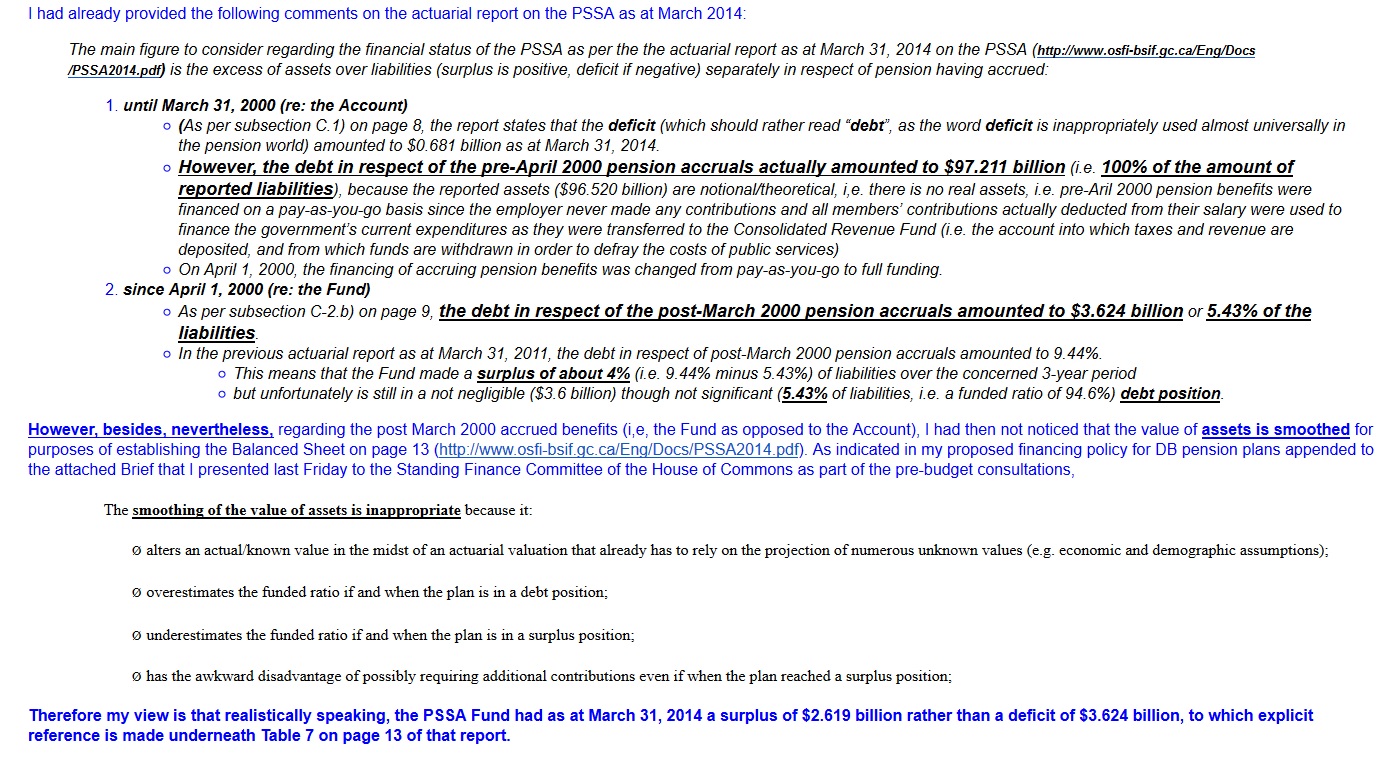
I asked Bernard Dussault, Canada’s former Chief Actuary, to provide me with his thoughts on the latest report on the PSSA as of March 2014 (click on image below to read his email response):

I thank Bernard for sharing his insights and I too am not a big fan of smoothing for the reasons he cites above.

In another major move, Quebec is shaking up pension landscape with shift to going-concern funding:

In a move that has drawn significant attention in the pension community, Quebec has introduced a potential solution to a major conundrum for employers: how to keep their costly defined benefit pension plans sustainable in the long run.

Under the new legislation, the province no longer requires defined benefit plans to fund themselves based on short-term assumptions about their own finances and market volatility. Instead, they now need to fund themselves based only on long-term, less conservative assumptions.

The law, which aims to reduce contribution volatility for employers and thus make defined benefit plans more sustainable, is the first of its kind in Canada.

“It will not necessarily encourage employers to shift back to defined benefit plans but it will curb the shift from defined benefit plans to defined contribution plans or at least slow it,” says Julien Ranger, a Montreal-based partner at Osler Hoskin & Harcourt.
Solvency requirement removed

Bill 57, which took effect on Jan. 1, removes the requirement to fund private defined benefit pension plans on a solvency basis. A valuation on the basis of solvency assumes the plan folds suddenly and looks at whether or not it holds enough assets to pay out all obligations accumulated until that time immediately.

Even before the change, Quebec’s public sector plans were for the most part exempt from the solvency- funding requirement. While certain pension plans in other parts of the country are also exempt from funding their solvency deficits, Quebec was the first province to introduce that exemption across the board.

Because the solvency valuation relies on current market conditions, when interest rates are low and markets are volatile — the way they’ve been recently — it has the effect of increasing plan liabilities and deficits.

Under the new rules, employers will have to fund their plans on a going-concern basis. A going-concern valuation assumes the plan will exist indefinitely and therefore lessens the impact of short-term market fluctuations on its funded status.

The new law is a positive development because it “will allow sponsors to use less conservative, more realistic long-term assumptions when they’re determining how much money to put in their plan,” says Ranger.

Cushion for bad times

As a trade-off for eliminating the need for solvency funding, employers will have to put money in a reserve even when they’ve fully funded their plans on a going-concern basis. The requirement is the law’s so-called stabilization provision aimed at helping pension plans withstand financial shocks.

“This reserve should provide a reasonable level of security even though we’re eliminating solvency,” says Ranger.

The size of the reserve will depend on each pension plan’s investment strategy. “The riskier your assets are, the larger the margin of the provision will be,” says Jason Malone, a Montreal-based partner at Aon Hewitt.

Other factors, such as the degree to which a plan’s assets and liabilities match, may also play a role in determining the reserve’s size, says Malone, noting more details will emerge soon.

Funding the reserve will increase costs for employers; however, according to Malone, the rationale behind the bill was never to trim expenses but rather to reduce the volatility of contributions.

The stabilization provision was a response to union concerns, says Malone. “The bill was a collaboration between the unions and the employers. The employers did not want the solvency [requirement] anymore, but the unions wanted protection as well.”

While the new law aims to reduce volatility, it may lead to higher employer contributions in some cases, says Malone. For example, a plan that isn’t fully funded on a going-concern basis may see an increase in contributions this year while a plan with a low solvency ratio but relatively high funding on a going-concern basis may see a decrease in contributions.

Lower employer contributions do present potential risks, however. If the employer goes bankrupt for some reason, there could potentially be less money in the plan than there would have been under the old rules, says Gavin Benjamin, senior consulting actuary at Willis Towers Watson.

“In other words, [if] the employer isn’t there to fund the deficit, then you’re looking at members potentially receiving reduced benefits,” says Benjamin, something he admits is a remote possibility.

Less frequent valuations

The new development also eliminates, at least in certain instances, the need for annual actuarial valuations.

If a plan is at least 90% funded on a going-concern basis on the date of the valuation, that appraisal will be good for three years, says Marco Dickner, a Montreal-based senior consultant and retirement practice leader at Willis Towers Watson. If the funded ratio is less than that, the plan sponsor will still have to file a valuation the following year.

The change gives sponsors more certainty because each time they get a new valuation, they’re subject to new employer contributions, says Dickner.

More surplus clarity

Another change introduced by the new law is a clarification of who has access to surplus funds resulting from excess employer contributions in the case of a plan windup.

The old law didn’t stipulate whether the employer or employees should get the surplus, meaning the issue could end up in court, says Dickner.

“The most likely scenario [was] that you would have to share the surplus with the employees. Employers had no incentive to put too much money because if something was to happen and they were to terminate their plan, access to that surplus was really uncertain.”

Now, employers will have easier access the surplus if the plan folds and the text allows for it, says Dickner.

When plans have a surplus on an ongoing basis, employers have the option of taking a break from making contributions, says Dickner. That was also true under the old rules.

Lower payouts to members

The new law also affects the minimum rights employees have when they leave their jobs and, therefore, their pension plans.

When employees leave the plan, they can choose to receive a lump sum reflecting the value they’ve accrued. Plan sponsors now have the option to pay the transfer value based on the solvency ratio of the plan. As a result, they no longer have to provide a 100% payout if the plan isn’t fully funded on a solvency basis, says Dickner. For example, if the plan is at 90% funding on a solvency basis, the employee will receive 90% of the commuted value.

That aspect of the law will affect even employers with plans registered outside of Quebec but that have some plan members in that province. That’s because the province of employment dictates minimum payout rights while the province of registration stipulates solvency funding rules, says Dickner.

Will other provinces follow suit?

As Quebec’s employers deal with the new law, Ontario is considering changes to its own pension rules.

The Ministry of Finance recently announced on its website that it “will initiate, on an expedited basis, a review of the current solvency funding rules for defined benefit pension plans, focusing on plan sustainability, affordability and benefit security. To provide private-sector sponsors with immediate assistance in the face of persistently low interest rates, the government intends to offer temporary solvency funding relief.”

But whether Ontario will follow Quebec’s lead and when that might happen is hard to predict, says Dickner.

Get a PDF of this article.

Bernard Dussault shared this with me: “What I see in the new Quebec pension valuation rules much pleases me, as it goes much along the lines of my proposed financing policy for DB plans, with the exception that it required the maintenance of a contingency reserve built from members’ contributions.”

I’m not sure about the pros and cons of Quebec’s new pension law. On the one hand it bolsters defined-benefit plans but it also allows employers to lower their pension contributions, which can be disastrous for employees if a company goes under.

Again, go back to read my comment on introducing real change to Canada’s pension plan, where I wrote the following:

In my ideal world, we wouldn’t have company pension plans. That’s right, no more Bell, Bombardier, CN or other company defined-benefit plans which are disappearing fast as companies look to offload retirement risk. The CPP would cover all Canadians regardless of where they work, we would enhance it and bolster its governance. The pension contributions can be managed by the CPPIB or we can follow the Swedish model and create several large “CPPIBs”. We would save huge on administrative costs and make sure everyone has a safe, secure pension they can count on for life.

Unless we get companies out of managing pensions and enhance the CPP (or QPP in Quebec) so that all Canadians working in the private sector are fully backstopped by the federal government when it comes to their pension (not their company’s fortunes), then all these changes to our laws governing pensions are merely cosmetic and will do nothing to bolster our retirement system.

As always, I welcome your feedback on these issues so feel free to email me at LKolivakis@gmail.com if you have anything to add.


Photo by  B Smith via Flickr CC License

Ontario Teachers Dumping PE Funds?

496px-Canada_blank_map.svg

Leo Kolivakis is a blogger, trader and independent senior pension and investment analyst. This post was originally published at Pension Pulse.

Yolanda Bobeldijk of Dow Jones Financial News reports, Ontario Teachers to offload $1bn private equity portfolio:

Toronto-based Ontario Teachers’ Pension Plan is preparing to sell a large private equity portfolio into the market for second-hand fund stakes, according to people familiar with the matter.

The portfolio is worth around $1 billion and consists of fund stakes in a range of private equity funds spread globally, the people said.

The $155 billion Canadian pension plan is speaking to a limited group of potential buyers. The process is at an early stage and no formal bids have been made yet.

A spokesman for Ontario Teachers’ declined to comment on the deal, but said in an emailed statement: “We regularly review our allocation of funds. We remain committed to investing in Europe via GP [general partner] allocation, co-investments and directly.”

As the private equity market continues to mature, many institutions have become active buyers and sellers in the secondaries market, which saw an annual volume of around $40 billion in 2015, according to secondary advisory firm Greenhill Cogent.

While just 14% of sellers in the secondaries market last year were public pension funds, they accounted for over 45% of the aggregate dollar volume in 2015, according to Greenhill Cogent’s Secondary Market Trends & Outlook report, which was published in January.

Ontario Teacher’s private equity investments totalled $21 billion at the end of 2014, compared with $14.8 billion at December 31, 2013, according to Ontario Teachers’ website.

After reading this comment, you might be wondering why is the Ontario Teachers’ Pension Plan trying to sell $1 billion of global private equity funds in the secondary market where it will sell these fund stakes at a deep discount? (also, how did this leak out?!?!)

A billion dollars represents just under 5% of Teachers’ private equity portfolio, so we’re not talking about peanuts even if it only represents 0.6% of the entire fund. The official reply was that Teachers regularly reviews its allocations to funds but there might be more to this move than meets the eye.

In particular, Ontario Teachers just stepped on a German land mine and will take a hefty $185 million writedown in its 28% stake in Maple Financial Group whose German subsidiary was shut down for illegal trading activity which was tax fraud.

While Teachers won’t publicly comment on this, I’m sure it had something to do with this decision. But that’s not the only thing. I think Ontario Teachers is increasingly worried about investing in private equity funds that charge hefty fees (even if it co-invests to bring fees down) and are not delivering the returns they used to.

In my humble opinion, Ontario Teachers is also sending a clear message to the market: it’s increasingly concerned about liquidity (or illiquidity) risk and it wants to raise cash in its private equity portfolio to weather the storm ahead.

Ron Mock, Teachers’ CEO, already sounded the alarm on alternatives back in April. More recently, we got wind that many large Canadian pensions are cooling on infrastructure, unwilling to bid up prices paid for mature infrastructure assets that are being bid up by global pension and sovereign wealth funds.

But we also recently learned that the Canadian federal government is courting Canada’s Top Ten pensions to help it invest in infrastructure and this too may be why Teachers is selling $1 billion in private equity stakes.

Why? Because given the choice of investing in infrastructure at a reasonable cost or doling out huge fees to private equity funds that are struggling for all sorts of reasons, and will continue to struggle as deflation sets in, Teachers is wisely selling fund stakes to bolster its liquidity and have cash at hand to invest in better alternatives in its private and public market portfolios.

In other news, India’s Snapdeal raised $200 million led by Ontario Teachers’ Pension Plan:

Indian online marketplace Snapdeal has raised $200 million in a fresh funding round led by Canada’s Ontario Teachers’ Pension Plan, the company said.

The latest fund-raising follows $500 million raised last August in a round led by Alibaba Group Holding, SoftBank Group Corp and Foxconn.

The e-commerce market in India is expected to grow to $220 billion in the value of goods sold by 2025, from an expected $11 billion this year, Bank of America Merrill Lynch said in a recent report.

Not sure about Snapdeal but India is one of the better emerging markets going forward and this could prove to be a great long term investment. But this too might explain why Teachers is selling $1 billion in PE funds stakes as these are significant investments ($185 M here, $200 M there, pretty soon you’re talking about real money!).

Again, these are all my observations. I have not spoken to Ron Mock or anyone else at Teachers so take everything I’ve written above as mere conjecture and nothing based on hard facts (nobody at Teachers will ever discuss this publicly).


Photo credit: “Canada blank map” by Lokal_Profil image cut to remove USA by Paul Robinson – Vector map BlankMap-USA-states-Canada-provinces.svg.Modified by Lokal_Profil. Licensed under CC BY-SA 2.5 via Wikimedia Commons – http://commons.wikimedia.org/wiki/File:Canada_blank_map.svg#mediaviewer/File:Canada_blank_map.svg
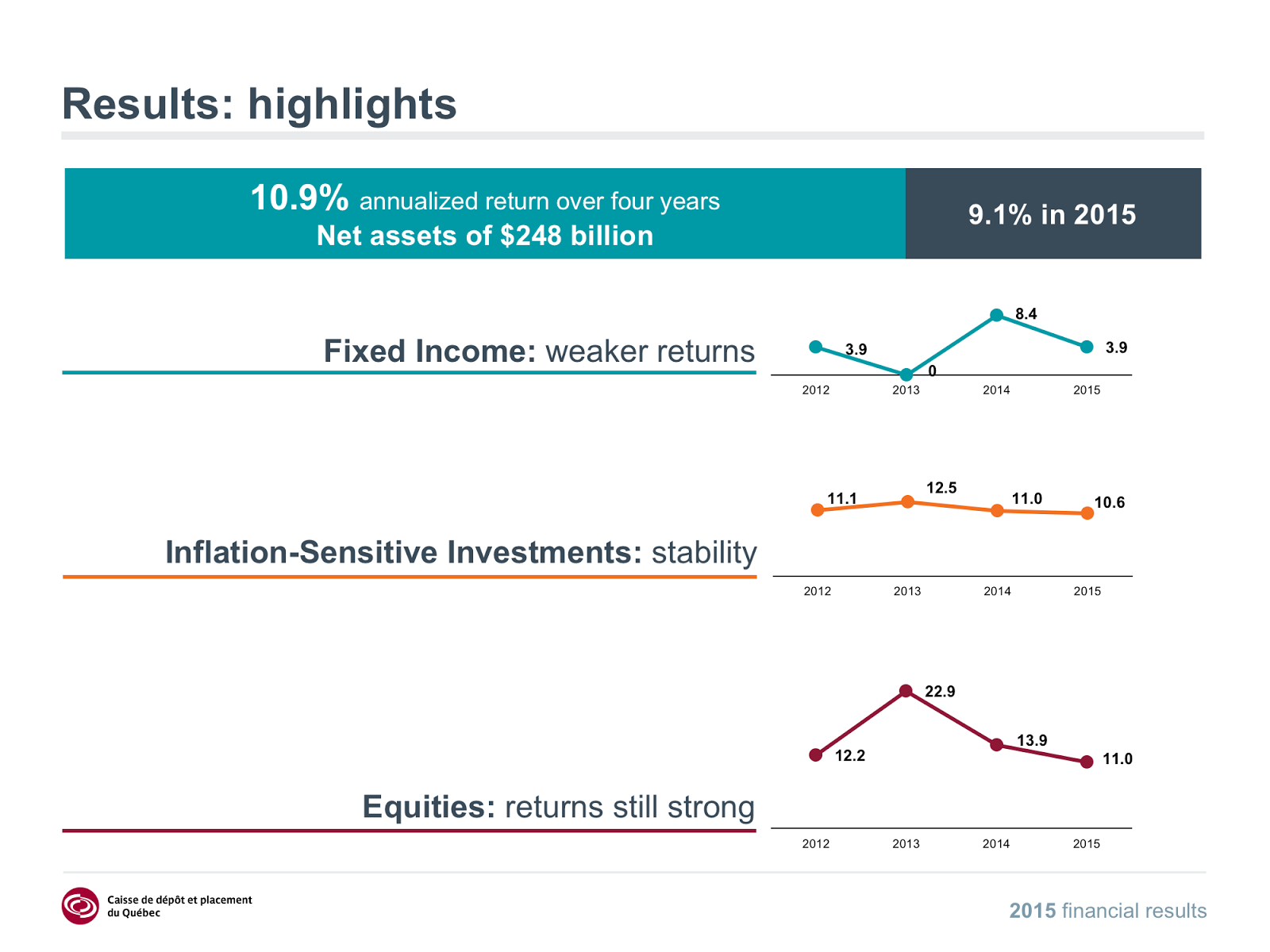
A Conversation on Pensions and Inequality

6924223634_74e709f616_o

Leo Kolivakis is a blogger, trader and independent senior pension and investment analyst. This post was originally published at Pension Pulse.

A couple of weeks ago I had a conversation with Gordon T. Long of the Financial Repression Authority on how financialization is causing inequality and limiting aggregate demand growth:

In this 45 minute video interview Leo Kolivakis discusses the importance of a good pension system with strong governance being critical in insuring the average persons retirement security. Pension liabilities are going up while bond yields are going lower which is going to create a huge amount of stress on pensions!

Contributory Pensions and 401Ks have proven to be a failure compared to Defined Benefits programs. History will eventually show that the transition from Defined Benefits to Contributory Benefits was in fact is detrimental to the global economy.

Structural Issues

Leo Kolivakis believes we have entered a period of long deflation due to six major structural issues:

  • The global jobs crisis
  • Aging demographics
  • The global pension crisis
  • Rising inequality
  • Technological Advances
  • High and unsustainable debt all over the world

Each of these structural factors is significantly contributing to global deflation. Together they are a domino effect, exacerbating deflationary headwinds in the world. They are causing rates to remain ultra low and will continue to for years to come.

I embedded our conversation below and thank Gordon Long for giving me another opportunity to discuss pensions, rising inequality and how it’s impacting aggregate demand.

Let me give you a little background on all this. For years, I’ve been arguing to prepare for global deflation. I still see a deflation tsunami coming our way but there is a huge battle going on as central banks desperately try to fight it off.

Right now, central banks are the only game in town and this is why we’re seeing negative interest rate policies springing up all over the world, all part of the new negative normal. Again, central banks are desperately trying to stoke inflation expectations to thwart deflation because once it becomes entrenched, it will be here for a very long period.

Negative bond yields and ultra low bond yields for years present serious challenges to individuals trying to retire on a fixed income and pensions trying to make their actuarial target rate of return. In effect, people will need to work longer to be able to retire and pensions will need to take increasingly more risk in private markets and hedge funds to make their bogey.

For individuals, I expect to see a rise in pension poverty. The brutal truth on defined-contribution plans is they’re simply not working and the inexorable global shift to DC plans will condemn millions to pension poverty, placing huge pressure on governments as social welfare costs soar.

In fact, this is already happening. New research from the Brooking’s Institute’s Barry Bosworth, Gary Burtless, and Kan Zhang finds evidence that some of Social Security’s progressivity is being offset due to a growing gap in life expectancy between the rich and the poor. Rising inequality among retired Americans is already impacting the United States of pension poverty where most Americans have little to no retirement savings and the great 401(k) experiment has failed them miserably.

In response, some private equity titans have peddled a solution to America’s retirement crisis which will effectively allow them to garner more assets so they can continue making off like bandits on fees. This is all part of America’s pension justice.

For its part, Congress is enabling the quiet screwing of America which is why we’re now seeing thousands of active and retired union workers at the Central States Pension Fund at risk of losing half their pension benefits.

Meanwhile, many state pensions are also at risk. Moody’s released some interesting data last month regarding the adjusted net pension liabilities of U.S. states. Bloomberg then spun that data into the chart below (click on image; h/t Pension 360):

Worse still, far too many states are delusional and still holding on to their pension rate-of return fantasy. I fear the worst for state pensions as global deflation sets in, decimating them and forcing them to come to grips with the fact that 8% will turn out to be more like 0% or lower in coming decade(s).

In her latest comment attacking CalPERS, Yves Smith of the naked capitalism blog notes:

This is just scary.

As those of you who follow the CalPERS soap opera may recall, California Governor Jerry Brown pushed for the giant pension fund CalPERS to lower its assumed investment return from 7.5% to 6.5%. Given that the world is headed towards deflation and that CalPERS earned only 2.4% for the fiscal year ended June 30, 2015, Brown’s request seemed entirely reasonable. Instead, the board approved a staff proposal to move to the 6.5% target over 10 years.

One of the things that is perverse about pension accounting is that the convention is that the liabilities, that is, what the pension fund expects to pay out over time, are discounted at the same rate as the assumed returns. However, for a government pension plan, where taxpayers are on the hook for any shortfalls, the risk of CalPERS beneficiaries getting their money is not the risk measured in terms of what CalPERS projects in terms of future employee contributions, expected returns, and expected payouts; it’s ultimately California state risk, which means the liabilities should be discounted at California’s long term borrowing rate. With California rated S&P AA3, Moody’s Aa-, and 20 year AA muni yields 2.75% and A at 3%, no matter how you look at it, the discount rate on the liability side is indefensibly high.

This matters on the estimation of liabilities because the lower the discount rate, the larger the amount (in current terms) that has to be paid out. Remember, this is the mirror image of “inflation can help bail out underwater borrowers” scenario. High discount rates erode the value of future commitments; low ones increase them. This is why we have been warning that ZIP and QE, which explicitly sets out to lower long-term interest rates, is a death sentence to long-term investors like life insurers and pension funds. And investors like CalPERS are trying to finesse that problem by continuing to pretend that they can earn a higher rate of return than is attainable without taking batshit crazy risks.

But even worse is the incomprehension about what is going on, as reflected in a statement by the president of CalPERS’ board, Robert Feckner. From the CalPERS website, State of the System 2016: Our Progress Toward a Sustainable Pension Fund:

The fact that our members are living longer is a sobering reminder that we have a growing obligation to provide for their pensions. Just a decade ago the ratio of active workers to retirees was over 2 to 1. That ratio is now 1.3 workers to every retiree, and we pay out more in benefits than we receive in contributions.

In response, our Board approved a policy designed to reduce the discount rate, our 7.5 percent assumed rate of return on investments, over time. The result will help pay down the pension fund’s unfunded liability and reduce risk and volatility in the fund.

Huh? This is utterly backwards. What will reduce CalPERS’ unfunded liability is higher contributions or higher earnings. A lower discount rate, while a reflection of current reality, exposes that it will be harder, not easier, to meet this objective.

The worst is that given the level of finance acumen I’ve seen after watching hours of Investment Committee hearings is that the odds are high that this is not an obfuscation misfire but evidence of an utter lack of understanding of finance basics. And worse is that CalPERS staff, which had to have reviewed this text, didn’t see fit to correct this glaring error. Do they also not get it or did they assume that beneficiaries were too clueless to catch it?

At the local and municipal level, the problems are even worse. The Financial Times just published an article on Philadelphia’s $5.7 billion ‘quiet crisis’ and these problems are going on all over U.S. where city, local and municipal pensions have been mismanaged for decades.

The central problem at U.S. public pensions remains governance, or more precisely, lack of proper governance. I wrote a comment for the New York Times back in 2013 discussing the need for independent, qualified investment boards that operate at arms-length from the government.

Instead, you have way too much political interference, and a bunch of underpaid public pension fund managers that are outsourcing investments to external asset managers, including hedge funds getting crushed and private equity funds that are way past their golden age.

[Interestingly, Bloomberg reports that two years after buying it, Carlyle Group LP will shut down its hedge fund-of-funds manager, Diversified Global Asset Management or DGAM of Toronto.]

And even though there are efforts to reduce fees of hedge funds and private equity funds, the sad truth is that quantitative easing, ultra low rates, negative rates and more volatility in public markets will force public pensions to increase their allocations to these alternative investment funds that have become nothing more than glorified asset gathers.

This is all part of the financialization of our economies. In my discussion with Gordon below, I recommend a book I’m currently reading by FT columnist and British economist John Kay, Other People’s Money. You can read the introduction here.

The two other books I just ordered on financialization of the economy are Michael Hudson’s, Killing the Host: How Financial Parasites and Debt Bondage Destroy the Global Economy (all of Michael’s books are must reads) and Gretta Krippner’s Capitalizing on Crisis: The Political Origins of the Rise of Finance.

But there is something else out there that a lot of authors examining inequality are not particularly aware of. Public pensions taking increasing risks in alternative asset classes are enriching a new class of hedge fund and private equity billionaires which then use their extraordinary wealth to fund Super PACs against progressive candidates like Bernie Sanders (Bernie should rework Bill Clinton’s old campaign slogan and turn it into “It’s about inequality, stupid”).  

Rising and perverse inequality is a huge problem and it’s deflationary. In his recent TED talk, Capitalism Will Eat Democracy, Greece’s now defunct former Minister of Finance Yanis Varoufakis talks about the twin peaks: the global glut of savings from billionaires and corporations hoarding cash and the debt crises that many nations face. 

In effect, he’s right, this mismatch is one reason why the structural unemployment rate of many developed nations remains stubbornly high. This is part of the global jobs crisis and pension crisis which is related to rising inequality. Of course, Varoufakis and Tsipras lacked the courage to implement real and much needed reforms in Greece which is why that country remains a basket case (after Brexit, Grexit will resurface this summer or later this year).

So what are the solutions to this? I talk about some solutions with Gordon, including bolstering well-governed defined-benefit plans, enhancing Social Security and modelling after the Canada Pension Plan Investment Board, introducing risk sharing in state plans, amalgamating local and municipal plans at the state level. I forgot to mention that we basically need to go Dutch on pensions all around the world.

I continue to defend well-governed defined-benefit plans and believe they are part of the solution to addressing rising inequality which threatens aggregate demand. The benefits of DB plans are greatly under-appreciated by everyone, including policymakers who lack a comprehensive vision of what the real problems are and how we can address them.

I also discussed the need to spend on infrastructure and how pensions which need yield can help cash strapped governments on revitalizing Canada’s and America’s crumbling infrastructure.

Below, take the time to listen to my conversation. As you can tell, I’m not really a “Skyper” and make a few mistakes here and there but the main message is there and I thank Gordon Long for giving me an opportunity to speak with him on these important issues which politicians tend to ignore.

I also embedded another recent interview I liked from the Financial Repression Authority, featuring another Greek, John Charalambakis, the Managing Director of Black Summit Financial Group, discussing risk mitigation and capital preservation. I don’t agree with everything he says but he’s extremely intelligent and this is a great interview.

Listen to us Greeks, we know a thing or two about where the world is heading. In all seriousness, I thank Gordon for this opportunity to speak on these issues and hope we can continue the conversation in the future. I’d also like to see other experts debate pension policies on his show in the future and forwarded him a list of people to talk with on this important and often ignored topic.

Canadian Pensions Defy Volatile Markets?

496px-Canada_blank_map.svg

Leo Kolivakis is a blogger, trader and independent senior pension and investment analyst. This post was originally published at Pension Pulse.

Reuters reports Canadian pension funds defy volatile markets to achieve 5.4% annual return in 2015:

Canadian pension funds achieved a return of 5.4 per cent on their investments in 2015 as their strategy of diversifying internationally helped mitigate volatile market conditions, research by RBC Investor & Treasury Services showed.

The research, which is the industry’s most comprehensive study of Canadian funds, showed they achieved a return of 3.1 per cent in the fourth quarter of 2015, following back-to-back losses in the second and third quarters.

The funds have pursued a strategy of directly investing in assets globally, including investments in infrastructure and real estate. Pension experts say that has provided them with a buffer against market volatility and challenging economic conditions.

“Canadian pension plans clearly benefited from global diversification portfolio strategies,” David Heisz, chief executive officer of RBC Investor Services Trust, said in a statement on Thursday.

Heisz said the positive 2015 performance could largely be attributed to a lift from global equities, offsetting downward pressure from weaker domestic sectors, particularly commodities, resources and energy over the course of the year.

Canada’s biggest 10 public pension funds now manage assets worth more than $1.1 trillion, having tripled in size since 2003, a study by the Boston Consulting Group showed in December.

You can view the press release on RBC’s quarterly analysis of Canadian pensions here as well as a lot more general material on RBC Investor & Treasury Services site.

The findings of the report confirm that Canada’s large well-governed DB pensions are able to navigate through volatile markets investing directly in public and private markets around the world.

And now that the federal government is courting Canada’s Top Ten to invest in greenfield infrastructure projects, there will be even more opportunities to escape volatile public markets which are here to stay in an ultra low rate/ low return/ highly volatile environment which even top funds find challenging.

In the next few weeks we will learn the 2015 performance on the Caisse, Ontario Teachers, OMERS and HOOPP. I expect it to be in the mid to high single digits but on average, I’m sure they all performed decently.

What’s interesting to note is that the 5.4% annual rate RBC is quoting is for all large Canadian DB pensions, not just Canada’s Top Ten mega pensions which now rank among the largest in the world.

How does this annual performance stack up relative to most Canadian balanced mutual funds? I will let you peruse through a few Canadian balanced funds here but with few exceptions, they all significantly underperformed the performance of large Canadian DB plans in 2015 and that doesn’t take into account fees.

There was however a notable exception, the Calgary-based Mawer Balanced Fund run by Greg Peterson, which gained 10.5% in 2015 and has been performing exceptionally well over the last three, five and ten years (click on image):

Also note the equity sector weights and asset mix of this balanced fund (click on image):

If I was a broker at a Canadian bank, I’d be shoving all my clients into this balanced fund. That is one solid low-cost performance over a very long period and note the internal benchmark they are using:

*5% FTSE TMX 91 Day T-Bill Index, 5% Citi World Government Bond Index, 30% FTSE TMX Canada Universe Bond Index, 15% S&P/TSX Composite Index, 15% S&P 500 Index (CAD), 15% MSCI EAFE Index (Net, CAD), 7.5% BMO Small Cap Index (Blended, Weighted) and 7.5% Russell Global Small Cap Index (Gross, CAD)

Most large Canadian pensions I cover on my blog would have a very hard time beating the Mawer Balanced Fund’s internal benchmark (h/t to Denis Parisien who introduced me to this fund yesterday over lunch; we both like Mawer’s philosophy on their logo: “Be Boring, Make Money”).

But the truth is Canada’s large well-governed DB plans are doing much better than most publicly available Canadian balanced funds, especially over a long period, and they are delivering this solid performance by investing in public and private markets directly.

We will soon find out just how Canada’s large DB plans performed in 2015. Earlier this month, CPPIB updated its quarterly performance for the third quarter of fiscal 2016 which ends on March 31st. I note the following from the press release:

For the nine month fiscal year-to-date period, the CPP Fund increased by $18.0 billion from $264.6 billion at March 31, 2015. This included $16.3 billion in net investment income after all CPPIB costs and $1.7 billion in net CPP contributions. The portfolio delivered a gross investment return of 6.3% for this period, or 6.1% net of all costs.

So, expect most of Canada’s Top Ten to deliver a comparable performance for 2015 to what CPPIB reported in its latest quarterly report with some minor variations due to the different fiscal year (in my opinion, CPPIB and PSP Investments should also report their calendar year net performance too so we can compare performance across funds).


Photo credit: “Canada blank map” by Lokal_Profil image cut to remove USA by Paul Robinson – Vector map BlankMap-USA-states-Canada-provinces.svg.Modified by Lokal_Profil. Licensed under CC BY-SA 2.5 via Wikimedia Commons – http://commons.wikimedia.org/wiki/File:Canada_blank_map.svg#mediaviewer/File:Canada_blank_map.svg

Ontario Delays Launch of ORPP?

496px-Canada_blank_map.svg

Leo Kolivakis is a blogger, trader and independent senior pension and investment analyst. This post was originally published at Pension Pulse.

Adrian Morrow of the Globe and Mail reports, Ontario to delay start of pension plan in bid to ease business fears:

Ontario is slowing down the start of its signature pension plan but speeding up the delivery of this year’s budget, two moves calculated to soothe the fears of business leaders amid an uncertain economy.

Big corporations will not have to start contributing to the Ontario Retirement Pension Plan (ORPP) until 2018, rather than 2017.

The budget, meanwhile, will come down on Feb. 25 – more than a month before the end of the fiscal year and more than two months earlier than the Liberal government’s three previous spending plans.

Finance Minister Charles Sousa made both announcements in a speech to the Empire Club on Tuesday.

He said he decided to move up the budget so businesses could see the government’s fiscal framework for the coming year as soon as possible, helping them better plan as the country rides an economic roller-coaster. For instance, the budget will implement a cap-and-trade system for carbon emissions starting in January, 2017; releasing the details early will give companies more time to prepare.

“We focus on a dynamic business environment, strategic infrastructure, investments in skills and training, all within a fair society,” Mr. Sousa said in his speech. “There are opportunities to be seized upon, but we need to act quickly.”

He later told reporters: “Our government is committed to creating a low-carbon economy through a cap-and-trade system. The budget will set the stage for Ontario to be a part of the 2017 carbon auction.”

The ORPP is one of Premier Kathleen Wynne’s legacy pieces. Funded by contributions from workers matched by their employers, it will return an average payment of $6,410 a year in retirement income if contributed to for 40 years.

Delaying the start of contributions for large corporations by a year will give them breathing space to sort out how they will make the payments. It will also mean some workers will receive slightly lower benefits in retirement as a consequence of missing one year of contributions. None of the other key dates for the plan’s rollout will change: Medium-sized companies will start contributing in 2018 and small businesses in 2019; the first benefits will be paid in 2022.

Karl Baldauf, vice-president of policy and government relations at the Ontario Chamber of Commerce, said the delay for big business is much-needed. The government has not yet done direct outreach to help companies set up ORPP payments, he said, and this has to happen to ensure the system is set up smoothly.

“You can’t reasonably expect to be collecting money from organizations who don’t know what their obligations will be,” he said in an interview. “We need education, registration, then implementation.”

The delay also gives the federal government and the other provinces more time to negotiate a possible enhancement to the Canada Pension Plan. A nationwide CPP expansion would help ensure Ontario firms aren’t put at a disadvantage by paying more in pension contributions. “We have agreed to enter into a national dialogue to enhance the Canada Pension Plan. To foster and accommodate this dialogue, we are extending the time required to comply with the ORPP,” Mr. Sousa said in his speech.

Dan Kelly, president of the Canadian Federation of Independent Business and an opponent of the ORPP, said he hoped Ontario would cancel the plan if the rest of the country agrees on a CPP enhancement.

“We’re hoping it’s the first step to delay or even rethink the ORPP,” he said. “It will allow the CPP discussion to take place to see what, if any, changes the government might consider to the ORPP program itself.”

But government sources said the Liberals are determined to push ahead with their pension plan. Even if the rest of the country reaches a deal on CPP by 2018, it could still take years to implement, and Ontario does not want to wait. The essential details of the ORPP – how much people and companies will pay into it and how much retirees will receive – are not going to change, the sources said.

If the rest of the country agrees to a CPP enhancement smaller than the ORPP, Ontario plans to merge the ORPP with CPP, but Ontarians would pay more into CPP and receive larger benefits than people in other provinces.

Are you confused with all this back and forth on the ORPP? I’m not. I still think it’s a “Wynning” pension strategy but obviously something is cooking in the background.

Importantly, politicians don’t delay a big bold pension policy unless there is a good reason to delay it. All this talk about giving big corporations more time to prepare sounds logical but more likely than not, it’s just a smoke screen. I think something is happening in the background on enhancing the CPP which is why Ontario is delaying the launch of the ORPP.

Why am I so sure? It was just a day ago when the federal government cleared the red tape on Ontario’s new pension plan. There’s definitely something cooking in the background here and the delay is not something that concerns me in the least.

I’ve said it before, and I’ll keep saying it. Ignore all the rubbish on the costly CPP and calls to cancel, not delay the ORPP. Until our politicians implement real change to Canada’s Pension Plan, and enhance the CPP once and for all despite the economic crisis headed our way, our retirement system will keep failing millions of Canadians staring at pension poverty. And this will jeopardize the long-term economic growth of our country and add to our debt profile.

There’s nothing to fear about enhancing the CPP or introducing another well-governed Canadian public defined-benefit plan. Politicians from all sides of the political spectrum should be agreeing on this, recognizing the brutal truth on DC plans as well as the benefits of DB plans.


Photo credit: “Canada blank map” by Lokal_Profil image cut to remove USA by Paul Robinson – Vector map BlankMap-USA-states-Canada-provinces.svg.Modified by Lokal_Profil. Licensed under CC BY-SA 2.5 via Wikimedia Commons – http://commons.wikimedia.org/wiki/File:Canada_blank_map.svg#mediaviewer/File:Canada_blank_map.svg

Ottawa Courts Pensions on Infrastructure?

Roadwork

Leo Kolivakis is a blogger, trader and independent senior pension and investment analyst. This post was originally published at Pension Pulse.

David Ljunggren and Matt Scuffham of Reuters report, Canada opens talks with pension funds on infrastructure funding:

The federal government is talking to the country’s largest pension funds about investing in billions of dollars worth of infrastructure projects to help stimulate the economy, the Infrastructure department told Reuters on Wednesday.

Prime Minister Justin Trudeau’s Liberals won an election in October on the back of a promise to run three consecutive annual budget deficits of up to $10-billion to help fund investment in infrastructure and will seek to boost that with private funding, sources told Reuters.

The funds are fiercely protective of their independence from political interference and would not be compelled to invest, but their backing for the projects would be a major boost for Mr. Trudeau.

“We are engaging pension funds and other potential partners to find areas of alignment,” a spokeswoman for Infrastructure Minister Amarjeet Sohi said. She did not give further details.

Executives at Canada’s pension funds, which are among the world’s biggest infrastructure investors, say that the projects will need to be structured in a way that limits the risk they take if they are to be lured into backing them.

Traditionally, funds such as the Canada Pension Plan Investment Board (CPPIB) have been reluctant to back “greenfield” projects, which are built from scratch, because of the risk they carry.

Funds usually prefer investing in “brownfield” infrastructure, projects that have already been constructed, executives said.

Mark Wiseman, chief executive of CPPIB, which has $283-billion in assets under management and invests on behalf of the federal plan that covers most working Canadians, told Reuters projects would need to have sufficient scale to be interesting, be overseen by a predictable regulatory regime and carry limited risk.

“That means projects where we are not going to have to take the build-out, greenfield-type risk because we’re not good at being able to assess those. There’s ways to structurally de-risk these opportunities for institutional investors,” he said.

Mr. Trudeau needs to find ways to boost Canada’s flagging economy, which has deteriorated more than expected since the Liberals came to power with economic growth fading, the dollar weakening and oil prices in free fall.

Bankers say private funding for the projects could amount to several times more than that coming from the public purse, and Canadian pension funds, already among the world’s biggest infrastructure investors, would be an obvious source of capital.

The CPPIB, the Caisse de dépôt et placement du Québec (Caisse), the Ontario Teachers’ Pension Plan and OMERS, the Ontario Municipal Employees Retirement System, are already among the top 10 infrastructure investors in the world.

One government source familiar with the matter said officials had also had conversations with institutional investors such as Brookfield Asset Management, as well as the major Canadian pension funds.

“We’ve talked to Teachers’, we’ve talked to Caisse, we’ve talked to OP Trust, we’ve talked to OMERS, we’re talking to CPPIB, most of the Canadian ones. I think the conversations have gone well and there’s lots of interest on both sides to find a way to partner,” the source said.

The source said the talks were exploratory and specific projects had not yet been discussed. Officials have sought advice on setting up the Canada Infrastructure Bank, which Mr. Trudeau had talked about creating during the election campaign to provide low-cost financing for infrastructure projects.

“Our conversations with the federal government have centered around what pension plans, like ours, look for in an infrastructure investment,” OP Trust CEO Hugh O’Reilly said.

The other funds and Brookfield declined to comment.

It is not yet clear if the plans will be announced in next month’s budget and no decisions had yet been taken on how much money will be raised from private investors, sources say.

The Caisse said last year that it would finance, develop and operate major infrastructure projects for the cash-strapped province of Quebec and hoped to pursue other projects internationally.

Executives say the Liberal government is right to invest in infrastructure, believing that monetary policy has exhausted its ability to stimulate the economy.

“Infrastructure makes economies more productive, it gives you more opportunities to grow. Monetary policy is not going to get us out of this slope we’re on,” a senior executive at one of Canada’s biggest three pension funds said.

Last Friday, I wrote a long comment on how Canadian pensions are cooling on infrastructure, quoting senior executives at Canada’s large pensions bemoaning the pricing on many infrastructure investments around the world.

Now we find out that Ottawa has been in discussions (read: please help us!!) with Canada’s large pensions to help them with their plan to invest billions rebuilding Canada’s infrastructure.

This is a smart move on the part of the federal government, a very smart move. I’ll briefly share some of my thoughts below:

  • Canada’s large pensions are indeed among the world’s biggest investors in infrastructure. They’ve been directly investing in infrastructure over many years.
  • Infrastructure is increasingly becoming one of the most important asset classes for Canada’s Top Ten. Why? Just look at what’s going on around the world. Sweden’s central bank pushed rates further into negative territory and the yield on the U.S. 10-year Treasury bond hit a low of 1.57% on Thursday morning as stock markets around the world plunge. The rising prospect of the new negative normal and ultra low rates for years is going to make it that much more difficult for Canadian and global pensions to make their actuarial return objective. In light of this, Canadian pensions are investing in infrastructure as a substitute to bonds, offering them a relatively safe yield between bonds and stocks over a very long period (in finance parlance, the long duration of infrastructure assets is a better match to pensions’ long dated liabilities).
  • Infrastructure assets, however, carry their own set of risks. Among these risks are illiquidity risk, currency risk, regulatory and political risks. All these risks (except of course illiquidity) can be mitigated by investing in domestic infrastructure projects.
  • Now, the type of infrastructure projects the federal government is talking about are greenfield, not brownfield which are already operating and have known cash flows. These greenfield projects carry their own set of additional risks like wrong cash flow projections, economic cycle risks, corruption, fraud, etc., but if done correctly using PPPs or using the expertise of a Canadian pension fund team with deep operational experience, these type of greenfield infrastructure investments offer very attractive returns for taking such development risks.
  • In Canada, OMERS Borealis is a world leader in developing infrastructure investing as an asset class for institutional investors. But there are others like Ontario Teachers’, the Caisse, CPPIB, PSP Investments, AIMCo which are huge direct investors in global infrastructure.
  • The thing that’s striking, however, is that most of the people running or working at infrastructure groups at Canada’s Top Ten have no operational experience whatsoever in terms of setting up an infrastructure project or running an infrastructure asset. They typically have an investment banking background and are great deal makers but they know very little about what it takes to operate an infrastructure investment. That works great when things are going well but when they turn south, you need people who know how to operate an infrastructure asset. And with few exceptions, these people are very scarce at Canada’s Top Ten. Instead, you have a bunch of deal makers bidding up prices of global brownfield infrastructure investments (they talk about ‘being disciplined’ but that’s what they all do).
  • I mention this because the article above cites CPPIB’s Mark Wiseman stating they avoid build-out, greenfield-type risk. No kidding, CPPIB is a prime example of what I’m talking about. I even sent a resume of a friend of mine to both Mark Wiseman and Ontario Teachers’ CEO Ron Mock, someone with actual operational experience and nothing came out of that. Instead, the Caisse had the brains to hire him and he’s very happy there working on greenfield infrastructure projects. When the shit hits the fan on infrastructure assets, you need people with actual operating experience to tell you how to manage those assets properly.
  • The article above also discusses governance and how Canada’s public pensions are fiercely independent. True, Canada’s large public pensions operate at arm’s length from the federal government but make no mistake, they need the federal government as much as the federal government needs them. Also, in the case of CPPIB and PSP Investments, if they don’t play nice, the federal government can make their lives miserable even if it’s not directly involved in the day to day operations of their funds.
  • But right now, there is no acrimony. I think everyone is on the same page. The federal government needs to get going on its massive infrastructure spending to mitigate the effects of a deep recession and Canada’s Top Ten need to invest in massive, scalable infrastructure projects to fight the scourge of ultra low bond yields for years to come. The discussions are taking place at a high level and I’m sure they’re constructive. If this is done right, it will be a major victory for everyone: the federal government, Canada’s Top Ten, Canadian pensioners, and most importantly Canadians looking for work to provide for their families.

Those are my thoughts in a nutshell. Are there other issues worth considering? Of course, like will the federal government use the expertise of private investors like Brookfield Asset Management and will it also court international pensions and sovereign wealth funds to invest in these greenfield projects?

That all remains to be seen. The good news is Canada has some of the best infrastructure investors in the world and they will be able to offer the federal government some very sound advice as it carries out its much needed spending on Canada’s infrastructure.

By the way, you should all read Canada’s infrastructure report card. Just like in the United States, there is a desperate need to fix our crumbling infrastructure and we need private and public partnerships to do this properly and at the most reasonable cost.

It’s also worth remembering that infrastructure jobs pay decent wages and have an important multiplier effect in the economy. More importantly, investing in infrastructure is a smart way of investing in the long-term prosperity of our country. And unlike the U.S., in Canada there’s a lot less political dysfunction when it comes to big spending projects, especially now that the Liberals swept into power (if only they got on to enhancing the CPP too!).

As always, if you have anything to add, feel free to reach out to me at LKolivakis@gmail.com. And if our Prime Minister has time, the next time he’s in Montreal, I’d be happy to meet up with him, my brother who he knows well from his high school years and my friend to discuss all this and much more, off the record, of course.


Photo by Kyle May via Flickr CC License

Ontario Teachers’ Pension Steps on a German Land Mine?

496px-Canada_blank_map.svg

Leo Kolivakis is a blogger, trader and independent senior pension and investment analyst. This post was originally published at Pension Pulse.

Barbara Shecter of the National Post reports, National Bank to write off $165-million investment after Germany shuts down Maple Bank:

National Bank of Canada will take a writedown of $165 million, which represents the full carrying value of its investment in Canadian trading and securities lending firm Maple Financial Group, after authorities in Germany shut down Maple’s business activities there over the weekend.

On Monday, a spokesperson for the Ontario Teachers’ Pension Plan, another minority investor in Maple, said the pension manager is “assessing the current situation,” which stems from an investigation launched last fall into alleged trading-related tax fraud at Maple’s German subsidiary.

Both Teachers’ and National Bank have pledged to repay dividends they received if the allegations are proven.

Montreal-based National Bank has a 24.9 per cent equity interest in Maple Financial Group, a private firm.

“National Bank has advised the German authorities that if it is determined portions of dividends received from Maple Financial Group Inc. could be reasonably attributable to tax fraud by Maple Bank, arrangements will be made to repay those amounts to the relevant authority,” National Bank said in a statement.

Deborah Allen, vice-president of communications at Teachers, said the pension manager “entered into a dialogue with the relevant authorities and gave assurances” about potential dividend repayments “immediately upon becoming aware of the allegations against employees of Maple Bank last fall.”

According to National Bank, which raised $300 million through an equity issue in October and signaled it would be taking action regarding the value of its holding in Maple, the investigation involves “selected trading activities by Maple Bank, and some of its current and former employees” during the 2006 to 2010 tax years.

“The German authorities have alleged that these trading activities violated German tax laws,” National Bank said in a statement, adding that neither National Bank nor its employees were involved in the trading activities, nor are they understood to be the subjects of the investigation.

Rob Sedran, an analyst at CIBC World Markets Inc., said National Bank’s equity raise last fall suggested the write down of its Maple holding “would be required at some point.”

In a note to clients Monday, Sedran said the impact on National Bank after the first-quarter charge should be “immaterial as Maple Financial was contributing less than one per cent to the bank’s earnings.”

According to Sedran, Maple’s businesses include collateralized asset-based lending, credit derivatives, and proprietary trading.

Maple Financial Group is unrelated to Maple Acquisition Group, which bought the TMX in 2012.

Doug Alexander of Bloomberg also reports, National Bank Takes $119 Million Writedown on Maple Bank:

National Bank of Canada said it will write off the full C$165 million ($119 million) carrying value of its stake in Maple Financial Group Inc. after that company’s operations in Germany were limited by regulators amid a tax probe.

The writedown will be included in fiscal first-quarter results reported on Feb. 23, cutting National Bank’s common equity Tier 1 ratio by about 13 basis points, the Montreal-based lender said Sunday in a statement. National Bank, which signaled in October that such a reduction was possible, owns 24.9 percent of Maple Financial, parent of Maple Bank GmbH.

“Beyond the charge this quarter, the earnings impact should be immaterial as Maple Financial was contributing less than 1 percent to the bank’s earnings,” Robert Sedran, an analyst with CIBC World Markets, said in a note to clients. “With no lasting earnings impact, there should be no lasting valuation impact either.”

Shares of National Bank fell 2.5 percent to C$38.83 at 9:54 a.m. in Toronto, the worst performance in the eight-company Standard & Poor’s/TSX Banks Index. The shares have slid 3.7 percent this year.

Tax Probe

Germany’s BaFin financial-services regulator said earlier Sunday that it’s limiting Maple Bank GmbH’s activities on concern the business faces over-indebtedness in the midst of the tax probe. Barbara Fuchs, a spokeswoman for Maple Bank in Frankfurt, said the company can’t comment on investigations.

“These events result from ongoing investigations launched by German authorities in September 2015 focusing on selected trading activities by Maple Bank, and certain of its current and former employees,” National Bank said Sunday. “None of National Bank of Canada and its employees were involved in these trading activities, nor to our knowledge is National Bank of Canada or any of our employees the subject of these investigations.”

Maple Financial is a closely held company based in Canada, whose shareholders also include Ontario Teachers’ Pension Plan, with a 28 percent stake, according to its website. The firm, which was formed in 1986, has more than 260 employees in Toronto, Frankfurt, London and Jersey City, New Jersey, among other locations. Its units include a German bank with branches in Canada and the Netherlands, and broker-dealers in Canada, the U.S. and U.K.

Deborah Allan, a spokeswoman for Toronto-based Ontario Teachers’, said the pension fund has discussed the allegations against Maple Financial with officials, and is “continuing to assess the current situation.”

Maple Bank GmbH has been in business since 1994 and deals in equity and fixed-income trading, repos and securities lending, as well as structured products and institutional sales, according to its website.

Arno Schuetze and Alexander Hübner of Reuters also report, Financial watchdog closes German unit of Canada’s Maple Financial:

German financial watchdog Bafin on Sunday closed the German operations of Canada’s Maple Financial on impending financial over-indebtedness related to tax evasion investigations.

In September, German prosecutors searched offices and residences linked to Maple Bank in a probe of serious tax evasion and money laundering connected to so called dividend stripping trades.

The trades involve buying a stock just before losing rights to a dividend, then selling it, taking advantage of a now-closed legal loophole that allowed both buyer and seller to reclaim capital gains tax.

Bafin said in a statement that once Maple Bank made some necessary tax provisions, over-indebtedness loomed.

Maple Bank said in a separate statement that the requested tax provisions are connected to the ongoing investigations into dividend stripping trades carried out between in 2006 to 2010.

A Maple Bank spokeswoman declined to comment on the amount of the necessary provisions.

German daily Sueddeutsche Zeitung reported on Sunday that Frankfurt prosecutors allege that Maple Bank and its business partners have bilked the taxpayer of some 450 million euros.

The bank has an equity capital of just 300 million euros.

Bafin said in a statement that the lender with 5 billion euros ($5.58 billion) in assets posed no threat to the financial stability of the country.

Despite its small size, Maple Bank shot to fame in Germany in 2008, when the lender helped Porsche in its takeover attempt of Volkswagen, which eventually led to the acquisition of the sports car maker by Europe’s leading car manufacturer.

Maple Bank specialises in equities and derivatives trading and as of Feb. 4 had 2.6 billion euros in liabilities mainly with institutional clients.

Bafin said it has barred Maple Bank from continuing its business to safeguard its assets.

While deposits of up to 100,000 euros are safeguarded by Germany’s deposits protection scheme, up to 60 million euros per client will be covered by Germany’s banking association’s guarantee fund if Bafin declares the bank an indemnification case, a spokesman for the bank lobby group said on Sunday.

Maple Bank is owned among others by the National Bank of Canada and the Ontario Teachers’ Pension Plan.

There were warnings that something was brewing with Maple Financial’s German subsidiary in October last year when Ross Marowits of the Canadian Press reported, Teachers’ Pension Plan, National Bank watching legal problems facing Maple investment:

Legal problems facing the European subsidiary of Maple Financial Group is creating uncertainty for two of its largest investors — the Ontario Teachers’ Pension Plan and the National Bank of Canada.

National Bank (TSX:NA) says its investment — which had a carrying value of $165 million as of Aug. 31 — was at risk for big losses because of allegations of tax irregularities between 2006 and 2010 in Germany against Maple Bank GmbH.

“Given the seriousness of the reported allegations and the actions which may be taken by German regulatory authorities . . . National Bank considers its investment at risk of substantial loss,” Canada’s sixth-largest bank said in a news release.

The bank holds a 24.9 per cent interest in Toronto-based Maple, just behind the 28 per cent state held by Teachers’, the country’s third-largest pension fund manager.

Vancouver’s Chan family owns 29 per cent, while Maple management and employees hold 13 per cent, with the remaining five per cent scattered among a number of investors, according to Maple’s financial report.

Teachers spokeswoman Deborah Allan said the fund manager was “closely monitoring any developments, but (we) are not commenting on the investment.”

Maple Financial Group is unrelated to Maple Acquisition Group, which bought the TMX in 2012.

Founded in 1986, Maple Financial changed its name in 1997 from Financial Products Group of First Marathon Inc. It had 3.75 billion euro of net assets as of Sept. 30, 2014.

The Office of the Superintendent of Financial Institutions (OSFI), which regulates federally registered banks, trusts and private pension plans, said it was aware of Maple’s situation but was not permitted by legislation to say if it was investigating.

National added Maple in 1999 as part of its $712-million acquisition of brokerage firm First Marathon. It was merged with National subsidiary Levesque Beaubien Geoffrion Inc. to form National Bank Financial.

The bank issued the warning about its Maple investment Thursday afternoon as it announced a restructuring that will see the elimination of several hundred jobs, mainly in Quebec.

It also announced that it expects to raise $300 million in gross proceeds after issuing 7.16 million shares to a syndicate of underwriters led by National Bank Financial.

“In an environment of low economic growth and high technological transformation, we feel that additional efforts to improve efficiency and processes, as well as adding to our excess capital cushion, are the right steps to take,” said CEO Louis Vachon.

The bank said Maple contributed less than one per cent to its annual profits in each of the last two years. A full writedown would reduce its Tier 1 capital ratio by about 13 basis points.

What are my thoughts on all this? First, this isn’t something that looks good for the National Bank or Ontario Teachers’ Pension Plan. Both these organizations pride themselves on “cutting edge due diligence” on external hedge funds but they obviously weren’t monitoring the operations at this German subsidiary very closely.

Second, the National Bank says none of their Canadian employees were involved with these trading activities but if they had any knowledge of what was going on, there could be legal ramifications (ie., heavy fines) in the future. Right now, it’s an $165 million write down and 13 basis points off its Tier 1 capital, which is a hit but nothing the bank can’t handle. However, if Bafin proves that the National Bank was aware of these trading activities and turned a blind eye to these trades, it could impose additional fines.

Third, this is the type of stuff that keeps the board of Ontario Teachers’ up at night. OTPP’s chairman of the board, Jean Turmel, was previously  president of Financial Markets, Treasury and Investment Bank at the National Bank and he knows its CEO Louis Vachon extremely well (they’re friends). I can guarantee you there are a lot of tough questions being asked at Teachers’ and the National Bank in regards to this screw-up.

Fourth, Ontario Teachers’ CEO Ron Mock knows all about harsh hedge fund lessons due to operational blowups. The last thing he needed was to find out news of shady tax evasion going on at the German subsidiary of a company Ontario Teachers’ owns a 28% stake in. That $185 million write down is going to hurt Teachers’ value added in 2016 and that is a huge sum to lose in a brutal environment where every basis point counts.

Now, it’s entirely possible and very likely that Louis Vachon, Ron Mock, Jean Turmel and the rest of the employees at the National Bank and Ontario Teachers’ had no idea of what was going on at Maple Financial’s German subsidiary. This beckons the question: What did Maple Financial’s senior managers in Toronto know and how did they not discover this illegal trading earlier? This is a huge operational screw-up on their part.

I met with representatives of Maple Financial a long time ago in Toronto. I thought very highly of them but it goes to show you even the most sophisticated shops drop the ball at times and this certainly doesn’t look good for them, the National Bank or Ontario Teachers.

And just to be clear, every major bank in Canada has had issues in the past. Some of them we hear about, others are brushed under the carpet. It took me less than 30 minutes to figure out Norshield Financial was a Ponzi scheme back in 2002 and yet the Royal Bank was allowing brokers to invest in this laughable “fund of funds” back then. What a joke!

This case should serve as a wake-up call to all the banks and Canadian pension funds investing in businesses. When you invest in businesses, you invest in people and you better make sure their operations are kosher because if they’re not, you’re in for a nasty surprise down the road.

Another thing that crossed my mind as I was writing this comment was whether German tax authorities wanted to stick it to Canadian banks and pension funds following PSP’s skirting of foreign taxes which embarrassed the Canadian federal government and German tax authorities. Trust me, I’m sure that had something to do with all this even though Germany’s Bafin will deny it.

Lastly, please note apart from naming Graven Larsen as its new CIO, Ontario Teachers’ recently made some important changes to its senior managers. You can read about these changes here.

Also, Ron Mock appointed Barbara Zvan to Senior Vice-President, Strategy & Risk and Chief Investment Risk Officer. Ms. Zvan reports to the CEO and leads the Strategy & Risk team in supporting the Plan Sponsors in plan design decisions and the Board in determining appropriate benchmarks and risk appetite. In addition, Ms. Zvan drives the responsible investing and climate change risk management and strategy for the Plan.

Teachers’ even posted a nice picture of Barbara Zvan, all smiles:

I’ve never met her (just spoke to her once) but have heard nothing but good things about her and Wayne Kozun from Leo de Bever. This also shows that just like CPPIB, OTPP is taking gender diversity seriously, but it too needs to do a lot more in terms of workplace diversity at all levels of the organization, and start hiring disadvantaged groups like people with disabilities.

Trust me, despite what Jean Turmel told me once, people with disabilities work just as hard, if not harder to overcome prejudices, and they can handle the stress of trading these crazy schizoid markets! (Still, Turmel was right about one thing, always manage your downside risk!!).

Was Barbara Zvan responsible for knowing what was going on at Maple Bank in Germany? Of course not but somebody somewhere dropped the ball and I’m blaming Maple’s Toronto office more than anyone else.

But one thing is for sure, this is the last thing Ontario Teachers’ or the National Bank needed to deal with at a time when markets are brutal and every gain or loss has an impact on the bottom line.


Photo credit: “Canada blank map” by Lokal_Profil image cut to remove USA by Paul Robinson – Vector map BlankMap-USA-states-Canada-provinces.svg.Modified by Lokal_Profil. Licensed under CC BY-SA 2.5 via Wikimedia Commons


Deprecated: Function get_magic_quotes_gpc() is deprecated in /home/mhuddelson/public_html/pension360.org/wp-includes/formatting.php on line 3712