CalPERS Gets Real on Future Returns?

Leo Kolivakis is a blogger, trader and independent senior pension and investment analyst. This post was originally published at Pension Pulse.

Randy Diamond of Pensions & Investments reports, CalPERS balancing risks in review of lower return target:

The stakes are high as the CalPERS board debates whether to significantly decrease the nation’s largest public pension fund’s assumed rate of return, a move that could hamstring the budgets of contributing municipalities as well as prompt other public funds across the country to follow suit.

But if the retirement system doesn’t act, pushing to achieve an unrealistically high return could threaten the viability of the $299.5 billion fund itself, its top investment officer and consultants say.

“Being aggressive, having a reasonable amount of volatility and (being) wrong could lead to an unrecoverable loss,” Andrew Junkin, president of Wilshire Consulting, the system’s general investment consultant, told the board at a November meeting. CalPERS’ current portfolio is pegged to a 7.5% return and a 13% volatility rate.

The chief investment officer of the California Public Employees’ Retirement System and its investment consultants now say that assumed annualized rate of return is unlikely to be achieved over the next decade, given updated capital market assumptions that show a slow-growing economy and continued low interest rates.

Still, cities, towns and school districts that are part of the Sacramento-based system say they can’t afford increased contributions they would be forced to pay to provide pension benefits if the return rate is lowered.

A decision could come in February.

Unlike other public plans that have leaned toward modest rate of return reductions, a key CalPERS committee is expected to be presented with a plan in December that’s considerably more aggressive.

That was set in motion Nov. 15 at a committee meeting when Mr. Junkin and CalPERS CIO Theodore Eliopoulos said 6% is a more realistic return over the next decade.

At that meeting, it also was disclosed that CalPERS investment staff was reducing the fund’s allocation to equities in an effort to reduce risk.

Only a year earlier, CalPERS investment staff and consultants had agreed that CalPERS was on the right track with its 7.5% figure. So confident were they that they urged the board to approve a risk mitigation plan that did lower the rate of return, but over a 20-year period, and only when returns were in excess of the 7.5% assumption.

Two years of subpar results — a 0.6% return for the fiscal year ended June 30 and a 2.4% return in fiscal 2015 — reduced views of what CalPERS can earn over the next decade. Mr. Junkin said at the November meeting that Wilshire was predicting an annual return of 6.21% for the next decade, down from its estimates of 7.1% a year earlier.

Indeed, Mr. Junkin and Mr. Eliopoulos said the system’s very survival could be at stake if board members don’t lower the rate of return. “Being conservative leads to higher contributions, but you still have a sustainable benefit to CalPERS members,” Mr. Junkin said.

The opinions were seconded by the system’s other major consultant, Pension Consulting Alliance, which also lowered its return forecast.

Shifting the burden

But a CalPERS return reduction would just move the burden to other government units. Groups representing municipal governments in California warn that some cities could be forced to make layoffs and major cuts in city services as well as face the risk of bankruptcy if they have to absorb the decline through higher contributions to CalPERS.

“This is big for us,” Dane Hutchings, a lobbyist with the League of California Cities, said in an interview. “We’ve got cities out there with half their general fund obligated to pension liabilities. How do you run a city with half a budget?”

CalPERS documents show that some governmental units could see their contributions more than double if the rate of return was lowered to 6%. Mr. Hutchings said bankruptcies might occur if cities had a major hike without it being phased in over a period of years. CalPERS’ annual report in September on funding levels and risks also warned of potential bankruptcies by governmental units if the rate of return was decreased.

If the CalPERS board approves a rate of return decrease in February, school districts and the state would see rate increases for their employees in July 2017. Cities and other governmental units would see rate increases beginning in July 2018.

Any significant return reduction by CalPERS, which covers more than 1.5 million workers and retirees in 2,000 governmental units, would cause ripples both in and outside the state. That’s because making such a major rate cut in the assumed rate of return is rare.

Mr. Eliopoulos and the consultants are scheduled to make a specific recommendation on the return rate at a Dec. 20 meeting. But they were clear earlier this month that they feel the system won’t be able to earn much more than an annualized 6% over the next decade.

Gradual reductions

Thomas Aaron, a Chicago-based vice president and senior analyst at Moody’s Investors Services, said in an interview that many public plans have lowered their return assumption because of lower capital market assumptions and efforts to reduce risk. But Mr. Aaron said the reductions have happened “very gradually, it tends to be in increments of 25 or 50 basis points.”

Statistics from the National Association of State Retirement Administrators show that 43 of 137 public plans have lowered their return assumption since June 30, 2014. But NASRA statistics show only nine plans out of 127 are below 7% and none has gone below 6.5%.

“CalPERS is the largest pension system in the country; definitely if CalPERS were to make a significant reduction, other plans would take notice,” said Mr. Aaron.

Mr. Aaron said it would be hard to predict whether other public plans would follow. While there has been a general trend toward reduced return assumptions given capital market forecasts, some plans are sticking to higher assumptions because they believe in more optimistic longer-term investment return forecasts.

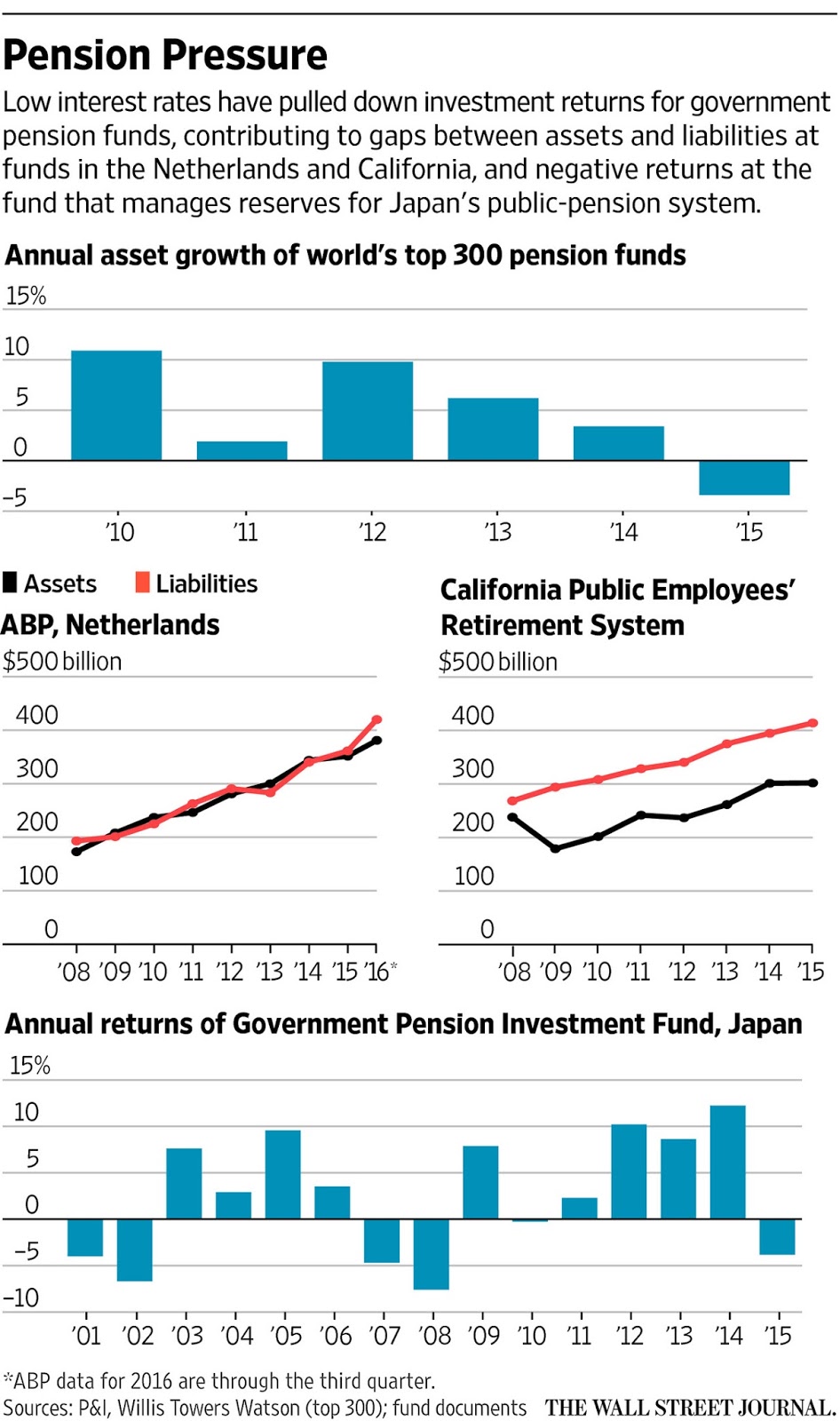
Compounding the problem is that CalPERS is 68% funded and cash-flow negative, meaning each year CalPERS is paying out more in benefits than it receives in contributions, Mr. Junkin said. CalPERS statistics show that the retirement system received $14 billion in contributions in the fiscal year ended June 30 but paid out $19 billion in benefits. To fill that $5 billion gap, the system was forced to sell investments.

CalPERS has an unfunded liability of $111 billion and critics have said unrealistic investment assumptions and inadequate contributions from employers and employees have led to the large gap.

Previously, CalPERS officials had said that any return assumption change would not occur until an asset allocation review was complete in February 2018. But Mr. Eliopoulos on Nov. 15 urged the board to act sooner, saying the U.S. could be in a recession by that date.

Richard Costigan, chairman of CalPERS finance and administration committee, said in an interview that he expects a recommendation and vote by the full board meeting in February, adding there is no requirement to wait until 2018 to consider the matter.

Some board members at the Nov. 15 meeting said CalPERS was moving too fast to implement a new assumption. “I’m a little confused at the panic and expediency that you guys are selling us right now,” said board member Theresa Taylor. “I think that we need to step back and breathe.”

But other board members suggested CalPERS needs to take immediate action even if it is uncomfortable.

Already adjusting

In a sense the system already has. Even without a formal return reduction, members of the investment staff have embarked on their own plan to reduce overall portfolio risk by reducing equity exposure, a policy supported by the board.

Mr. Eliopoulos said Nov. 15 that a pitfall of CalPERS’ current rate of return is the need to invest heavily in equities, taking more risk than might be prudent. He also said the system was reviewing its equity allocation.

The system’s latest investment report, issued Aug. 31, shows equity investments made up 51.1% or $155.4 billion of the system’s assets, down from 52.7% or $160 billion as of July 30 and down from 54.1% in July 2015.

CalPERS took $3.8 billion of the $4.6 billion in equity reduction and increased its cash position and other assets in its liquidity asset class. Liquidity assets grew to $9.6 billion as of Aug. 31 from $5.8 billion at the end of July.

But an even bigger cut in the equity portfolio occurred after the September investment committee meeting, when board members meeting in closed session reduced the allocation even more, sources said. It is unclear how big that cut was, but allocation guidelines allow equity to be cut to 44% of the total portfolio.

Board member J.J. Jelincic at the Nov. 15 meeting disclosed the new asset allocation was made at the September meeting closed session. But Mr. Jelincic said based on revisions the board approved in the system’s asset allocation, he felt the most CalPERS could earn was 6.25% a year because it was not taking enough risk.

Mr. Jelincic did not disclose the new asset allocation but said in an interview: “We are taking too little risk and walking away from the upside by not investing more in equities.”

So, CalPERS is getting real on future returns? It’s about time. I’ve long argued that US public pensions are delusional when it comes to their investment return assumptions and that if they used the discount rates most Canadian public pensions use, they’d be insolvent.

And J.J. Jelincic is right, taking too little risk in public equities is walking away from upside but he’s not being completely honest because when a mature pension plan with negative cash flows the size of CalPERS is underfunded, taking more risk in public equities can also spell doom because it introduces a lot more volatility in the asset mix (ie. downside risk).

When it comes to pensions, it’s not just about taking more risk, it’s about taking smarter risks, it’s about delivering high risk-adjusted returns over the long run to minimize the volatility in contribution risk.

Sure, CalPERS can allocate 60% of its portfolio to MSCI global stocks and hope for the best but can it then live through the volatility or worse still, a prolonged recession and bear market?

This too has huge implications because pension plans are path dependent which means the starting point matters and if the plan is underfunded or severely underfunded, taking more risk can put it in a deeper hole, one that it might never get out of.

Yeah but Trump won the election, he’s going to spend on infrastructure, build a wall on the Mexican border and have Mexico pay for it, renegotiate NAFTA and all other trade agreements, cut corporate taxes, and “make America great again”. Bond yields and stocks have surged, lowering pension deficits, it’s all good news, so why lower return assumptions now?

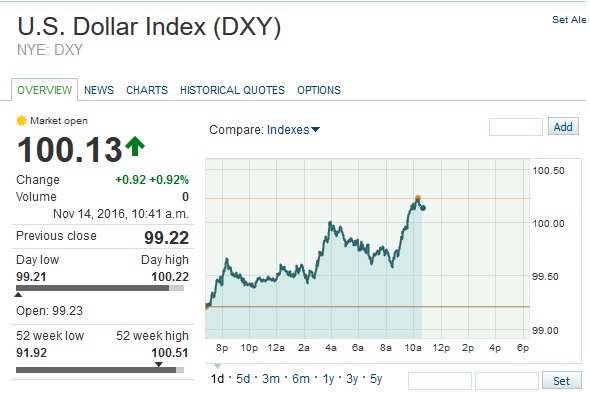
Because my dear readers, Trump won’t trump the bond market, there are huge risks in the global economy, especially emerging markets, and that’s one reason why the US dollar keeps surging higher, which introduces other risks to US multinationals and corporate earnings.

I’ve been warning my readers to take Denmark’s dire pension warning seriously and that the global pension crisis is far from over. It’s actually gaining steam because the risks of deflation are not fading over the long run, they are still lurking in the background.

What else? Investment returns alone will not be enough to cover future liabilities. The best plans in the world, like Ontario Teachers and HOOPP, understood this years ago which is why they introduced a shared-risk model to partially or fully adjust inflation protection whenever their plans experience a deficit and will only restore it once fully funded status is achieved again.

In Canada, the governance is right, which means you don’t have anywhere near the government interference in public pensions as you do south of the border. Canadian pensions have been moving away from public markets increasingly investing directly in private markets like infrastructure, real estate and private equity. In order to do this, they got the governance right and compensate their pension fund managers properly.

Now, as the article above states, if CalPERS decides to lower its return assumptions, it’s a huge deal and it will have ripple effects in the US pension industry and California’s state and local governments.

The main reason why US public pensions don’t like lowering their return assumptions is because it effectively means public sector workers and state and local governments will need to contribute more to shore up these pensions. And this isn’t always feasible, which means property taxes might need to rise too to shore up these public pensions.

This is why I keep stating the pension crisis is deflationary. The shift from defined-benefit to defined-contribution plans shifts the retirement risk entirely onto employees which will eventually succumb to pension poverty once they outlive their meager savings (forcing higher social welfare costs for governments) and public sector pension deficits will only be met by lowering return assumptions, hiking the contributions, cutting benefits or raising property taxes, all of which take money out of the system and impact aggregate demand in a negative way.

This is why it’s a huge deal if CalPERS goes ahead and lowers its investment return assumptions. The ripple effects will be felt throughout the economy especially if other US public pensions follow suit.

Unfortunately, CalPERS doesn’t have much of choice because if it doesn’t lower its return target and its pension deficit grows, it will be forced to take more drastic actions down the road. And it’s not about being conservative, it’s about being realistic and getting real on future returns, especially now that California’s pensions are underfunded to the tune of one trillion dollars or $93K per household.
Institutions Piling Into Illiquid Alternatives?

Leo Kolivakis is a blogger, trader and independent senior pension and investment analyst. This post was originally published at Pension Pulse.

BusinessWire reports, World’s Largest Institutional Investors Expecting More Asset Allocation Changes over Next Two Years Than in the Past:

Institutional investors worldwide are expecting to make more asset allocation changes in the next one to two years than in 2012 and 2014, according to the new Fidelity Global Institutional Investor Survey. Now in its 14th year, the Fidelity Global Institutional Investor Survey is the world’s largest study of its kind examining the top-of-mind themes of institutional investors. Survey respondents included 933 institutions in 25 countries with $21 trillion in investable assets.

The anticipated shifts are most remarkable with alternative investments, domestic fixed income, and cash. Globally, 72 percent of institutional investors say they will increase their allocation of illiquid alternatives in 2017 and 2018, with significant numbers as well for domestic fixed income (64 percent), cash (55 percent), and liquid alternatives (42 percent).

However, institutional investors in some regions are bucking the trend seen in other parts of the world. Many institutional investors in the U.S. are, on a relative basis, adopting a wait-and-see approach. For example, compared to 2012, the percentage of U.S. institutional investors expecting to move away from domestic equity has fallen significantly from 51 to 28 percent, while the number of respondents who expect to increase their allocation to the same asset class has only risen from 8 to 11 percent.

“With 2017 just around the corner, the asset allocation outlook for global institutional investors appears to be driven largely by the local economic realities and political uncertainties in which they’re operating,” said Scott E. Couto, president, Fidelity Institutional Asset Management. “The U.S. is likely to see its first rate hike in 12 months, which helps to explain why many in the country are hitting the pause button when it comes to changing their asset allocation.

“Institutions are increasingly managing their portfolios in a more dynamic manner, which means they are making more investment decisions today than they have in the past. In addition, the expectations of lower return and higher market volatility are driving more institutions into less commonly used assets, such as illiquid investments,” continued Couto. “For these reasons, organizations may find value in reexamining their investment decision-making process as there may be opportunities to bring more structure and accommodate the increased number of decisions, freeing up time for other areas of portfolio management and governance.”

Primary concerns for institutional investors

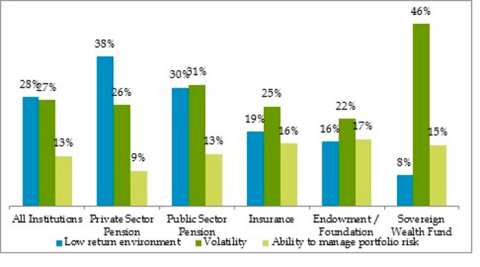
Overall, the top concerns for institutional investors are a low-return environment (28 percent) and market volatility (27 percent), with the survey showing that institutions are expressing more worry about capital markets than in previous years. In 2010, 25 percent of survey respondents cited a low-return environment as a concern and 22 percent cited market volatility.

“As the geopolitical and market environments evolve, institutional investors are increasingly expressing concern about how market returns and volatility will impact their portfolios,” said Derek Young, vice chairman of Fidelity Institutional Asset Management and president of Fidelity Global Asset Allocation. “Expectations that strengthening economies would build enough momentum to support higher interest rates and diminished volatility have not borne out, particularly in emerging Asia and Europe.”

Investment concerns also vary according to the institution type. Globally, sovereign wealth funds (46 percent), public sector pensions (31 percent), insurance companies (25 percent), and endowments and foundations (22 percent) are most worried about market volatility. However, a low-return environment is the top concern for private sector pensions (38 percent). (click on image)

Continued confidence among institutional investors

Despite their concerns, nearly all institutional investors surveyed (96 percent) believe that they can still generate alpha over their benchmarks to meet their growth objectives. The majority (56 percent) of survey respondents say growth, including capital and funded status growth, remain their primary investment objective, similar to 52 percent in 2014.

On average, institutional investors are targeting to achieve approximately a 6 percent required return. On top of that, they are confident of generating 2 percent alpha every year, with roughly half of their excess return over the next three years coming from shorter-term decisions such as individual manager outperformance and tactical asset allocation.

“Despite uncertainty in a number of markets around the world, institutional investors remain confident in their ability to generate investment returns, with a majority believing they enjoy a competitive advantage because of confidence in their staff or access to better managers,” added Young. “More importantly, these institutional investors understand that taking on more risk, including moving away from public markets, is just one of many ways that can help them achieve their return objectives. In taking this approach, we expect many institutions will benefit in evaluating not only what investments are made, but also how the investment decisions are implemented.”

Improving the Investment Decision-Making Process

There are a number of similarities in institutional investors’ decision-making process:

  • Nearly half (46 percent) of institutional investors in Europe and Asia have changed their investment approach in the last three years, although that number is smaller in the Americas (11 percent). Across the global institutional investors surveyed, the most common change was to add more inputs – both quantitative and qualitative – to the decision-making process.
  • A large number of institutional investors have to grapple with behavioral biases when helping their institutions make investment decisions. Around the world, institutional investors report that they consider a number of qualitative factors when they make investment recommendations. At least 85 percent of survey respondents say board member emotions (90 percent), board dynamics (94 percent), and press coverage (86 percent) have at least some impact on asset allocation decisions, with around one-third reporting that these factors have a significant impact.

“Institutional investors often assess quantitative factors such as performance when making investment recommendations, while also managing external dynamics such as the board, peers and industry news as their institutions move toward their decisions. Whether it’s qualitative or quantitative factors, institutional investors today face an information overload,” said Couto. “To keep up with the overwhelming amount of data, institutional investors should consider revisiting and evolving their investment process.

“A more disciplined investment process may help them achieve more efficient, effective and repeatable portfolio outcomes, particularly in a low-return environment characterized by more expected asset allocation changes and a greater global interest in alternative asset classes,” added Couto.

The complete report with a wealth of charts is available on request. For additional materials on the survey, go to institutional.fidelity.com/globalsurvey.

About the Survey

Fidelity Institutional Asset ManagementSM conducted the Fidelity Global Institutional Investor Survey of institutional investors in the summer of 2016, including 933 investors in 25 countries (174 U.S. corporate pension plans, 77 U.S. government pension plans, 51 non-profits and other U.S. institutions, 101 Canadian, 20 other North American, 350 European, 150 Asian, and 10 African institutions including pensions, insurance companies and financial institutions). Assets under management represented by respondents totaled more than USD $21 trillion. The surveys were executed in association with Strategic Insight, Inc. in North America and the Financial Times in all other regions. CEOs, COOs, CFOs, and CIOs responded to an online questionnaire or telephone inquiry.

About Fidelity Institutional Asset Management℠

Fidelity Institutional Asset Management℠ (FIAM) is one of the largest organizations serving the U.S. institutional marketplace. It works with financial advisors and advisory firms, offering them resources to help investors plan and achieve their goals; it also works with institutions and consultants to meet their varying and custom investment needs. Fidelity Institutional Asset Management℠ provides actionable strategies, enabling its clients to stand out in the marketplace, and is a gateway to Fidelity’s original insight and diverse investment capabilities across equity, fixed income, high‐income and global asset allocation. Fidelity Institutional Asset Management is a division of Fidelity Investments.

About Fidelity Investments

Fidelity’s mission is to inspire better futures and deliver better outcomes for the customers and businesses we serve. With assets under administration of $5.5 trillion, including managed assets of $2.1 trillion as of October 31, 2016, we focus on meeting the unique needs of a diverse set of customers: helping more than 25 million people invest their own life savings, nearly 20,000 businesses manage employee benefit programs, as well as providing nearly 10,000 advisory firms with investment and technology solutions to invest their own clients’ money. Privately held for 70 years, Fidelity employs 45,000 associates who are focused on the long-term success of our customers. For more information about Fidelity Investments, visit https://www.fidelity.com/about.

Sam Forgione of Reuters also reports, Institutions aim to boost bets on hedge funds, private equity:

The majority of institutional investors worldwide are seeking to increase their investments in riskier alternatives that are not publicly traded such as hedge funds, real estate and private equity over the next one to two years to combat potential low returns and choppiness in public markets, a Fidelity survey showed on Thursday.

The Fidelity Global Institutional Investor Survey showed that 72 percent of institutional investors worldwide, from public pension funds to insurance companies and endowments, said they would increase their exposure to these so-called illiquid alternatives in 2017 and 2018.

The survey, which included 933 institutions in 25 countries overseeing a total of $21 trillion in assets, found that the institutions were most concerned with a low-return investing environment over the next one to two years, with 28 percent of respondents citing it as such. Market volatility was the second-biggest worry, with 27 percent of respondents citing it as their top concern.

Private sector pensions were most concerned about a low-return environment, with 38 percent of them identifying it as their top worry, while sovereign wealth funds were most nervous about volatility, with 46 percent identifying it as their top concern.

“With the concern about the low-return environment as well as market volatility, as a result we’re seeing more of an interest in alternatives, where there’s a perception of higher return opportunities,” said Derek Young, vice chairman of Fidelity Institutional Asset Management and president of Fidelity Global Asset Allocation.

Investors seek alternatives, which may invest in assets such as timber or real estate or use tactics such as betting against securities, for “uncorrelated” returns that do not move in tandem with traditional stock and bond markets.

Young noted, however, that illiquid alternatives can also be volatile without it being obvious, since they lack daily pricing and as a result may give the perception of being less volatile.

“We would hope and would expect that institutional investors would appreciate the volatility that still exists within the underlying investments,” he said in reference to illiquid alternatives.

The survey, which was conducted over the summer, found that despite their concerns, 96 percent of the institutions believed they could achieve an 8 percent investment return on average in coming years.

U.S. public pension plans, on average, had about 12.1 percent of their assets in real estate, private equity and hedge funds combined as of Sept. 30, according to Wilshire Trust Universe Comparison Service data.

And Jonathan Ratner of the National Post reports, Low returns, high volatility top institutional investors’ list of concerns:

Low returns and market volatility topped the list of concerns in Fidelity Investments’ annual survey of more than 900 institutional investors with US$21 trillion of investable assets.

Thirty per cent of respondents cited the low-return environment as their primary worry, followed by volatility at 27 per cent.

“Expectations that strengthening economies would build enough momentum to support higher interest rates and diminished volatility have not borne out, particularly in emerging Asia and Europe,” said Derek Young, vice chairman of Fidelity Institutional Asset Management and president of Fidelity Global Asset Allocation.

The Fidelity Global Institutional Survey, which is now in its 14th year and includes investors in 25 countries, also showed that institutions are growing more concerned about capital markets.

Despite these issues, 96 per cent of institutional investors surveyed believe they can beat their benchmarks.

The group is targeting an average return of approximately six per cent per year, in addition to two per cent alpha, and short-term decisions are being credited for those excess returns.

Institutional investors remain confident in their return prospects due to their access to superior money managers. They also have demonstrated a willingness to move away from public markets.

On a global basis, 72 per cent of institutional investors said they plan to increase their exposure to illiquid alternatives in 2017 and 2018.

Domestic fixed income (64 per cent), cash (55 per cent) and liquid alternatives (42 per cent) were the other areas where increased allocation is expected to occur.

However, institutional investors in the U.S. are bucking this trend, and seem to have adopted a “wait-and-see” approach.

The percentage of this group expecting to move away from domestic equity has fallen from 51 per cent in 2012, to 28 per cent this year. Meanwhile, the number of respondents who plan to increase their allocation to U.S. equities has risen to just 11 per cent from eight per cent in 2012.

“With 2017 just around the corner, the asset allocation outlook for global institutional investors appears to be driven largely by the local economic realities and political uncertainties in which they’re operating,” said Scott Couto, president of Fidelity Institutional Asset Management.

He noted that with the Federal Reserve expected to produce its first rate hike in 12 months, it’s understandable why many U.S. investors are hitting the pause button when it comes to asset allocation changes.

On Thursday, I had a chance to speak to Derek Young, vice chairman of Fidelity Institutional Asset Management and president of Fidelity Global Asset Allocation. I want to first thank him for taking the time to go over this survey with me and thank Nicole Goodnow for contacting me to arrange this discussion.

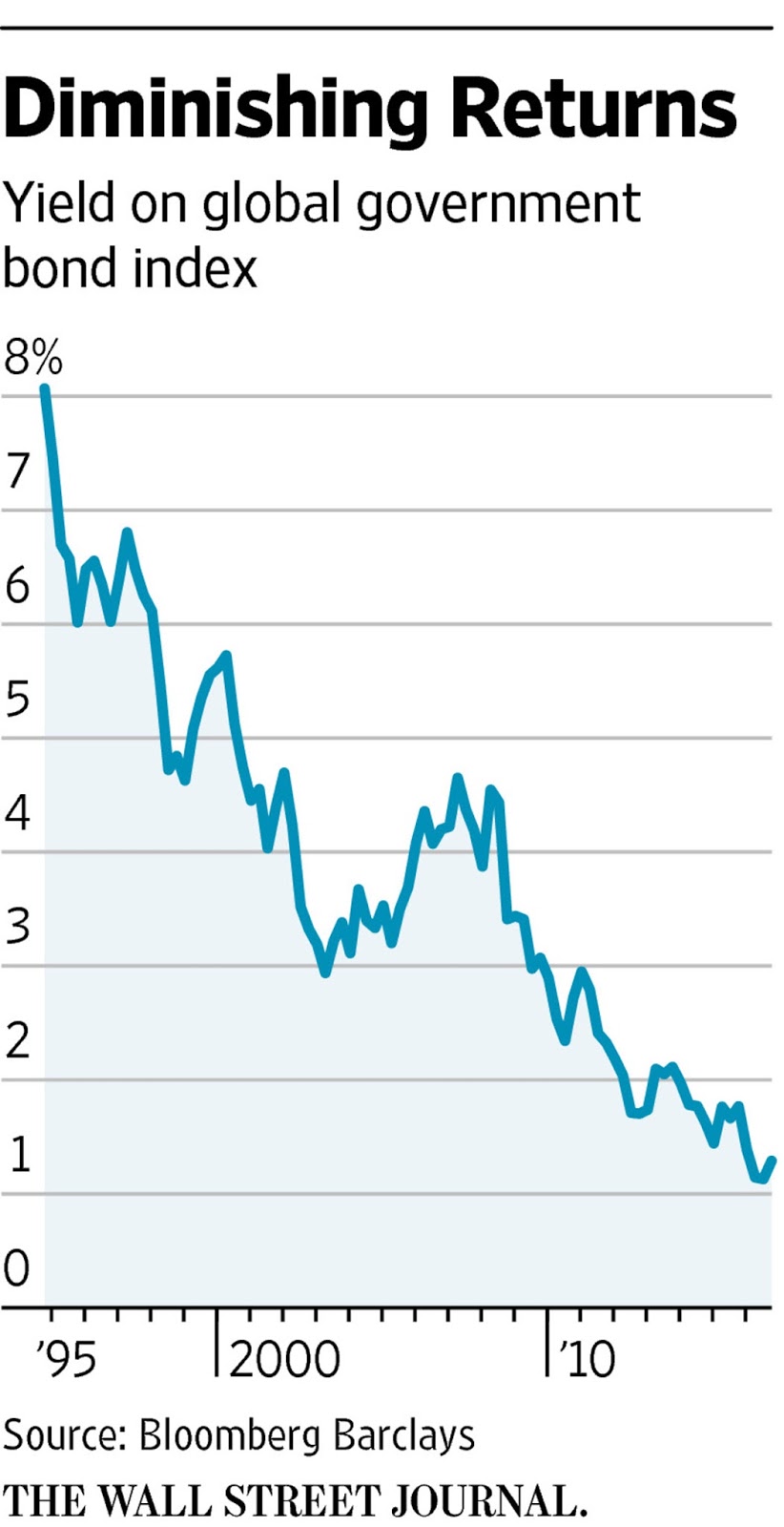
I can’t say I am shocked by the results of the survey. Since Fidelity did the last one two years ago, global interest rates plummeted to record lows, public markets have been a lot more volatile and return expectations have diminished considerably.

One thing that did surprise me from this survey is that the majority of institutions (96%) are confident they can beat their benchmark, “targeting an average return of approximately six per cent per year, in addition to two per cent alpha, and short-term decisions are being credited for those excess returns.”

I personally think this is wishful thinking on their part, especially if they start piling into illiquid alternatives at the worst possible time (see my write-up on Bob Princes’ visit to Montreal).

In our discussion, however, Derek Young told me institutions are confident that through strategic and tactical asset allocation decisions they can beat their benchmark and achieve that 8% bogey over the long run.

He mentioned that tactical asset allocation will require good governance and good manager selection. We both agreed that the performance dispersion between top and bottom quartile hedge funds is huge and that manager selection risk is high for liquid and illiquid alternatives.

Funding illiquid alternatives is increasingly coming from equity portfolios, except in the US where they have been piling into alternatives for such a long time that they probably want to pause and reflect on the success of these programs, especially considering the fees they are paying to external managers.

The move into bonds was interesting. Derek told me as rates go up, liabilities fall and if rates are going up because the economy is improving, this is also supportive of higher equity prices. He added that many institutions are waiting for the “right funding status” so they can derisk their plans and start immunizing their portfolios.

In my comment on trumping the bond market, I suggested taking advantage of the recent backup in yields to load up on US long bonds (TLT). I still maintain this recommendation and think anyone shorting bonds at these levels is out of their mind (click on chart):

Sure, rates can go higher and bond prices lower but these big selloffs in US long bonds are a huge buying opportunity and any institution waiting for the yield on the 10-year Treasury note to hit 3%+ to begin derisking and immunizing their portfolio might end up regretting it later on.

Our discussion on the specific concerns of various institutions was equally interesting. Derek told me many sovereign wealth funds need liquidity to fund projects. They are the “funding source for their economies” which is why volatile returns are their chief concern. (Oftentimes, they will go to Fidelity to redeem some money and tell them “we will come back to you later”).

So unlike pensions, SWFs don’t have a liability concern but they are concerned about volatile markets and being forced to sell assets at the wrong time (this surprised me).

Insurance companies are more concerned about hedging volatility risk to cover their annuity contracts. In 2008, when volatility surged, they found it extremely expensive to hedge these risks. Fidelity manages a volatility portfolio for their insurance clients to manage this risk on a cost effective basis.

I told Derek that they should do the same thing for pension plans, managing contribution volatility risk for plan sponsors. He told me Fidelity is already doing this for smaller plans (outsourced CIO) and for larger plans they are helping them with tactical asset allocation decisions, manager selection and other strategies to achieve their targets.

On the international differences, he told me UK investors are looking to allocate more to illiquid alternatives, something which I touched upon in my last comment on the UK’s pension crisis.

As far as Canadian pensions, he told me “they are very sophisticated” which is why I told him many of them are going direct when it comes to alternative investments and more liquid absolute return strategies.

In terms of illiquid alternatives, we both agreed illiquidity doesn’t mean there are less risks. That is a total fallacy. I told him there are four key reasons why Canada’s large pensions are increasing their allocations to private market investments:

  1. They have a very long investment horizon and can afford to take on illiquidity risk.
  2. They believe there are inefficiencies in private markets and that is where the bulk of alpha lies.
  3. They can scale into big real estate and infrastructure investments a lot easier than scaling into many hedge funds or even private equity funds.
  4. Stale pricing (assets are valued with a lag) means that private markets do not move in unison with public markets, so it helps boost their compensation which is based on four-year rolling returns (privates dampen volatility of overall returns during bear markets).

Sure, private markets are good for beneficiaries of the plan, especially if done properly, but they are also good for the executive compensation of senior Canadian pension fund managers. They aren’t making the compensation of elite hedge fund portfolio managers but they’re not too far off.

On that note, I thank Fidelity’s Derek Young and Nicole Goodnow and remind all of you to please subscribe and donate to this blog (pensionpulse.blogspot.ca) on the top right-hand side under my picture and show your appreciation of the work that goes into these blog comments.

I typically reserve Fridays for my market comments but there were so many things going on this week (OPEC, jobs report, etc.) that I need to go over my charts and research over the weekend.

One thing I can tell you is that US long bonds remain a big buy for me and I was watching the trading action on energy, metal and mining stocks all week and think a lot of irrational exuberance is going on there. There are great opportunities in this market on the long and short side, but will need to gather my thoughts and discuss this next week.

Addressing The UK’s Pension Crisis?

Leo Kolivakis is a blogger, trader and independent senior pension and investment analyst. This post was originally published at Pension Pulse.

The Mail Online reports, Pension funding deficits ‘nearly a third of UK GDP’:

Britain’s mammoth funding gap for gold-plated company pensions stands at nearly a third of the country’s economic output despite a £50 billion boost in November.

A report by PricewaterhouseCoopers shows the deficit for so-called defined benefit pensions – such as final salary schemes, which guarantee an income in retirement – narrowed by £50 billion to £580 billion last month.

This marks the third month in a row that the funding gap has improved after hitting a record high of £710 billion in August.

But the pensions black hole is still £110 billion higher than it was at the start of the year and is equivalent to almost a third of the UK’s entire gross domestic product (GDP).

PwC’s Skyval Index gives a snapshot of the health of the UK’s 6,000 defined benefit pension funds.

It reveals the battering that pension schemes have taken since the Brexit vote, with rock-bottom interest rates taking their toll after the Bank of England halved its base rate to 0.25% in August.

BT recently revealed its pension deficit surged to £9.5 billion at the end of September from £6.2 billion three months earlier.

Barclays has also seen its pension fund slip into the red by £1.1 billion from a surplus of £800 million last December, while Debenhams likewise suffered a reversal to a £4.1 million deficit in September against a surplus of £26.2 million in August last year.

Firms have blamed a sharp reduction in bond yields, which increases the pension liabilities, as a result of the Bank’s economy-boosting action after the EU referendum vote.

This peaked in August, when the pension deficit shot up by £100 billion, with bond yields since having recovered a little.

Businesses are now under pressure to pump cash into their company schemes to address the shortfalls, especially after BHS’s £571 million pension deficit contributed to its high profile collapse in April.

But Raj Mody, partner at PwC and global head of pensions, said companies should have realistic funding plans in place over longer timescales – up to 20 years rather than the nine or 10 year average.

He said: “Pension funding deficits are nearly a third of UK GDP. Trying to repair that in, say, 10 years could cause undue strain, akin to about 3% per year of potential GDP growth being redirected to put cash into pension funds.

“This would be like the UK economy running to stand still to remedy the pension deficit situation.”

When I warn my readers that the ongoing global pension crisis is deflationary, this is exactly what I am alluding to. Not only is the shift from DB to DC pensions going to cause widespread pension poverty as it shifts retirement risk entirely on to employees, but persistent and chronic public and private pension deficits are diverting resources away from growing and hiring people which effectively exacerbates chronic unemployment which is itself very deflationary (limits aggregate demand).

And while some think President-elect Trump and his new powerhouse economic cabinet members are going to trump the bond market and bond yields are going to rise sharply over the next four years, relieving pressure on pensions and savers, I remain highly skeptical that policymakers have conquered global deflation and would take Denmark’s dire pension warning very seriously.

How are British policymakers responding to their pension crisis? Last month, I discussed the UK’s draconian pension reforms, stating they would make the problem a lot bigger down the road.

This week, former pensions minister Steve Webb says the government is considering raising pension age sooner than previously planned, a proposal which has sparked outrage among citizens calling it a “huge tax increase”.

In her comment to the Guardian, pension expert Ros Altmann writes, There are fairer ways to set the pension age – but politicians are ducking them:

Younger generations are being told to prepare to wait even longer for their pensions, with former minister Steve Webb suggesting that the retirement age for a state pension will rise to 70.

I can understand why some policymakers seeking to cut the costs of state support for pensioners are attracted to the idea of continually raising pension ages, but I believe this is potentially damaging to certain social groups.

The justification for such an increase is based on forecasts of rising average life expectancy. But just using average life expectancy as a yardstick ignores significant differences in longevity across British society. For example, people living in less affluent areas, or who had lower paid or more physically demanding careers, or started work straight from school, have a higher probability of dying younger. Continually increasing state pension ages, and making such workers wait longer for pension payments to start, prolongs significant social disadvantage.

The state pension qualification criteria depend on national insurance contributions. Normally, workers and their employers make contributions that can amount to around 25% of their earnings. Even now, a significant minority of the population does not live to state pension age, or dies very soon thereafter, despite having paid significant sums into the system. By raising the state pension age, based on rising average life expectancy, this social inequality is compounded.

Increasing the state pension age is a blunt instrument. A stark cutoff fails to recognise the needs of millions of people who will be physically unable to keep working to the age of 70, because of particular circumstances in their working life, their current health, or environmental and social factors that negatively impact on specific regions of the country.

State pension unfairness is even greater, because those who are healthy and wealthy enough can already get much larger state pensions than others who cannot afford to wait. If you can delay starting your state pension until 70 – assuming you either have a good private income or are able to keep working – the new state pension will pay over £200 a week. But if you are very ill, caring for relatives, or for whatever reason cannot keep working up to state pension age (now 65 for men and between 63 and 64 for women) you get nothing at all.

In fact, just reforming state pensions is not the best way to cope with an ageing population. It is important to rethink retirement too. Those who can and want to work longer could boost their own lifetime incomes and future pensions, and also the spending power of the economy and national output, if more were done to facilitate and encourage later life working. Having more older workers in the economy, especially given the demographics of the western world, is a win-win for all of us. Even a few years of part-time work, before full-time retirement, can benefit individuals and the economy. But this should not be achieved by forcing everyone to wait longer for a state pension and ignoring the needs of those groups who cannot do so.

There is no provision, for example, for an ill-health early state pension, or for people to start state pensions sooner at a reduced rate. Politicians have entirely ducked this question but such a system would acknowledge the differences across society. There are, surely, more creative and equitable ways of managing state pension costs for an increasingly ageing population, using parameters other than just the starting age.

Indeed, raising state pension ages has already caused huge hardship to many women born in the 1950s. These women believed their state pension would start at 60, but many discovered only recently they will need to wait until 66. Many women have no other later life income, therefore they are totally dependent on their state pension.

Rather than just considering increasing the pension age, the government could consider having a range of ages, instead of one stark chronological cutoff. Allowing people an early-access pension, possibly reflecting a longer working life or poorer health, could alleviate some of the unfairness inherent in the current system. Increasing the number of years required to qualify for full pensions could also help.

Raising the state pension age is rather a crude measure for managing old-age support in the 21st century.

In her insightful comment, Ros Altmann shows why raising the pension age, while politically expedient, can be detrimental and devastating to certain socioeconomic cohorts, including people suffering from an illness and many women relying on their state pension to survive in their golden years.

There is a lot to think about in terms of pension policy not just in the UK, but here in Canada and across the world.

Also, remember how I keep telling you pension plans are about managing assets and liabilities. Clearly the backup in yields has helped many British and global pensions. Interest rates are the determining factor behind pension deficits. The lower yields go, the higher the pension deficits no matter how well assets perform because the duration of pension liabilities is a lot bigger than the duration of pension assets, so for any decrease or increase in the discount rate, pension liabilities will increase or decrease a lot faster than assets rise or decline.

In the UK, something happened earlier this year, a vote for Brexit which sent the British pound plummeting to multi decade lows relative to other currencies. Some think this is great for British exports and inflation expectations but I’m skeptical because a rise in exports and inflation expectations due to currency depreciation isn’t sustainable and it’s not the good type of inflation either (based on a rise in wages).

For UK pensions that fully hedged currency risk, they took a huge hit on their foreign bond, stock, real estate and other assets just on the devaluation of the British pound. So if interest rates didn’t rise and instead declined, those pension deficits would have been far, far worse for these pensions.

Conversely, for UK pensions that didn’t hedge currency risk, their foreign asset holdings rose as the pound took a beating. For these pensions, the gain in foreign assets would have dampened any losses on domestic assets and along with the rise in bond yields, helped their pension deficits.

And it’s not just currency risk plaguing UK pensions. Cambridge Associates has come out with a new study which states many pension funds will struggle to close their funding gap unless they reduce their on public equities and other liquid assets:

Pension funds are too focused on holding liquid assets to the detriment of the long-term health of their investment portfolio, according to research by Cambridge Associates, the global provider of investment services. If they considered switching from liquid public equities to illiquid private investments, they could improve their chances of closing the funding gap and reduce the likelihood to requiring additional capital injections to honour their commitments to pension fund members.

The average UK pension fund can have a staggering 90-95 per cent of their assets in liquid assets — those easily convertible into cash. This amount is far more than they need in order to be able to pay pension fund members. “Many schemes do not need to set aside more than 5-10 per cent of assets for benefit payments in any given year for the next 20 years,” according to Alex Koriath, head of Cambridge Associates’ European pensions practice. “By having such liquid portfolios, they are giving up return opportunities and face having to deal with the risk of a widening funding gap.”

Already, as of October 2016, the average UK pension scheme holds assets that cover just 77.5 per cent of their liabilities, according to data from the UK’s Pension Protection Fund. Even though the value of “growth” assets — such as equities — has soared over the past 5 years, this funding gap has continued to widen because the dramatic fall in interest rates has increased the value of liabilities at an even faster rate.

For a typical scheme, some 40 per cent of the liquid assets is invested in “liability-matching” assets such as gilts, while around 60 per cent is held in growth assets such as equities, credit and other such asset classes. Of the 60 per cent, some 5-10 per cent is invested in illiquid assets such as real estate, private equity, private credit, venture capital and other less liquid investments.

But this allocation may need to change because many pension funds are facing difficult choices. As their member population ages, trustees understandably want to “de-risk” by buying more liability-matching assets and selling more volatile assets such as equities. However, de-risking also means that fewer assets can earn the higher return that is needed to plug the large funding gap. Even a pension scheme that hedges just 40 per cent of its liabilities faces a more than one third chance of seeing its funding level fall by 10 per cent at least once during the next 20 years. “In other words,” said Mr Koriath, “the scheme could very well find itself needing a capital injection.”

A New Solution: The “Barbell Approach”

To close the funding gap, Cambridge Associates proposes considering a “barbell approach”. Here, trustees target substantially higher returns in a small part of the portfolio — say, 20 per cent — by focusing this portion on private investments. The rest of the portfolio — as much as 80 per cent — can then be focused on gilts and other liability-matching assets in order to reduce liability risk. Himanshu Chaturvedi, senior investment director at Cambridge Associates in London, said: “This approach to pension investing can deliver a hat-trick of benefits: plenty of liquidity, reduced volatility and appropriate rates of return to close the current funding gap.”

The 80 per cent allocation to liability-matching assets should address the volatility and liquidity issues facing pension funds. The increased hedging reduces the risk of a slump in funding levels, while the large allocation to liquid assets should provide ample liquidity to pay benefits without needing any liquidity from the growth assets. According to Cambridge Associates, a representative scheme that is mature and closed to future accrual (say 70 per cent funded on a buyout basis with liabilities split 75 per cent/25 per cent between deferred members and pensioners) only has to make annual benefit payments of between 3 per cent to 7 per cent of assets in any given year for the next 10 years. Meanwhile, the 20 percent allocation to private investments should help address the return requirements of pension funds, allowing them to target higher return opportunities in return for accepting illiquidity in this small part of the overall portfolio.

Mr Chaturvedi said: “In our view, even a growth portfolio purely focused on public equities, typically the highest expected return option available in public markets, will not close the funding gap fast enough for most schemes.” In the 10 years to September 2015, the MSCI World Index saw returns of 6.4 per cent. By contrast, the Cambridge Associates Private Equity and Venture Capital Index saw annualised returns of 13.4 per cent.

The Challenges of the Barbell Approach

In its analysis, Cambridge Associates found that there were two important requirements for successful implementation of the barbell approach. One is governance. As Mr Chaturvedi said: “A program of private investments takes years to put into place — perhaps two cycles of trustees. So it can’t be the passion of one group of trustees.”

The other requirement is astute manager selection. “Finding high quality managers is not easy,” said Mr Koriath. “At Cambridge Associates, we track more than 20,000 funds across all private investments and in any given year we only see about 200 that merit our clients’ capital.” But the benefits of getting it right in private investments are substantial. Over a 10-year time frame, the annual difference between the top and bottom quartile managers of public equities is about 2 per cent. By contrast, for private equity and venture capital managers, the annual difference is as large as 12-18 per cent.

Obviously Cambridge Associates is talking up its business, after all, it is in the business of building customized portfolios for clients looking to allocate in alternative investments like private equity, real estate and hedge funds.

But the recommendation for a “barbell approach” is sound and to be honest, even though most UK pensions are mature, I was surprised at how little illiquidity risk they are taking given they have a very long investment horizon and can afford to take on some illiquidity risk, especially since the average funded status of 77% is far from disastrous (I would be a lot more worried if Illinois Teachers’ Retirement System or some other severely underfunded pensions were trying to close their funded gap by increasing their allocation to illiquid alternatives).

And Mr Chaturvedi is right, allocating more to illiquid alternatives will not work unless these UK pensions get the governance right and choose their partners wisely.

Lastly, one group that’s not suffering from pension poverty in the UK is company directors. Carolyn Cohn of Reuters reports, Majority of UK pension funds say executive pay too high-survey:

Eighty-seven percent of UK pension funds say executives at UK listed companies are paid too much, a survey by the Pensions and Lifetime Savings Association said on Thursday, as Britain proposes changes to the way companies are run.

Britain began consultations on encouraging better corporate behaviour and curbing executive pay this week, part of Prime Minister Theresa May’s campaign to help those who voted for Brexit in protest at “out of touch” elites.

“It’s time companies got the message and started to reduce the size of the pay packages awarded to their top executives,” said Luke Hildyard, policy lead for stewardship and corporate governance at the PLSA.

The number of shareholder revolts, defined as cases where more than 40 percent of shareholders voted against pay awards at FTSE 100 company annual meetings, rose to seven this year from two in 2015, the PLSA’s analysis found.

The PLSA said it will publish guidelines encouraging pension funds to take a tougher line on the re-election of company directors responsible for setting company pay.

The average pay of bosses in Britain’s FTSE 100 index rose more than 10 percent in 2015 to an average of 5.5 million pounds ($6.9 million), meaning CEOs now earn 140 times more than their employees on average, according to a survey by the High Pay Centre released in August.

The PLSA’s members include more than 1,300 UK pensions schemes with 1 trillion pounds in assets.

What this article doesn’t mention is that pension perks are increasingly a huge part of executive compensation in the UK, US and elsewhere. Corporate directors are padding the pensions of executives which are often based on their overall compensation, which is surging.

And remember what I keep warning of, rising inequality is deflationary, so keep your eye on this trend too as it limits aggregate demand.

Canada’s Great Pension Debate?

Leo Kolivakis is a blogger, trader and independent senior pension and investment analyst. This post was originally published at Pension Pulse.

In a response to Bernard Dussault, Canada’s former Chief Actuary, Bob Baldwin, a consultant and former board of director at PSP Investments, sent me his thoughts on Bill C-27, DB, DC and target benefit plans (added emphasis is mine):

Bernard Dussault has circulated an article and slide presentation in which he has provided a endorsement of DB workplace pension plans coupled with an expression of concern about certain design features of DB plans that he sees as discriminatory. I share his preference for DB. But, I think his account of DB is incomplete and avoids certain issues and problems in DB that DB plan members, people with DB governance responsibilities and DB advocates should be aware of.

In his article “How Well Does the Canadian Landscape Fare?” Bernard says: “… DB plans offer better retirement security because they attempt to provide a predetermined amount of lifetime annual retirement income at an unknown periodic price.” The unknown nature of the price is unavoidable given the factors that determine the price that have magnitudes that cannot be foreseen such as: future wages and salaries, investment returns and longevity.

In context, two attributes of DB in its pure form are important to note. First, all of the uncertainty will show up in variable contribution rates and none in variable benefits. Second, the plan sponsor or sponsors have an unlimited willingness and ability to contribute more to the plan if need be.

The second of these attributes is, in principle, largely implausible. There simply are not sponsors who can and will contribute more without limit. Moreover, as I have noted in several publications, in practice when combined employer and employee contributions get up to the 15 to 20 per cent level, even jointly governed plans that were purely DB begin allocating some financial risk to benefits – usually by making indexation contingent on the funded status of the plan.

Moreover above some level, escalating pension contributions begin to depress pre-retirement living standards below post retirement levels. Even recognizing that the impact on living standards of a particular combination of benefit levels and contributions will vary from member to member in a DB plan (you can’t make it perfect for everyone), it is still desirable to try to avoid depressing pre-retirement living standard below the post-retirement level. The object of the workplace pension exercise is to facilitate the continuity of living standards and depressing pre-retirement living standards below the level of post-retirement living standards is not consistent with that objective. You can have too much pension!

The contributions that are relevant to the question whether contributions are depressing pre-retirement living standards to too low a level include both employer and employee contributions. This is because in most circumstances, the economic burden of employer contributions will fall on the employee plan members. This happens because rational employers will reduce their wage and salary offers to compensate for foreseeable pension contributions. There may be circumstances where an employer cannot shift the burden fully in the short term. But, in the normal case, the burden will be shifted. To the extent that required pension contributions are varying through time and being shifted back to the employee plan members, the net replacement rates generated by DB plans are clearly less predictable than the gross replacement rates.

Under the subheading “Strengths of DB plans”, Bernard’s slides include the following statement “investment and longevity risks are pooled, i.e. not borne exclusively by members, be it individually or collectively.” Having introduced the word “exclusively” the statement is probably correct. But, there are a variety of risks to plan members in DB plans. As was noted in the previous paragraph, there is a risk in ongoing DB plans that the pre-retirement living standards will be depressed below post-retirement levels. There is also a risk that a DB plans will get into serious financial difficulty and benefits will be reduced for future service and/or the plan will be converted to DC for future service. Both of these outcomes focus financial risks on young and future plan members as does escalating contributions. Finally, in the event of the bankruptcy of a plan sponsor, all members will face benefit reductions if the plan is not fully funded.

Bernard’s article and slides include reference to provisions in DB plans that he finds discriminatory. For me, the provisions on which he focuses raise a related issue.

The key factors that determine outcomes in all types of workplace pension plans are the same: rates of contributions, salary trajectories, returns on investment, longevity and so on. So what is it that allows a DB plan to provide a more predictable outcome? It is basically two distinct but related things: varying the contribution (saving) rate through time to meet a pre-determined income target; and, cross-subsidies within and between different cohorts of plan members.

In and of itself, the existence of cross-subsidies is not a bad thing. It is fundamental to all types of insurance and insurance is worth paying for. But, what DB plans could do much better than they do is to help plan members understand what the cross-subsidies are and how much they cost. This would allow plan members to decide what cross-subsidies are “worth it” and which ones are not worth it. My guess would be that within limits established by periods of guaranteed payments, members would accept cross-subsidies based on differential longevity in order to have a pension guaranteed for a lifetime. There may be less enthusiasm for a cross-subsidy from members whose salaries are flat as they approach retirement to those whose salaries escalate rapidly.

With respect to the plan features that Bernard has identified as discriminatory, my first and strongest inclination is to shine light on them so plan members have a chance to decide what is and is not acceptable.

The relatively predictable outcomes of DB plans in terms of the benefits they provide are clearly desirable. DC plans – especially those that involve individual investment decision-making and self-managed withdrawals – impose too much uncertainty on plan members with respect to the retirement incomes they will provide and demand excessive knowledge, skills and experience of plan members – not to mention time. As a renown professor of finance put it, a self-managed DC arrangement is like asking people to buy a “do it yourself” kit and perform surgery on themselves.

It is unfortunate however, that so much of the discourse about the design of pension plans is presented as a binary choice between DB and DC. There are several reasons why this is unfortunate.

First, the actual world of pension design is more like a spectrum than a binary choice. In Canada and across the globe, there are any number of pension plan designs that combine elements of DB and DC. Financial risks show up in both benefits and contributions.

Second, sometimes plans are managed in ways that are not entirely consistent with formal design features of plans. In the 1980s and 1990s when returns on financial assets were high and wage growth low, many DB plans ran up surpluses on a regular basis and these were often converted into benefit improvements. Many DB plans were managed as if they were collective DC plans (investment returns were determining benefits) with DB guarantees. The upside investment risk was not converted into variable contributions.

Third and finally, some plans that are labelled DB fall well short of addressing all of the financial contingencies that retirees will face. This is most strikingly true of DB plans that make no inflation adjustments. What is defined – in terms of living standards – only exists during the period immediately after retirement.

The difficulty in knowing exactly what we are referring to in using the DB and DC labels has not rendered the terms totally meaningless. As noted above, there are plans that are mainly DB but allocate some financial risk to the indexation of benefits. There are also a few grandfathered Canadian DC plans that include minimum benefit guarantees. The union created multi-employer plans have fixed rates of contribution like DC plans, pool many risks like a DB plan, but allow reductions in accrued benefits. The point is not to get stuck on the DB and DC labels but to understand how financial risks are being allocated.

The basic strength of DB plans in providing a relatively predictable retirement income is not diminished by the issues raised above. But, it is clear that for the well being of plan members and sponsors, the basic strength of DB has to be reconciled with acceptable levels and degrees of volatility of contributions. It also has to be reconciled with reasonable degrees of cross-subsidization within and between cohorts of plan members. With regard to cross-subsidies between cohorts, a regime in which accrued benefits cannot be reduced places all financial risk on young and future plan members. Target benefit plans try to avoid this problem by spreading the risk sharing across all cohorts as in the union created multi-employer plans.

Bernard’s article and slides touch on a number of regulatory issues. The only one of these that I will comment on is the prohibition of contribution holidays. This suggestion is put forward along with the use of realistic assumptions that err on the safe side.

In an environment where investment returns are consistently greater than the discount rate (e.g. the 1980s and 1990s), the practical effect of banning contribution holidays will be to build up surpluses that will significantly exceed what is required to protect against downside risks that plans may face. Rather than mandate the banning of contribution holidays, an approach that would create downside protection without building up excess surplus would be to mandate the adoption of funding policies that prohibit the use of surplus to reduce contributions or increase benefits until threshold levels of surplus have been achieved. The threshold levels should take account of the riskiness of the pension fund’s investments and the maturity of the plan. Funding policies of this general sort have begun to emerge in large Canadian plans and should be made to be common practice.

First, let me thank Bob Baldwin for sharing his thoughts on DB and DC plans. Bob is an expert who understands the complexities and issues surrounding pension policy.

In his email response, Bob added this: “(in a previous email he stated) my views were quite different from Bernard’s. I am not sure whether I should have said “quite different” “somewhat different” “slightly different”. In any event, they are attached. You would be correct in inferring that they cause me to be more open to Bill C-27 than Bernard is.”

Go back to read my last comment on Bill C-27, Targeting Canada’s DB Plans, where I criticized the Trudeau Liberals for their “sleazy and underhanded” legislation which would significantly weaken DB plans across the country. Not only do I think it’s sleazy and underhanded, I also find such pension policy inconsistent (and hypocritical) following their push to enhance the CPP for all Canadians.

In that comment, I shared Bernard Dussault’s wise insights but I also stated the following:

Unlike Bernard Dussault and public sector unions, however, I don’t think DB plans can be bolstered just by prohibiting contribution holidays (something I agree with). I believe that some form of risk-sharing is essential if we are to safeguard DB plans and make sure they are sustainable over the long run. Target benefit plans are not the solution but neither is maintaining the farce that DB plans can exist with no shared-risk model.

[Note: To be fair, after reading my comment, Bernard sent me his proposed DB pension plan financing policy which “promotes true risk sharing at any level (ideally 50%/50%) between the plan sponsor and the plans members, in such a way that not only would both parties share the cost but also the 15-year amortization of surpluses and deficit.”]

I take Denmark’s dire pension warning very seriously and so should many policymakers and unions who think we can just continue with the status quo. We can’t, we need to adapt and be realistic about what defined-benefit pensions can and cannot offer in a world of low or negative rates.

On that note, let me once more end by sharing this nice clip from Ontario Teachers’ Pension Plan on how even minor adjustments to inflation protection can have a big impact on plan sustainability.

The future of pensions will require bolstering defined-benefit plans, better governance and a shared-risk model, which is why pensions like OTPP, HOOPP, OMERS, OPTrust, CAAT and other pensions will be able to deliver on their promise while others will struggle and will face hard choices.

This means while I firmly believe the brutal truth on defined-contribution plans is they aren’t real pensions and will lead to widespread pension poverty because they shift retirement risk entirely on to employees and that the benefits of defined-benefit plans are grossly underestimated, I also firmly believe that some form of shared-risk must be implemented in order to keep DB plans solvent and sustainable over the long run.

I mention this because public sector unions think I am pro-union and for everything they argue for in regards to pension policy. I am not for or against unions, I am pro private sector, as conservative as you get when it comes to my economic policies and fiercely independent in terms of politics (have voted between Conservatives and Liberals in the past and will never be a card carrying member of any party).

However, my diagnosis with multiple sclerosis at the age of 26 also shaped my thoughts on how society needs to take care of its weakest members, not with rhetoric but actual programs which fundamentally help people cope with poverty, disability and other challenges they confront in life.

All this to say, when it comes to pension policy, I am pro large, well-governed DB plans which are preferably backed by the full faith and credit of the federal government and think the risk of these plans needs to be shared equally by plan sponsors and beneficiaries.

Now, Bernard Dussault shared this with me this morning:

I sense that the description of my proposed financing policy for DB pension plans deserves to be further clarified as follows:

My proposed improved DB plan is essentially the same as Bill C-27’s TB plan except that under my promoted improved DB:

  1. Deficits affect only active members’ contributions (via 15-year amortization, i.e. through a generally small increase in the contribution rate), and not necessarily the sponsor’s contributions, as opposed to both contributions and benefits of both active and retired members under Bill C-27.
  2. Not only are contribution holidays prohibited, but any surplus is amortized over 15 years through a generally small decrease in the members’ and not necessarily sponsor’s contribution rate.

Therefore, my view is that if my proposed financing policy were to apply to DB plans, TB plans would no longer be useful. They would just stand as a useless and overly complex pension mechanism.

But Bob Baldwin makes a great point at the end of his comment:

Rather than mandate the banning of contribution holidays, an approach that would create downside protection without building up excess surplus would be to mandate the adoption of funding policies that prohibit the use of surplus to reduce contributions or increase benefits until threshold levels of surplus have been achieved. The threshold levels should take account of the riskiness of the pension fund’s investments and the maturity of the plan. Funding policies of this general sort have begun to emerge in large Canadian plans and should be made to be common practice.

Funding policies need to be mandated to prohibit the use of surpluses to reduce contributions or increase benefits until certain threshold elements of pensions are achieved.

Take the example of Ontario Teachers’ Pension Plan and the Healthcare of Ontario Pension Plan, two of the best pension plans in the world.

They both delivered outstanding investment results over the last ten and twenty years, allowing them to minimize contribution risk to their respective plans, but investment gains alone were not sufficient to get their plans back to fully-funded status when they experienced shortfalls.

This is a critical point I need to expand on. You can have Warren Buffet, George Soros, Ken Griffin, Steve Cohen, Jim Simons, Seth Klarman, David Bonderman, Steve Schwarzman, Jonathan Gray and the who’s who of the investment world all working together managing public pensions, delivering unbelievable risk-adjusted returns, and the truth is if interest rates keep tanking to record low or negative territory, liabilities will soar and they won’t produce enough returns to cover the shortfall.

Why? Because the duration of pension liabilities is a lot bigger than the duration of pension assets so for any given drop (or rise) in interest rates, pension liabilities will soar (or drop) a lot faster than assets rise or decline.

In short, interest rate moves are the primary determinant of pension deficits which is why smart pension plans like Ontario Teachers’ and HOOPP adjust inflation protection whenever their plans run into a deficit.

This effectively means they sit down like adults with their plan sponsors and make recommendations as to what to do when the plan is in a deficit and typically recommend to partially or fully remove inflation protection (indexation) until the plan is fully funded again.

Once the plan reaches full-funded status, they then sit down to discuss restoring inflation protection and if it reaches super funded status (ie. huge surpluses), they can even discuss cuts in the contribution rate or increases in benefits, but this only after the plan passes a certain level of surplus threshold.

In the world we live in, I always recommend saving more for a rainy day, so if I were advising any pension plan which has the enviable attribute of achieving a pension surplus, I’d say to keep a big portion of these funds in the fund and not use the entire surplus to lower the contribution rate or increase benefits (apart from fully restoring inflation protection).

I realize pension policy isn’t a sexy topic and most of my friends love it when I cover market related topics like Warren Buffet’s investments, Bob Prince’s visit to Montreal, Trumping the bond market or whether Trump is bullish for emerging markets.

But pensions are all about managing assets AND liabilities (not just assets) and the global pension storm is gaining steam, which is why I take Denmark’s dire pension warning very seriously and think we need to get pension policy right for the millions retiring and for the good of the global economy.

In Canada, we are blessed with smart people like Bernard Dussault and Bob Baldwin who understand the intricacies and complexities of public pension policy which is why I love sharing their insights with my readers as well as those of other experts.

It’s not just Canada’s pension debate, it’s a global pension debate and policymakers around the world better start thinking long and hard of what is in the best interests of their retired and active workers and for their respective economies over the long run.

As I keep harping on this blog, regardless of your political affiliation, good pension policy is good economic policy, so policymakers need to look at what works and what doesn’t when it comes to bolstering their retirement system over the long run.

GPIF Riding The Trump Effect?

Leo Kolivakis is a blogger, trader and independent senior pension and investment analyst. This post was originally published at Pension Pulse.

Anna Kitanaka and Shigeki Nozawa of Bloomberg report, World’s Biggest Pension Fund Finds New Best Friend in Trump:

One of the world’s most conservative investors has found an unlikely new ally in one of its most flamboyant politicians: Donald Trump.

The unconventional president-elect’s victory is helping Japan’s giant pension fund in two important ways. First, it’s sending stock markets surging, both at home and overseas, which is good news for the largely passive equity investor. Second, it’s spurred a tumble in the yen, which increases the value of the Japanese manager’s overseas investments. After the $1.2 trillion Government Pension Investment Fund reported its first gain in four quarters, analysts are betting the Trump factor means there’s more good news to come.

“The Trump market will be a tailwind for Abenomics in the near term,” said Kazuhiko Ogata, the Tokyo-based chief Japan economist at Credit Agricole SA. “GPIF will be the biggest beneficiary among Japanese investors.”

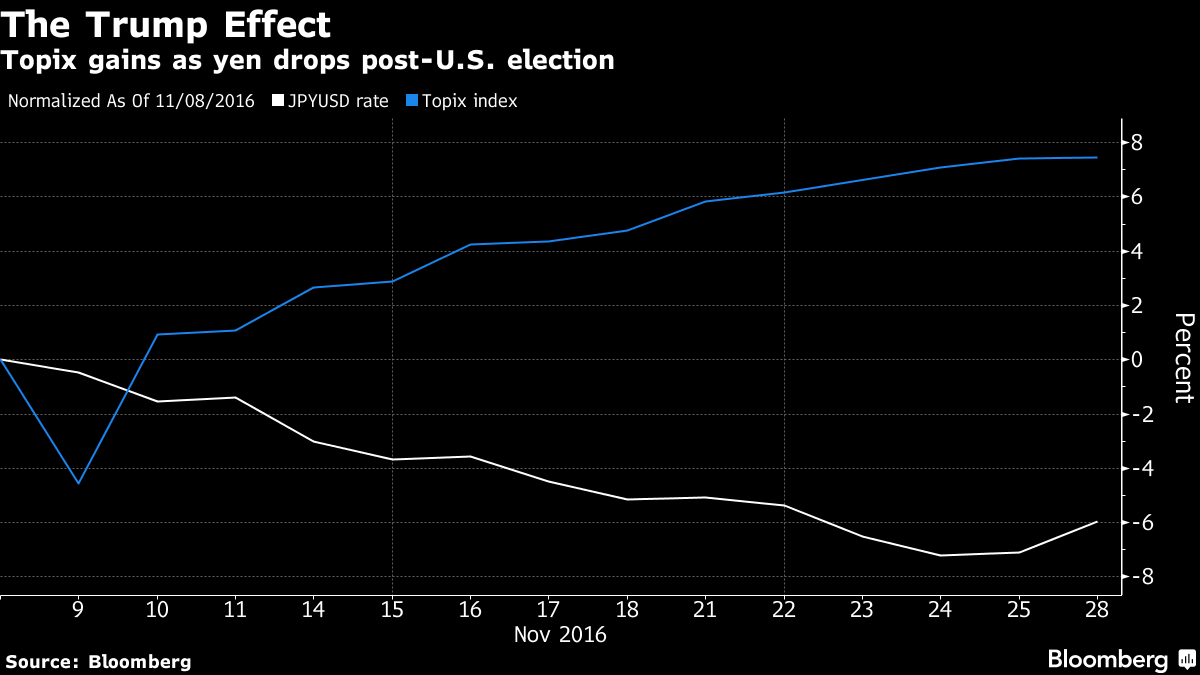
While most analysts were concerned a Trump victory would hurt equities and strengthen the yen, the opposite has been the case. Japan’s benchmark Topix index cruised into a bull market last week and is on course for its 12th day of gains. The 4.6 percent slump on Nov. 9 now seems a distant memory. The yen, meanwhile, is heading for its biggest monthly drop against the dollar since 2009.

GPIF posted a 2.4 trillion yen ($21 billion) investment gain in the three months ended Sept. 30, after more than 15 trillion yen in losses in the previous three quarters. Those losses wiped out all investment returns since the fund overhauled its strategy in 2014 by boosting shares and cutting debt. It held more than 40 percent of assets in stocks, and almost 80 percent of those investments were passive at the end of March.

Tokyo stocks are reaping double rewards from Trump, as the weaker yen boosts the earnings outlook for the nation’s exporters. The Topix is the fourth-best performer since Nov. 9 in local-currency terms among 94 primary equity indexes tracked by Bloomberg.

Global Rally

But they’re not the only ones. More than $640 billion has been added to the value of global stocks since Nov. 10, when many markets around the world started to climb on bets Trump would unleash fiscal stimulus and spur inflation, which has boosted the dollar and weakened the yen. The S&P 500 Index closed Wednesday at a record high in New York.

Bonds have tumbled for the same reasons, with around $1.3 trillion wiped off the value of an index of global debt over the same period. Japan’s benchmark 10-year sovereign yield touched a nine-month high of 0.045 percent on Friday, surging from as low as minus 0.085 percent on Nov. 9.

GPIF’s return to profit is a welcome respite after critics at home lambasted it for taking on too much risk and putting the public’s retirement savings in jeopardy.

The fund’s purchases of stocks are a “gamble,” opposition lawmaker Yuichiro Tamaki said in an interview in September, after an almost 20 percent drop in Japan’s Topix index in the first half of the year was followed by a 7.3 percent one-day plunge after Britain’s shock vote to leave the European Union. Prime Minister Shinzo Abe said that month that short-term losses aren’t a problem for the country’s pension finances.

Feeling Vindicated

“I’d imagine GPIF is feeling pretty much vindicated,” said Andrew Clarke, Hong Kong-based director of trading at Mirabaud Asia Ltd. “It must be cautiously optimistic about Trump.”

Still, the market moves after Trump’s victory are preceding his policies, and some investors are questioning how long the benefits for Japan — and GPIF — can last. Trump already said he’ll withdraw the U.S. from the Trans-Pacific Partnership trade pact on his first day in office. The TPP is seen as a key policy for Abe’s government.

“It looks good for GPIF for now,” said Naoki Fujiwara, chief fund manager at Shinkin Asset Management Co. in Tokyo. But “whether the market can continue like this is debatable.”

In my opinion, it’s as good as it gets for GPIF as global stocks surged, global bonds got hammered and the yen depreciated a lot versus the US dollar following Trump’s victory.

I’ve already recommended selling the Trump rally. Who knows, it might go on till the Inauguration Day (January 20th) or even beyond, but the truth is there was a huge knee-jerk reaction mixed in with some irrational exuberance propelling global stocks and interest rates a lot higher following Trump’s victory.

Last week, I explained why I don’t see global deflation risks fading and told my readers to view the big backup in US bond yields as a big US bond buying opportunity. In short, nothing trumps the bond market, not even Trump himself.

All these people telling you global growth is back, inflation expectations will rise significantly, and the 30+ year bond bull market is dead are completely and utterly out to lunch in my opinion.

As far as Japan, no doubt it’s enjoying the Trump effect but that will wear off fairly soon, especially if Trump’s administration quits the TPP. And it remains to be seen whether Trump is bullish for emerging markets and China in particular, another big worry for Japan and Asia.

In short, while the Trump effect is great for Japan and Euroland in the short-run (currency depreciation alleviates deflationary pressures  in these regions), it’s far from clear what policies President-elect Trump will implement once in power and how it will hurt the economies of these regions.

All this to say GPIF should hedge and take profits after recording huge gains following Trump’s victory. Nothing lasts forever and when markets reverse, it could be very nasty for global stocks (but great for global bonds, especially US bonds).

One final note, I’ve been bullish on the US dollar since early August but think traders should start thinking about the Fed and Friday’s job report. In particular, any weakness on the jobs front will send the greenback lower and even if the Fed does move ahead and hike rates once in December, you will see traders take profits on the US dollar.

If the US dollar continues to climb unabated, it will spell trouble for emerging markets and US corporate earnings and lower US inflation expectations (by lowering import prices).

Be very careful interpreting the rise in inflation expectations in countries like the UK where the British pound experienced a huge depreciation following the Brexit vote. These are cyclical, not structural factors, driving inflation expectations higher, so don’t place too much weight on them.

And you should all keep in mind that Japan’s aging demographics is a structural factor weighing down growth and capping inflation expectations. This is why Japan is at the center of the global pension storm and why it too will not escape Denmark’s dire pension warning.

Targeting Canada’s DB Pensions?

Leo Kolivakis is a blogger, trader and independent senior pension and investment analyst. This post was originally published at Pension Pulse.

Grace Macaluso of the Windsor Star reports, Opposition MPs, labour groups decry federal ‘anti-pension’ bill:

A growing number of seniors could face poverty if the federal Liberals proceed with proposed legislation enabling Crown corporations and federally regulated private sector employers to back out of defined benefit pension plans, Essex MP Tracey Ramsey said Monday.

“With less and less retirement security, seniors in Windsor-Essex are living more precariously than they ever have because of the erosion of benefits,” said Ramsey.

In Windsor-Essex, one in 11 seniors was living in poverty, according to figures compiled by the Windsor-Essex County United Way. For a single family household, the low income cutoff totalled about $19,900 a year.

The NDP member and labour groups are sounding the alarm over Bill C-27, which would amend the Pension Benefits Standards Act, and allow federally regulated employers and Crown corporations to replace defined benefit plans with target benefit plans.

More than 820,000 people, or six per cent of all Canadian workers, are employed in such sectors as banking, rail, air and ferry transportation, radio and television broadcasting.

Introduced by Finance Minister Bill Morneau last month, the bill has yet to be debated in the House of Commons.

The legislation is “an attack on retirees and working people,” Ramsey said. “There couldn’t be a more wrong-headed approach. When we talk about defined benefits, that’s deferred wages. That’s something workers know they can count on. These new target plans are extremely unstable.”

Defined benefit pensions guarantee a specified payment upon an employee’s retirement. Any funding shortfall must be covered by the employer. Target pension plans borrow attributes from defined benefit plans and defined contribution pension plans, which absolve employers from covering any funding deficits. Target benefits plans can place limits on the volatility of employer contributions; in the event of a funding deficit, part or all of it can be compensated by reducing benefits. A traditional defined benefit plan would require the entire deficit to be made up by the employer.

The proposed federal legislation will broaden the scope of retirement savings opportunities, a Department of Finance spokesman said in an emailed statement.

Target benefit plans “represent a new, voluntary, sustainable and flexible pension option for employees in federally regulated private sector and Crown corporation pension plans,” the statement said. “For those who choose this option, (target benefit plans) will provide a lifetime pension that benefits from the pooling of market risk and protects against the risk of outliving one’s retirement savings. At the same time, transferring benefits from an existing plan to a (target benefit plan) is optional.”

Hussan Yussuff, president of the Canadian Labour Congress, viewed the move as yet another attempt by employers to shift workers out of defined benefit plans.

“Currently, defined benefit pensions provide stability and security to employees because employers are legally obliged to fund employees’ earned benefits,” said Yussuff. “Bill C-27 removes employers’ legal requirements to fund plan benefits, which means that benefits could be reduced going forward or even retroactively. Even people already retired could find their existing benefits affected.”

Yussuff said the former federal Conservative government attempted a similar move but, after holding public consultations, dropped the plan ahead of the October 2015 election.

The Liberals, on the other hand, introduced the proposed legislation, without consulting Canadians, unions or pensioners, he said. “This proposal directly contradicts Prime Minister Justin Trudeau’s campaign promise to help the middle class by improving retirement security.”

It also smacks of hypocrisy given the fact that MPs are enrolled in defined benefit pension plans, noted Yussuff. “They maintain a defined benefits plan for themselves, and I don’t have an issue with that. But why would they treat workers with such disregard?”

Pension numbers

4,402,000 Canadian employees were in defined benefit pension plans in 2013, down 0.5 per cent from 2012.

71.2 per cent of employees in a registered pension plan in 2013 had defined benefits, compared with more than 84 per cent a decade earlier.

1,037,000 employees were in defined contribution plans in 2013, up 0.6 per cent from 2012.

86 per cent of employees with defined contribution plans in 2013 worked in the private sector.

746,000 employees belonged to other pension plans, such as hybrid or composite, in 2013 — up two per cent from 2012.

Source: Statistics Canada

I asked Bernard Dussault, Canada’s former Chief Actuary, to share his thoughts on Bill C-27 (added emphasis is mine):

For both concerned employers and employees, Bill C-27 is a poor, inappropriate and unduly complex solution to the possibly real, but generally highly overestimated debt of Defined Benefit (DB) plans sponsored by employers for their employees.

Such pension debt overestimates are caused by the DB plans-related legislation, i.e. the 1985 Pension Benefits Standards Act (PBSA), which compels these plans to be evaluated on a solvency as opposed to a realistic ongoing concern basis.

And as Bill C-27 allows any DB plan sponsor to shift to active and retired plan members the responsibility to assume any debt of the DB plan upon the effective date of its conversion into a Target Benefit (TB) plan, it plainly corresponds to an unfair and inappropriate legalized embezzlement of some pension benefits by the plan sponsor.

Actually, Bill C-27 is a replicate of the so-called Shared Risk Plan (actually and more precisely a TB plan that fully shifts the risks to, rather than shares risks with, plan members) introduced in New Brunswick on January 1, 2014, with the exception that DB plan members would have to consent to its conversion into a TB plan. It is to be reasonably feared that DB plan members would give such consent only pursuant to a misunderstanding of the complex TB plans provisions envisioned by Bill C-27.

By virtue of Bill C-27, a DB plan converted into a TB plan would no longer be subject to solvency valuations. Besides, the onus of any still emerging deficits would be assumed entirely by active and retired members.

Indeed, pension deficits would naturally continue to emerge from time to time as would surpluses. In this vein, Bill C-27 fails to address the existing unsuitable PBSA provision allowing plan sponsors to take possession of DB and TB pension plans surplus through contribution holidays (CH). These CHs are a sure recipe for financial disaster and are a very, if not the most important cause of financial difficulties encountered by DB plans.

In light of the above considerations, I have been steadily promoting since 2013 the following three amendments to the PBSA, which would be much more sensible, effective and appropriate than Bill C-27 and would also counteract its severe inadequacies:

  1. Evaluation of DB plans on a realistic (i.e. margin-free best estimate assumptions erring on the safe side, no asset value averaging, etc.) going concern basis rather than a solvency basis.
  2. Full prohibition of contribution holidays.
  3. Amortization of emerging surplus over 15 years, just as already are emerging deficits, i.e. through a generally small decrease or increase, respectively, in the contribution rate. This would well address one of the DB pan sponsors’ main aversion for DB plans, i.e. their highly fluctuating and unpredictable costs. In case where a given DB plan sponsor would still envision the higher stability of contribution rates under a TB pension plan, then there would be a case to maintain the DB plan (as opposed to convert it into a TB plan) and negotiate with plan members the transfer to them of the very light contribution rates volatility of my proposed DB plan financing policy.

I thank Bernard for sharing his wise insights with my readers. I’ve openly questioned the merits and logic of Bill C-27 in a recent post covering the Liberals attack on public pensions.

There is a wide gap in the pension policy the Liberals are implementing. On the one hand, they are enhancing the CPP for all Canadians which is a very smart move, and courting large funds to help them with their infrastructure program (another very smart move), but on the other hand they are introducing a bill which will potentially kill defined-benefit plans in Canada (a very dumb move).

This is a sleazy and underhanded move from a party which was attacking the Conservatives when they tried doing the same thing (at least they were upfront about it).

The global pension storm is gathering steam and one thing that worries me is bonehead policies like this which attack defined-benefit plans, the very plans we need to bolster and expand in a world where pension poverty and anxiety are on the rise. And make no mistake, if Bill C-27 passes, it will exacerbate pension poverty and negatively impact economic activity for decades to come.

Unlike Bernard Dussault and public sector unions, however, I don’t think DB plans can be bolstered just by prohibiting contribution holidays (something I agree with). I believe that some form of risk-sharing is essential if we are to safeguard DB plans and make sure they are sustainable over the long run. Target benefit plans are not the solution but neither is maintaining the farce that DB plans can exist with no shared-risk model.

[Note: To be fair, after reading my comment, Bernard sent me his proposed DB pension plan financing policy which “promotes true risk sharing at any level (ideally 50%/50%) between the plan sponsor and the plans members, in such a way that not only would both parties share the cost but also the 15-year amortization of surpluses and deficit.”]

I take Denmark’s dire pension warning very seriously and so should many policymakers and unions who think we can just continue with the status quo. We can’t, we need to adapt and be realistic about what defined-benefit pensions can and cannot offer in a world of low or negative rates.

Denmark’s Dire Pension Warning?

Leo Kolivakis is a blogger, trader and independent senior pension and investment analyst. This post was originally published at Pension Pulse.

Frances Schwartzkopff of Bloomberg reports, World’s Best-Funded Pension Market Has a $650 Billion Warning:

No country on the planet is better prepared to pay for its aging population than Denmark. But a nation whose pension industry has been ahead of the curve for decades is now bracing for a fundamental shift that most people probably aren’t prepared for, according to the financial regulator.

Jesper Berg, the director general of the Financial Supervisory Authority in Denmark, wants to warn policy makers of the backlash he says they may face once households understand the risks they run. More specifically, Berg says people haven’t grasped that they will lose money if their banks or the investments their funds make fail.

“While people applaud if money doesn’t go out of their pocket as a taxpayer, they have yet to realize that it will go out of their pocket as a depositor or pensioner or investor,” Berg said in an interview in Copenhagen. “These are enormous amounts of money, so this is an important discussion to have.”

Berg says the FSA has called for talks with politicians and industry representatives to take place in March to discuss the issue.

Privatizing Risk

Denmark’s life insurers hold more than $650 billion in assets, which is roughly 2 1/2 times the size of the economy, according to UBS’s Pension Fund Indicators 2016. At $118,214, assets per capita are among the highest in the world. In Switzerland, the figure is $98,287. In the Netherlands, it’s $79,721.

Berg says the redrawing of financial regulation since the crisis of 2008 has had some profound consequences. New solvency rules for pension funds mean clients are being pushed out of defined benefit plans and into defined contributions plans, to help providers cut their capital requirements. That helps insurers stay solvent. It also frees them to take riskier bets. But, crucially, that risk is transferred to pensioners on an individual basis.

This privatization of risk that has followed the global regulatory overhaul is “the new reality” that “we need to discuss,” Berg said.

Global Leader

Denmark’s warning is worth heeding. The country has been at the forefront of pension reform, ensuring that companies can meet their obligations and that people have enough savings to live comfortably in retirement. It’s repeatedly topped rankings in the Melbourne Mercer Global Pension Index on adequacy and sustainability.

In practical terms, the risk is that a pension fund invests in something “that makes huge losses with the result that pensioners lose money and have to live with lower pensions or stay in the labor market longer,” Berg said.

And demand for risky assets is growing as funds look for ways to generate returns in an era of record-low interest rates. Denmark’s regulator has started looking more closely at funds’ investments in less liquid assets and found that holdings of so-called alternative investments surged 66 percent from 2012 to 2015.

Berg says it’s not the role of the supervisor to question the model. But he’s worried about how well it’s understood.

“While I believe in the economic incentive to privatize risk, my biggest fear is that people aren’t aware of that, and as a consequence we’ll have a backlash,” he said.

A new regulation called the prudent person principle guides funds’ investments, but it’s “still a very general principle,” Berg said. It is for the politicians to decide whether additional rules are necessary and the FSA will provide them with options, “but I just want that discussion to be taken before we have the first meltdown.”

Politicians around the world better heed Jesper Berg’s warning because if they think Brexit, Trump and Marine Le Pen are all part of the anti-establishment revolution, wait till they see millions of retired people succumb to pension poverty. This will really shake up politics like never before.

Last week, I discussed the global pension storm, noting the following:

[…] last week was a great week for savers, 401(k)s and global pensions. The Dow chalked up its best week in five years and stocks in general rallied led by banks and my favorite sector, biotechs which had its best week ever.

More importantly, bond yields are rocketing higher and when it comes to pension deficits, it’s the direction of interest rates that ultimately counts a lot more than any gains in asset values because as I keep reminding everyone, the duration of pension liabilities is a lot bigger than the duration of pension assets, so for any given move in rates, liabilities will rise or decline much faster than assets.

Will the rise in rates and gains in stocks continue indefinitely? A lot of underfunded (and some fully funded) global pensions sure hope so but I have my doubts and think we need to prepare for a long, tough slug ahead.

The 2,826-day-old bull market could be a headache for Trump but the real headache will be for global pensions when rates and risk assets start declining in tandem again. At that point, President Trump will have inherited a long bear market and a potential retirement crisis.

This is why I keep hammering that Trump’s administration needs to include US, Canadian and global pensions into the infrastructure program to truly “make America great again.”

Trump also needs to carefully consider bolstering Social Security for all Americans and modeling it after the (now enhanced) Canada Pension Plan where money is managed by the Canada Pension Plan Investment Board. One thing he should not do is follow lousy advice from Wall Street gurus and academics peddling a revolutionary retirement plan which only benefits Wall Street, not Main Street.

You should read my comment on the global pension storm to understand why I continue to worry about global deflation, the rising US dollar and why bond yields are likely to revisit new secular lows, placing even more pressure on global pensions in the years ahead.

This is why I respectfully disagree with Bob Prince and Ray Dalio at Bridgewater who called an end to the 30-year bond bull market after Trump’s victory. I have serious concerns on Trump and emerging markets and I wouldn’t be so quick to rush out of bonds (in fact, I see the big backup in bond yields as an opportunity to buy more long dated bonds (TLT) and will cover this in a separate comment).

But Jesper Berg’s critical point is this, as defined-benefit pensions become a thing of the past, retirement anxiety will grow as risk is transferred to pensioners, many of which risk outliving their savings and succumbing to pension poverty. This will have profound social, political and economic consequences for all countries.

And he’s absolutely right, this privatization of risk that has followed the global regulatory overhaul is “the new reality” that “we need to discuss.”

Why? Because pension poverty is part of rising inequality, and along with aging demographics, these are major structural forces driving global deflation. You simply cannot have increasing aggregate demand and inflation when a large subset of the population is succumbing to pension poverty.

The other part of Jesper Berg’s warning is equally important, namely, global pensions are responding to record low yields by increasingly shifting their portfolio into illiquid assets. I touched upon it last week when I covered Bob Prince’s visit to Montreal:

So what in a nutshell did Bob Prince say? Here are the main points that I jotted down:

  • Higher debt and low rates will impact asset values, limit credit growth and economic growth over next decade
  • Monetary policy and asset returns are skewed  (so you will see bigger swings in risk assets)
  • Currency swings matter a lot more in a low rate/ QE world (expect higher currency volatility)
  • Low rates and low returns are here to stay (expected returns in public markets will be in low single digits over next decade)
  • We are reaching an important inflection point where valuations of illiquid assets are nearing a peak at the same time where dollar liquidity dries up.

I emphasized that last point because it’s bad news for many pensions, insurance companies, sovereign wealth funds and endowments piling into illiquid assets like private equity, real estate and infrastructure at historically high valuations.

Not that they have much of a choice. Bob Prince said in this environment, you have three choices:

  1. Do nothing and accept the outcome
  2. Take more risk
  3. Take more efficient risk (like in illiquid assets)

Institutions have been taking more efficient risk in illiquid asset classes but the pendulum may have swing too far in that direction and if he’s right and we’re at an important inflection point, then there will be a big correction in illiquid asset classes.

Even if he’s wrong, expected returns on liquid and illiquid asset classes will necessarily be lower over the next decade, so the diversification benefits of illiquid assets won’t be as strong going forward.

[Note: Admittedly, this is a bit of self-serving point made by the co-CIO of the world’s largest hedge fund which invests only in liquid assets. He’s trying to steer investors away from illiquid to more liquid alternatives like Bridgewater but he forgets that pensions and other institutional investors have a very long investment horizon, so they can take a lot more illiquidity risk.]

Taking more “efficient risk” by investing billions into private equity, real estate and infrastructure makes sense for pensions with a long investment horizon but it’s no panacea and if it’s not done properly, it could spell ruin for many chronically underfunded pensions taking more risk at the worst possible time.

Pension deficits are path dependent. If your pension is chronically underfunded, taking more risk in public or private markets praying for a miracle, then that is not a strategy, that is a recipe for disaster.

What is a better strategy? Politicians need to bolster defined-benefit plans, get the governance and compensation right, bolster the social safety net (enhance the Canada Pension Plan and US Social Security) and set up a system that allows pensions to invest billions in domestic infrastructure.

I’ve discussed my thoughts on this recently going over how pensions can make America great again and why the Canadian federal government is courting large global and domestic funds to develop its infrastructure program.

Of course, pensions have a mission to maximize returns without taking undue risk. This means that if they invest in infrastructure, they will necessarily expect a return on their investment or else they are better off investing elsewhere.

I mention this because I’m a bit dismayed at some of the nonsense I’m reading from Nobel-laureate Paul Krugman warning of an infrastructure privatization scam before even seeing the details of the program. My former BCA colleague Gerard MacDonell loves praising Krugman for being ‘wonderfully non-centrist‘ but there’s is nothing wonderful about spreading nonsense on infrastructure program whose details have yet to be unveiled.

And the problem is that unions read Krugman as if he’s some kind of economic god and take his economic articles very seriously (sure, he’s a brilliant economist but he has a political axe to grind because Clinton undoubtedly promised him a high-profile cabinet position). When I read articles like this one on public risk, private profits, I’m disheartened by the leftist union rhetoric which quite frankly goes against what is in the best interests of public defined-benefit pensions and the economy over the long run.

Let me be a little blunt here, after all I hate skirting around an issue. Yes, we need to address the concerns of unions but we also need a reality check when it comes to infrastructure and courting pensions and private equity firms. Governments are constrained in terms of borrowing and spending and when it comes to managing infrastructure assets, I trust the people at Ontario Teachers, OMERS, the Caisse, CPPIB, PSP, and other large Canadian pensions a lot more than some government bureaucrats who do not have a profit motive.

Does this mean we need more tolls and higher user fees to pay for infrastructure? You bet it does and there’s nothing wrong with this as it’s not only fair for pensions looking to make long-term steady returns on their infrastructure investments, it’s fair for taxpayers and it helps alleviate the fiscal burden on governments.

All this to say, Denmark’s dire pension warning is real and policymakers and the elite intelligentsia better discuss solutions to the global pension crisis like adults, not like left-wing or right-wing adolescent brats that place ideology and politics over logic and what is in the best interest of pensioners and the country over the long run.

CalSTRS Sets Standard on Fee Disclosure?

Leo Kolivakis is a blogger, trader and independent senior pension and investment analyst. This post was originally published at Pension Pulse.

Robin Respaut of Reuters reports, CalSTRS calculates total fees in likely first for public pension:

The California State Teachers’ Retirement System announced on Wednesday that it had calculated the total costs and fees paid to manage its entire investment portfolio, likely the first public pension fund to do so.

CalSTRS found total expenses, including carried interest, reached $1.6 billion in calendar year 2015, or less than 1 percent of the portfolio’s $186 billion net asset value.

Presented for first time at Wednesday’s meeting of CalSTRS’ board, the new cost report marks a milestone among public pension funds to keep tabs on investment expenses and may motivate other funds to track their fees.

It also comes at a time when public pension funds, which manage the retirement benefits of public sector workers and retirees, face growing pressure to disclose the fees that they pay.

The task was not an easy one, however. CalSTRS has over 600 partnership investments, separately managed accounts, joint ventures and co-investments within its portfolio, and there is no industry standard for cost reporting.

As a result, to tally up all of the carried interest, management fees, partnership expenses and portfolio company fees paid by CalSTRS, information had to be collected one investment at a time through direct engagement.

“To the best of my knowledge, this is the most comprehensive review of investment costs,” Allan Emkin of Pension Consulting Alliance said at Wednesday’s meeting. “On the issue of transparency and disclosure, you will be seen as the new leader.”

On Monday, CalSTRS sister fund, CalPERS, announced it had shared about 14 percent of the profit made on private equity investments in the past year with firms managing its private equity asset class.

CalSTRS took fee disclosure a step further, calculating the fees and costs for its entire portfolio. Of the $1.6 billion, approximately 61 percent was external and internal costs, while 39 percent was carried interest, or profits shared.

CalSTRS said it paid an outside firm to compile the data, with the total cost of the project reaching $425,000 plus 1,500 hours of staff time.

Board members said the report was worth the money because it clarified important investment costs.

“This is absolutely fantastic,” said Board Member Paul Rosenstiel. “I think it’s very well worth the time and the expenditure.”

CalSTRS is leading the way once again with this initiative to be completely transparent by disclosing all the fees it pays out to external managers and track total expenses more closely.

Why is this exercise important? Because in a world of historically low rates, fees and other costs matter a lot more and they can add up fast, eating away at the investment returns over a long period.

You’ll recall last month CalSTRS cut about $20 billion from its external manager program. A big part of this decision was a consequence of this exercise where they delved into what they were paying in fees and what they were receiving in return.

Kudos to CalSTRS as I honestly think it’s essential to be as transparent as possible on every aspect of pension investments, including fees and benchmarks used to evaluate performance of various investment portfolios.

I give CalSTRS an A+ on benchmarks, communication and transparency. It was actually one of the pension funds I used as an example when I wrote a big report on the governance of the federal public sector pension plan back in the summer of 2007 for the Treasury Board of Canada.

Where CalSTRS fails to meet my governance standards is that it still has too much state government interference in its affairs, there is no independent qualified board to oversee its operations and while compensation is solid, it can be significantly improved as they bring more assets internally.

Think about it, they paid 39 percent of $1.6 billion in carried interest in calendar year 2015 which translates into $640 million. That doesn’t include management fees, this is only carried interest (performance fees).

No doubt, pensions need to pay for performance, especially if they cannot replicate it in-house, I totally agree with this. But imagine they took 5% of that $640 million to hire people to manage assets internally across public and private markets, wouldn’t they be better off?

In order to do this, they need to get the governance and compensation right, the way Canada’s large public pensions have done. And that’s where CalSTRS, CalPERS and most US public pensions run into trouble as there is way too much political interference in the operations of their pensions.

Having said this, sometimes you need some political interference to get these large public pensions to disclose things, like fees and total expenses. Here, I applaud California’s State Treasurer John Chiang as he has put the screws on CalPERS and CalSTRS to disclose these fees.

Is it perfect? No, far from it, there are tons of hidden fees that were probably not accounted for because they were hidden and hard to find or because they decided to ignore these fees.

And let’s not make this out to be more than it truly is, an accounting exercise. In fact, Leo de Bever, the former head of AIMCo who ran a similar exercise back in 2009 when AIMCo paid out $174 million in external fees to highlight the need to compensate internal staff properly, shared this with me:

This is just accounting – how hard can this be?

The problem may be that they used to subtract carried interest from return.

Capitalization of some structuring cost can be another issue – there are rules about what is capital and what is not.

Sure, accounting for all these internal and external costs isn’t easy, especially if you don’t have the right systems in place to track all these fees and costs, but let’s not get ahead of ourselves here as there is nothing earth-shattering in tallying up fees and costs and many senior pension fund managers reading this will agree with me.

Still, let me be fair and crystal clear, I am for more transparency when it comes to fees and internal costs, and if CalSTRS is ready to set the standard in terms of reporting fees and costs, then I’m all for it.

In an ideal world, we should be able to read the annual report of any public pension to understand how much was paid out in management fees, how much in performance fees (carried interest), how much for internal salaries, how much to vendors, brokers, consultants, accountants, lawyers, etc. and exactly who received what amount.

This information is readily available but I doubt any public pension is willing to provide such granular detail. However, I remember a long time ago, a senior private equity manager of a large Canadian pension telling me how it would be nice if pensions reported the IRRs of their internal staff relative to their external managers. A lot of things would be nice, but they will never happen.

One thing is for sure, I applaud CalSTRS’ new initiative and hope all other pensions follow suit in terms of disclosing total fees and costs and providing more specific information in terms of external manager fees.

Of course, the devil is in the details. I reached out to Chris Ailman, CalSTRS’ CIO, to discuss this new initiative but he’s tied up in board meetings today.

The latest CalSTRS board meeting (November 16-17) isn’t available yet but it will soon be made public here.

Canada Courts Big Funds on Infrastructure?

Leo Kolivakis is a blogger, trader and independent senior pension and investment analyst. This post was originally published at Pension Pulse.

Bill Curry and Jacqueline Nelson of the Globe and Mail report, Trudeau touts Canada as safe option for infrastructure investment:

Justin Trudeau is billing Canada as a stable option for international investors amid market uncertainty in the aftermath of the election of Donald Trump in the United States.

Speaking at the end of a day spent courting some of the world’s largest wealth managers, the Prime Minister added a clear political spin to his government’s pitch that investors should be working with Ottawa on infrastructure projects.

“The fact is Canada is lucky to have citizens that are forward-thinking, that are reasonable, that are understanding that drawing in global investment will lead to good Canadian jobs,” he said.

Mr. Trudeau said Canada is attracting attention from people who wonder how the country remains open to investment, trade and immigration during a period of uncertainty, making reference to the “election of the Republican candidate in the United States” without naming Mr. Trump.

Mr. Trudeau is encouraging banks, pension funds, insurance companies and private wealth funds to take equity stakes in Canadian infrastructure projects through a new Canada Infrastructure Bank announced this month. Advocates say such a bank could group public and private funds together for large projects, allowing more construction to proceed more quickly.

Politics aside, some of the investors in attendance gave the government’s presentation an enthusiastic response.

Mark Machin, chief executive officer of the Canada Pension Plan Investment Board, was among the roughly two dozen Canadian-based investors who met Monday morning with Mr. Trudeau and senior ministers to discuss infrastructure spending.

“It’s a terrific initiative,” he said in an interview at the CPPIB’s Toronto headquarters following the meeting. Mr. Machin said the infrastructure plan should “absolutely” attract new money from institutional investors because the bank will offer firms a single point of contact and is promising to do the advanced research in order to prioritize infrastructure projects that are good candidates for private partnerships.

“I would think if this gets off the ground the way it should, then it should result in significant increase in activity in infrastructure,” he said.

The CPPIB announced earlier this month that the assets of the CPP fund have climbed above $300-billion as of Sept. 30, which is up from $287.3-billion the year before.

The CPP fund has just one current investment in Canadian infrastructure: a 40-per-cent share of Ontario’s 407 toll highway, which runs through the Greater Toronto Area.

Mr. Trudeau also met Monday with global wealth managers in the afternoon, among them representatives from BlackRock Inc., which is the largest asset manager in the world.

Executives from the country’s largest banks, pension funds and insurance companies said Monday morning’s meeting affirmed the government’s commitment to developing its infrastructure plan, but several attendees said it was short on details of what the planned infrastructure bank would look like.

Ministers representing the departments of Finance, Transport, Natural Resources and Infrastructure and Communities outlined the types of infrastructure deals and projects that are most interesting to the government. Some executives offered thoughts on what made certain infrastructure deals work well in other parts of the world, and they suggested different investment structures that could work for building new projects such as pipelines and electricity transmission.

“I believe that they have a vision to put together a model which is pretty ground-breaking,” said Ron Mock, chief executive officer of the Ontario Teachers’ Pension Plan, after the session. He noted that private funding models exist in Britain, Australia and Mexico and that Canada could be a leader with its plan. “In terms of the details of how it will actually be executed, I think they are correctly looking to the expertise that exists in the country for input and advice on how to move this agenda forward.”

Attendees characterized the meeting as an early step in gathering input and support for the part of the government’s planned $180-billion spending spree that is counting on an influx of private capital. But some said they were hoping there would be more clarity on what happens next, rather than being asked for another round of input on how to make the plan work.

During the session, the group discussed the widespread interest in so-called “brownfield” assets – where investors buy and operate existing infrastructure, rather than taking on the risk of constructing new projects from scratch. The government has expressed more interest in using private capital in building new infrastructure projects, called “greenfield.”

Questions about how the federal government would align its objectives with the provincial and municipal governments that traditionally control a lot of infrastructure spending were also top of mind for many participants. Constructing new infrastructure where users must pay fees or tolls may be a tricky sell to these lower levels of government and their constituents.

“Clearly the execution of this becomes important, and that in many cases requires the federal, provincial, municipal alignment, which is which is pretty key,” Mr. Mock said. “Because most infrastructure in this country is either provincial or municipal and it’s the federal government that is wanting to initiate such a plan.”

Barbara Shecter of the National Post also reports, Trudeau’s investment pitch wins praise as Ottawa courts world’s most powerful investors:

Prime Minister Justin Trudeau pitched fund managers from around the world on the merits of investing billions in Canadian infrastructure projects Monday, earning praise from some but leaving others with questions about how such deals would work.

Ottawa is setting up a new entity — the Canada Infrastructure Bank — to promote large national and regional projects, including revenue-generating ones it hopes will draw the interest of big institutional investors, including domestic pension funds.

Monday’s meetings in downtown Toronto — a morning session with Canadian pension funds managers and top bankers, and an afternoon discussion with international investors — brought the prime minister and key cabinet ministers face-to-face with some of the money managers they will need to attract to make the bank a success.

Ron Mock, chief executive of the Ontario Teachers’ Pension Plan, said Trudeau and his cabinet have “got their head in the right place” in creating projects that would draw on government money and investment from institutions, such as pension funds.

“They did a great job,” Mock said as he left the morning meeting, which also included Trudeau, Finance Minister Bill Morneau and top representatives from the Caisse de dépôt et placement du Québec and the Canada Pension Plan Investment Board.

But Hugh O’Reilly, chief executive of the Ontario Public Service Employees Union Pension Trust, said many details needed to be ironed out.

“We still have many questions about how this infrastructure bank will work,” he said. “But the federal government acknowledged that — and are looking to pension funds to provide advice.”

The plan, which has $16 billion in assets, will look at opportunities case by case, he added.

After the meeting, Trudeau said he was “tremendously pleased to see so many business leaders at the table.”

“We know that partnerships with the private sector can be done right, and we look forward to working with these significant global investors to see how we can make sure we’re responding to their needs,” he said.

His government has pledged $81 billion over the next 10 years for infrastructure, including public transit and renewable power projects. The first $15 billion will become available in the spring 2017 budget.

A spokesman for the Canada Pension Plan Investment Board called the talks “constructive.”

The Canadian Infrastructure Bank should offer “an intelligent bridge between what investors are looking for and what governments can offer. (CPPIB officials) look forward to seeing the pipeline of potential infrastructure investments.”

The prime minister said he hoped the bank would “be up and running in 2017, but we’re also working very, very hard with experts and listening to people to make sure we get it right.”

Earlier Monday, a few blocks from the Trudeau meeting, Marc Garneau, the transportation minister, told another group of investors Ottawa’s recently announced $10.1-billion funding commitment to upgrade trade transportation corridors does not depend on participation by the private sector.

Garneau said he expects there will be interest from the public–private partnerships to invest in the trade transportation improvements. But even if there isn’t, the federal government will go ahead with the spending.

“The funding is there,” Garneau said in a brief interview after his speech at a conference organized by the Canadian Council for Public-Private Partnerships, which attracted about 1,200 investors, project proponents and governments from around the world.

“If there is not large institutional investors that want to become involved with it, we will still be using the money, as I said in my speech, to reduce bottlenecks and congestion and make our trade transportation corridors as efficient as possible.”

Morneau announced the $10.1 billion in trade transportation funding in his fall fiscal update this month. The trade corridor upgrades are part of a massive boost in planned infrastructure spending.

Garneau said improving transportation corridors is so important for Canada’s trade, it won’t need to wait for private funding. About one-fifth of Canadian goods is shipped by rail, and much of that is destined for export.

Transportation volumes are increasing. Over the past 30 years, the amount of goods moved by rail has increased 60 per cent, while the amount shipped by sea is up 40 per cent.

The $10.1 billion in funding is designed to remove bottlenecks that are slowing traffic on important export corridors.

That doesn’t mean the government is not interested in encouraging private-sector involvement. The new infrastructure bank is intended to foster private investment in projects.

Garneau said Ottawa understands some projects, especially in public transportation, might require tolls to encourage private-sector investment.

“We’re open to that concept,” he said, in answer to a question from the audience.

Matt Scuffham of Reuters also reports, Canada courts sovereign wealth for infrastructure bank:

Canada’s Liberal government is speaking to sovereign wealth funds and global private equity firms as well as domestic pension funds as it ramps up efforts to attract funding for its new infrastructure bank, according to two sources.

The overseas investors that the officials developing the infrastructure bank are speaking to include the Government Pension Fund of Norway, one of the world’s largest sovereign wealth funds, said the sources, who declined to speak on the record because of the sensitivity of the talks.

The government said earlier this month it would set up an infrastructure bank and give it access to C$35 billion ($26 billion) to help fund major projects.

Prime Minister Justin Trudeau and Finance Minister Bill Morneau are attending an event in Toronto on Monday aimed at attracting private investment. The event is part of a series of meetings with private investors ahead of the launch of the bank, which Ottawa hopes will be up and running next year, the sources said.

Trudeau and Morneau had previously expressed a desire to attract investment from Canada’s biggest pension plans such as the Canada Pension Plan Investment Board (CPPIB), the Caisse de depot du Quebec and the Ontario Teachers’ Pension Plan.

A significant proportion of the projects the bank hopes to fund will be built from scratch, known as “greenfield” investments, rather than “brownfield” investments which have already been built.

The Canadian pension funds, among the world’s ten biggest infrastructure investors, have invested more in projects overseas than in their domestic market.

That is partly because they have preferred to invest in existing infrastructure which has established revenue streams and does not carry construction risk. However, that stance is changing as investors seek alternatives to government bonds and volatile equity markets.

Last week, CPPIB’s Chief Executive Mark Machin said in an interview the fund would be open to investing in greenfield projects through the infrastructure bank.

Meanwhile, the Caisse, Quebec’s public pension fund, is planning to build a new 67 kilometer public transit system in Montreal, investing C$3 billion and seeking to supplement that with C$2.5 billion of federal and provincial government funding.

That project could be one of the first to be funded by the new infrastructure bank, the sources said.

Sources said the Ontario Teachers Pension Plan is also planning to invest more in greenfield projects.

Before I start covering the latest developments on Canada’s infrastructure program, I want to correct an error I made last week when I posted that Bert Clark, the former head of Infrastructure Ontario, left that agency to head up the newly created Canadian Infrastructure Development Bank (CIDB).

It turns out that Mr. Clark is Ontario’s new pension leader, now in charge of running the newly created the Investment Management Corporation of Ontario (IMCO). As of now, the federal government has not named a leader for Canada’s new infrastructure bank. I can suggest a few people, including Bruno Guilmette, the former head of infrastructure at PSP Investments (not sure he wants this job but he is more than qualified and has the right connections).

Let me begin my coverage by referring you to a recent post where I explained why Canada’s large pensions are lukewarm on Canadian infrastructure.

In that comment, I went over concerns on governance and ended it with an update sharing some excellent insights from Andrew Claerhout, Senior Vice-President of Infrastructure & Natural Resources at Ontario Teachers’ Pension Plan who responded to Chas’s comment at the end of the Benefits Canada article:

  • Andrew told me that OTPP, CPPIB, OMERS and the rest of Canada’s large pensions are not interested in small DMBF/ PPP projects which are typically social infrastructure like building schools, hospitals or prisons. Why? Because they’re small projects and the returns are too low for them. However, he said these are great projects for construction companies and lenders because you have the government as your counterparty so no risk of a default.
  • Instead, he told me they are interested in investing in “larger, more ambitious” infrastructure projects which are economical and make sense for pensions from a risk/ return perspective. In this way he told me that they are not competing with PPPs who typically focus on smaller projects and are complimenting them because they are focusing on much larger projects.
  • Here is where our conversation got interesting because we started talking about Australia being the model for privatizing infrastructure to help fund new infrastructure projects. He told me that while Australia took the lead in infrastructure, the Canadian model being proposed here takes it one step further. “In Australia, the government builds infrastructure projects and once they are operational (ie. brownfield), they sell equity stakes to investors and use those proceeds to finance new greenfield projects. In Canada, the government is setting up this infrastructure bank which will provide the bulk of the capital on major infrastructure greenfield projects and asks investors to invest alongside it” (ie. take an equity stake in a big greenfield project).
  • Andrew told me this is a truly novel idea and if they get the implementation and governance right, setting up a qualified and independent board to oversee this new infrastructure bank, it will be mutually beneficial for all  parties involved.
  • In terms of subsidizing pensions, he said unlike pensions which have a fiduciary duty to maximize returns without taking undue risk, the government has a “financial P&L” and a “social P & L” (profit and loss). The social P & L is investing in infrastructure projects that “benefit society” and the economy over the long run. He went on to share this with me. “No doubt, the government is putting up the bulk of the money in the form of bridge capital for large infrastructure projects and pensions will invest alongside them as long as the risk/ return makes sense. The government is reducing the risk for pensions to invest alongside them and we are providing the expertise to help them run these projects more efficiently. If these projects don’t turn out to be economical, the government will borne most of the risk, however, if they turn out to be good projects, the government will participate in all the upside” (allowing it to collect more revenues to invest in new projects).
  • He made it a point to underscore this new model is much better than the government providing grants to subsidize large infrastructure projects because it gets to participate in the upside if these projects turn out to be very good, providing all parties steady long-term revenue streams.

Basically, Andrew Claerhout explains why pensions are not competing with DBFM/ PPPs and are looking instead to invest alongside the federal government in much larger, more ambitious greenfield infrastructure projects where they can help it make them economical and profitable over the long run.

Andrew added this: “Most infrastructure investors focus on brownfield opportunities while the government is most interested in seeing more infrastructure built (i.e., greenfield). The infrastructure development bank is meant to help bridge this divide – hopefully it is successful.”

As the Reuters article mentions, OTPP is open to investing in greenfield infrastructure projects of which the first one to likely be funded by the new federal infrastructure bank is the Caisse’s new 67 kilometer public transit system in Montreal.

Prime Minister Trudeau and Finance Minister Morneau pitched their new infrastructure program to Canada’s large pensions but also to sovereign wealth funds like Norway’s Government Pension Fund and Blackrock, the world’s largest asset manager where Mark Wiseman now works.

The thing that is a bit confusing is that typically large pensions and sovereign wealth funds invest in “brownfield” infrastructure which is already operational with known cash flows, but the federal government is not looking to sell stakes in Canada’s existing airports or ports which it owns.

Instead, the newly created Canada Infrastructure Bank will partner up with Canada’s large pensions and other large global funds to invest in greenfield projects which carry a whole new set of risks.

Can this be done successfully? Of course, and some of Canada’s large pensions like the Caisse have already begun working on greenfield projects and they have the internal resources to complete such ambitious projects.

When I mention the right internal resources, let me be very clear. Macky Tall, the head of CDPQ Infra, has assembled an outstanding team full of people with actual project finance and operational experience in large infrastructure projects. These people previously worked at large engineering/ construction companies like SNC-Lavalin and other places where they had to handle budgeting, building and operating large greenfield infrastructure projects.

I’m going to be very honest here, Canada’s large pensions have made outstanding “brownfield” infrastructure investments all over the world but nobody has assembled a team like that at CDPQ Infra to handle the risks and complexities that go along with greenfield projects.

In fact, when it comes to direct infrastructure and real estate investments, CDPQ Infra and Ivanhoé Cambridge, the Caissse’s real estate subsidiary, are truly on another level in terms of operational expertise.

Interestingly, I had a brief chat with Hugh O’Reilly, CEO of OPTrust, this morning in the midst of writing this comment and asked him why he said many details needed to be ironed out on this new infrastructure program.

Hugh repeated that there are a lot of questions on how the federal infrastructure bank will operate but the government is going to address these concerns. He also said the federal government needs to reach out to public-sector unions to address their concerns, “just like the Caisse did.” 

He also told me that OPTrust’s alternatives portfolio is growing and they are investing more and more directly in private equity, real estate and infrastructure. I will cover OPTrust in detail in a future comment and thank Hugh for taking the time from his busy schedule to speak with me (extremely nice man, would like to spend more time with him and James Davis, OPTrust’s CIO, to understand their investments and operations).

Let me end my comment by stating that even though there are a lot of details that need to be worked out, there is no question in my mind that Canada has the requisite expertise to make a successful partnership between the new Infrastructure Bank, Canada’s large pensions and foreign investors interested in investing in large greenfield infrastructure projects.

Importantly, if Canada’s new infrastructure program is successful and they get the governance right at the Canadian Infrastructure Development Bank (CIDB) , it will be a new unique approach to investing in greenfield infrastructure unlike anything else in the world. It will set a new global standard, one that many countries will try to adopt, including the United States where I really believe a Trump administration needs to approach US, Canadian and global pensions to “make America great again”  (Trump’s plan to rebuild America will be a lot harder to pay for than it sounds).

Lastly, please pay no attention whatsoever to Terence Corcoran’s latest, The Liberals’ new ‘infrastructure bank’ is pure central planning at its worst. I’m tired of addressing the drivel coming out of the National Post from the likes of Andrew Coyne and Terence Corcoran who quite frankly haven’t the faintest idea of good governance, investing in infrastructure, and why this plan makes sense for the federal government, Canada’s large pensions, their members and stakeholders, Canadian taxpayers and most important of all, for the Canadian economy over the long run.

The Global Pension Storm?

Leo Kolivakis is a blogger, trader and independent senior pension and investment analyst. This post was originally published at Pension Pulse.

Timothy W. Martin, Georgi Kantchev and Kosaku Narioka of the Wall Street Journal report, Era of Low Interest Rates Hammers Millions of Pensions Around World (h/t Ken Akoundi, Investor DNA):

Central bankers lowered interest rates to near zero or below to try to revive their gasping economies. In the process, though, they have put in jeopardy the pensions of more than 100 million government workers and retirees around the globe.

In Costa Mesa, Calif., Mayor Stephen Mensinger is worried retirement payments will soon eat up all the city’s cash. In Amsterdam, language teacher Frans van Leeuwen is angry his pension now will be less than what his father received, despite 30 years of contributions. In Tokyo, ex-government worker Tadakazu Kobayashi no longer has enough income from pension checks to buy new clothes.

Managers handling trillions of dollars in government-run pension funds never expected rates to stay this low for so long. Now, the world is starved for the safe, profitable bonds that pension funds have long needed to survive. That has pulled down investment returns and made it difficult for funds to meet mounting obligations to workers and retirees who are drawing government pensions.

As low interest rates suppress investment gains in the pension plans, it generally means one thing: Standards of living for workers and retirees are decreasing, not increasing.

“Unless ordinary people have money in their pockets, they don’t spend,” the 70-year-old Mr. Kobayashi said during a recent protest of benefit cuts in downtown Tokyo. “Higher interest rates would mean there’d be more money at our disposal, even if slightly.”

The low rates exacerbate cash problems already bedeviling the world’s pension funds. Decades of underfunding, benefit overpromises, government austerity measures and two recessions have left many retirement systems with deep funding holes. A wave of retirees world-wide is leaving fewer active workers left to contribute. The 60-and-older demographic is expected to roughly double between now and 2050, according to the United Nations.

Government-bond yields have risen since Donald Trump was elected U.S. president, though few investors expect a prolonged climb. Regardless, the ultralow bond yields of recent years have already hindered the most straightforward way for retirement funds to recover—through investment gains (click on image).

Pension officials and government leaders are left with vexing choices. As investors, they have to stash away more than they did before or pile into riskier bets in hedge funds, private equity or commodities. Countries, states and cities must decide whether to reduce benefits for existing workers, cut back public services or raise taxes to pay for the bulging obligations.

“Interest rates have never been so low,” said Corien Wortmann-Kool, chairwoman of the Netherlands-based Stichting Pensioenfonds ABP, Europe’s largest pension fund. It manages assets worth €381 billion, or $414 billion. “That has put the whole system under pressure.” Only about 40% of ABP’s 2.8 million members are active employees paying into the fund.

Pension funds around the world pay benefits through a combination of investment gains and contributions from employers and workers. To ensure enough is saved, plans adopt long-term annual return assumptions to project how much of their costs will be paid from earnings. They range from as low as a government bond yield in much of Europe and Asia to 8% or more in the U.S.

The problem is that investment-grade bonds that once churned out 7.5% a year are now barely yielding anything. Global pensions on average have roughly 30% of their money in bonds.

Low rates helped pull down assets of the world’s 300 largest pension funds by $530 billion in 2015, the first decline since the financial crisis, according to a recent Pensions & Investments and Willis Towers Watson report. Funding gaps for the two biggest funds in Europe and the U.S. have ballooned by $300 billion since 2008, according to a Wall Street Journal analysis.

Low rates helped pull down assets of the world’s 300 largest pension funds by $530 billion in 2015, the first decline since the financial crisis, according to a recent Pensions & Investments and Willis Towers Watson report. Funding gaps for the two biggest funds in Europe and the U.S. have ballooned by $300 billion since 2008, according to a Wall Street Journal analysis (click on image).

Few parts of Europe are feeling the pension pain more acutely than the Netherlands, home to 17 million people and part of the eurozone, which introduced negative rates in 2014. Unlike countries such as France and Italy, where pensions are an annual budget item, the Netherlands has several large plans that stockpile assets and invest them. The goal is for profits to grow faster than retiree obligations, allowing the pension to become financially self-sufficient and shrink as an expense to lawmakers.

ABP currently holds 90.7 cents for every euro of obligations, a ratio that would be welcome in other corners of the world. But Dutch regulators demand pension assets exceed liabilities, meaning more cash is required than actually needed.

This spring, ABP officials had to provide government regulators a rescue plan after years of worsening finances. ABP’s members, representing one in six people in the Netherlands, haven’t seen their pension checks increase in a decade. ABP officials have warned payments may be cut 1% next year.

“People are angry, not because pensions are low, but because we failed to deliver what we promised them,” said Gerard Riemen, managing director of the Pensioenfederatie, a federation of 260 Dutch pension funds managing a total of one trillion euros.

Benefit cuts have become such a divisive issue that one party, 50PLUS, plans for parliamentary-election campaigns early next year that demand the end of “pension robbery.”

“Giving certainty has become expensive,” said Ms. Wortmann-Kool, ABP’s chairwoman.

That is tough to swallow for Mr. van Leeuwen, the Amsterdam language teacher. Sitting on a bench near one of the city’s historic canals, he fumed over how he had paid the ABP every month for decades for a pension he now believes will be less than he expected.

Japan is wrestling with the same question of generational inequality. Roughly one-quarter of its 127 million residents are now old enough to collect a pension. More than one-third will be by 2035.

The demographic shift means contributions from active workers aren’t sufficient to cover obligations to retirees. The government has tried to alleviate that pressure. It decided to gradually increase the minimum age to collect a pension to 65, to require greater contributions from workers and employers and to reduce payouts to retirees.

A typical Japanese couple who are both 65 would collect today a monthly pension of ¥218,000 ($2,048). If they live to their early 90s, those payouts, adjusted for inflation, would drop 12% to ¥192,000.

The Japanese government has turned to its $1.3 trillion Government Pension Investment Fund for cash injections six of the past seven years. That fund, the largest of its kind in the world, manages reserves for Japan’s public-pension system and seeks to earn returns that outpace inflation. The more it earns, the more it can shore up the government’s pension system.

In February, Japanese central bankers adopted negative interest rates for the first time on some excess reserves held at the central bank so commercial banks would boost lending. The pension-investment fund raised a political ruckus in August when it said it lost about ¥5.2 trillion ($49 billion) in the space of three months, the result of a foray into volatile global assets as it tried to escape low rates at home.

The fund’s target holdings of low-yielding Japanese bonds were cut to 35% of assets, from 60% two years ago, and it has added heaps of foreign and domestic stocks. It is now considering investing more in private equity.

The government-mandated target is a 1.7% return above wage growth. “We’d like to strive to accomplish that goal,” said Shinichiro Mori, a deputy director-general of the fund’s investment-strategy department.

The fund posted a loss of 3.8% for the year ended in March because of the yen’s surge and global economic uncertainty. It was its worst performance since the 2008 global financial crisis. Mr. Mori said performance “should be evaluated from a long-term perspective,” citing returns of ¥40 trillion ($376 billion) since 2001.

Mr. Kobayashi, the former Tokyo government worker, said the government’s effort to boost returns by making riskier investments was supposed to “increase benefits for everyone, even if only slightly. It didn’t turn out that way…And they are inflicting the loss on us.”

Mr. Kobayashi joined roughly 2,300 people who marched in downtown Tokyo in October to protest government plans to cut pension benefits further.

In the U.S., the country’s largest public-pension plan is struggling with the same bleak outlook. The California Public Employees’ Retirement System, which handles benefits for 1.8 million members, recently posted a 0.6% return for its 2016 fiscal year, its worst annual result since the financial crisis. Its investment consultant recently estimated that annual returns will be closer to 6% over the next decade, shy of its 7.5% annual target.

Calpers investment chief Ted Eliopoulos’s strategy for the era of lower returns is to reduce costs and the complexity in the fund’s $300 billion portfolio. He and the board decided to pull out of hedge funds, shop major chunks of Calpers’ real-estate and forestry portfolios and halve the number of external money managers by 2020.

“Calpers isn’t taking a passive approach to the anticipated lower return rates,” fund spokeswoman Megan White said. “We continue to reassess our strategies to improve performance.”

Yet the Sacramento-based plan still has just 68% of the money needed to meet future retirement obligations. That means cash-strapped cities and counties that make annual payments to Calpers could be forced to pay more.

That is a concern even for cities such as affluent Costa Mesa in Orange County, which has a strong tax base from rising home prices and a bustling, upscale shopping center.

The city has outsourced government services such as park maintenance, street sweeping and the jail, as a way to absorb higher payments to Calpers. Pension payments currently consume about $20 million of the $100 million annual budget, but are expected to rise to $40 million in five years.

The outsourcing and other moves eliminated one-quarter of the city’s workers. The cost of benefits for those remaining will surge to 81 cents of every salary dollar by 2023, from 37 cents in 2013, according to city officials.

The mayor, Mr. Mensinger, is hopeful for a state solution involving new taxes or a benefits overhaul, either from lawmakers in Sacramento or from a California ballot initiative for 2018 that would cap the amount cities pay toward pension benefits for new workers.

Weaker cities across California could face bankruptcy without help, said former San Jose Mayor Chuck Reed, who oversaw a pension overhaul there in 2012 and is backing the 2018 initiative that would shift onto workers any extra cost above the capped levels. “Something is broken,” he said. “The plans are all based on assumptions that have been overly optimistic.”

Costa Mesa resident James Nance, 52, worries the city’s pension burden will affect daily life. “We could use more police,” said the self-employed spa repairman. “I’d like to know the city is safe and well protected, but I know there have been tremendous cutbacks.”

Costa Mesa ended the latest fiscal year with an $11 million surplus, its largest ever. But that will soon disappear, Mr. Mensinger said, as pension costs swallow up $2 of every $5 spent by the city.

“We have this gigantic overhead cliff called pensions.”

This is an excellent article which gives you a little glimpse of what lies ahead as global pensions confront an era of low growth and ultra low rates which are here to stay.

Or are they? Ken Akoundi of Investor DNA (subscribe for free here to receive his daily email with links to interesting articles like the one above) also posted a link to a free Stratfor report, Inflation Makes a Comeback in the Global Economy, which states assuming recent signals in the market are not false alarms, the world’s economies may be in for a big readjustment in 2017.

What I find quite amazing is how Trump’s victory has done more to  raise inflation expectations than all the world’s powerful central bankers combined, something John Graham of Arrow Capital Management noted on LinkedIn last week after the election (click on image):

You’ll notice my comment to his post and that of Glenn Paradis basically questioning how sustainable the rise in inflation expectations is going forward.

Why is this important? Because as I noted in my recent comments on sell the Trump rally and whether Trump is bullish for emerging markets, it’s far from clear what Trump’s election means for global deflation going forward.

As I keep warning, another crisis in emerging markets is deflationary, and investors need to keep an eye on the surging US dollar index (DXY) which just crossed 100, a key level of resistance (click on image):

I warned my readers to ignore Morgan Stanley’s warning that the greenback was set to tumble back in August and think the trend is continuing in large part due to Trump’s campaign proposal to slash taxes on cash US companies have stashed outside of the country, all part of his corporate repatriation plan.

The key thing to keep in mind is the surging greenback has the potential to disrupt and wreak more deflationary havoc on emerging markets (especially commodity producers) and clobber the earnings of US multinational corporations.

A surging US dollar will also lower US import prices, effectively importing global deflation to the United States, and if it continues, it might jeopardize that much anticipated Fed rate hike in December, especially after October’s Fed game changer which signaled the US central bank is ready to err on the side of inflation, staying accommodative for far longer than markets anticipate.

I think a lot of attention is spent on Trump’s fiscal plan to stimulate the US economy through massive infrastructure program, which is a great idea, especially if he attracts US, Canadian and global pensions into the mix, lowering the cost of this program.

A lot less attention is being placed on what Trump’s presidency means for emerging markets, the US dollar and global deflation going forward. Admittedly, I’m struggling to make sense of all this because it’s not entirely clear to me that President Trump will follow through with a lot of his more contentious campaign proposals regarding trade agreements.

In fact, like millions of others, I watched President-elect Trump on 60 Minutes Sunday evening, and found him a lot more sober, serious, subdued — and dare I say, a lot humbler — than the brash and arrogant candidate we were accustomed to.

At one point, he and his daughter Ivanka emphasized the needs of the country are far more important than the “Trump brand.” I made the mistake of tweeting my thoughts on the interview and got all these die-hard Hillary Clinton supporters on my case (click on image):

Even my mother called from London this morning to tell me “how terrible it is that Trump was elected” and that “Hillary was so much better than him in the debates.”

Like a good son, I listened patiently as she went on and on praising Hillary Clinton but at one point I had enough and politely interjected: “Mom, it’s over, for a lot of reasons Hillary Clinton lost and Trump will be the next US president. Take the time to watch his 60 Minutes interview, you’ll see his focus is on jobs and the economy, not on abortion and other divisive issues” (as I predicted).

[Note: My brother and I believed Bernie Sanders had a much better chance than Hillary Clinton to defeat Trump because he too tapped into voters’ anxieties about jobs and trade deals and he had a full-blown grass roots movement which was gaining momentum. But it will be a day in hell before America’s power elites accept a “socialist” like Bernie as their next leader; they’d rather a “nut” like Trump in power as he will cut taxes and bolster their power hold.]

One thing that is for sure, last week was a great week for savers, 401(k)s and global pensions. The Dow chalked up its best week in five years and stocks in general rallied led by banks and my favorite sector, biotechs which had its best week ever.

More importantly, bond yields are rocketing higher and when it comes to pension deficits, it’s the direction of interest rates that ultimately counts a lot more than any gains in asset values because as I keep reminding everyone, the duration of pension liabilities is a lot bigger than the duration of pension assets, so for any given move in rates, liabilities will rise or decline much faster than assets.

Will the rise in rates and gains in stocks continue indefinitely? A lot of underfunded (and some fully funded) global pensions sure hope so but I have my doubts and think we need to prepare for a long, tough slug ahead.

The 2,826-day-old bull market could be a headache for Trump but the real headache will be for global pensions when rates and risk assets start declining in tandem again. At that point, President Trump will have inherited a long bear market and a potential retirement crisis.

This is why I keep hammering that Trump’s administration needs to include US, Canadian and global pensions into the infrastructure program to truly “make America great again.”

Trump also needs to carefully consider bolstering Social Security for all Americans and modeling it after the (now enhanced) Canada Pension Plan where money is managed by the Canada Pension Plan Investment Board. One thing he should not do is follow lousy advice from Wall Street gurus and academics peddling a revolutionary retirement plan which only benefits Wall Street, not Main Street.


Deprecated: Function get_magic_quotes_gpc() is deprecated in /home/mhuddelson/public_html/pension360.org/wp-includes/formatting.php on line 3712