The More You Know: For Participants, Retirement Confidence Comes From Engagement, Education

Credit: BlackRock DC Pulse Survey

Barely a majority of 401(k) participants are confident about their retirement readiness, and many were unsure of their investment options and how much they should be saving, according to a new survey from BlackRock.

Further, education and engagement can serve as wellsprings of confidence for unsure participants.

PlanAdviser has the cliffnotes:

BlackRock’s DC Pulse Survey of 1,003 DC plan participants found 28% reported feeling “unsure” about whether they are on track for retirement.  The survey revealed people “unsure” about their retirement prospects are much more likely than those “on track” to admit that “I don’t know as much as I should about investing for my retirement” (66% vs. 38%, respectively) and “I don’t know how much money I need to save in order to fund the retirement I want” (68% vs. 32%, respectively).

“Unsure” participants also are less likely to be taking proactive steps to improve their knowledge.

[…]

According to BlackRock’s analysis, the link between a basic understanding of key retirement planning principles and retirement confidence holds true for people at all income levels—suggesting that such confidence is not simply a function of greater financial resources.

“Unfortunately, many individuals who consider themselves ‘off track’ face financial realities requiring support beyond their DC plan,” says Anne Ackerley, head of BlackRock’s U.S. & Canada Defined Contribution Group. “But the good news is that people who are unsure about their retirement standing may be able to build their confidence with relative ease by working in the near term to close critical knowledge and saving gaps.”

BlackRock’s findings on engagement:

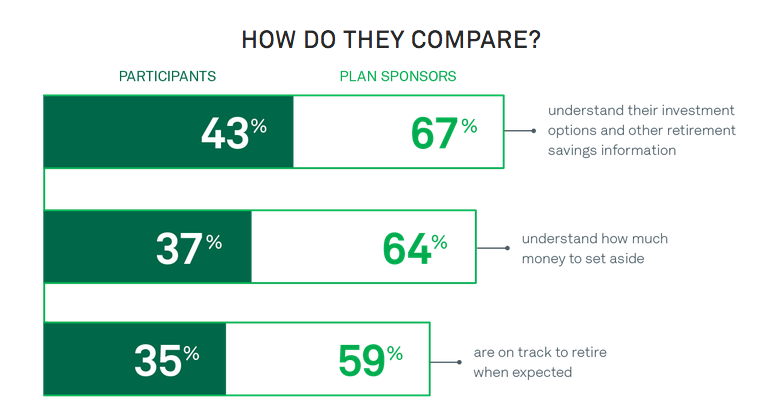
The survey also found that across the board, “unsure” individuals are less likely than “on track” participants to engage with their DC plan. Those “unsure” were less likely than those “on track” to say they take full advantage of retirement savings guidance provided by their employer (43% vs. 67%, respectively) and also less likely to have increased their contribution in the past 12 months (35% vs. 47%). They also reported less engagement in evaluating their investment options (25% vs. 38%) and were less likely to report that they evaluate their investment options at least quarterly (29% vs. 50%).

“Our survey shows that plan engagement is a key vehicle for boosting retirement confidence—and that’s a critical message for plan participants and sponsors alike,” says Ackerley. “Individuals need to take greater advantage of the tools already available to them through their plan. And plan sponsors can feel confident that adding more and better tools for their DC participants is a worthy effort—because a robust, participant-focused DC plan really does have the power to make a difference.”

Inside Knowledge: An Advisor’s Take on What Makes A Great Retirement Plan Advisor

Three out of four plan sponsors hire the services of an advisor for their plan, according to the Retirement Advisor Council. And they’re looking for more from their advisor than ever before.

What makes an advisor stand out?

Mark Davis, Senior Vice President of CAPTRUST Financial Advisors, offers his insight in a column published in the Summer issue of the Journal of Pension Benefits.

We picked out some key excerpts, below.

On plan design:

Going forward, in many states, we may well see a growth in usage of state-sponsored plans or mandatory IRA solutions for the smallest of employers. In order to justify the cost of using a company-sponsored plan, advisors will need to know the details of sophisticated plan designs or partner with TPAs who do. Advisors who want to serve larger plans need to show their ability to think strategically and recommend that their clients act tactically to accomplish plan goals.

On participant engagement:

It is the advisor’s job to help make sure the benefit is attractive to and valued by participants. I think it is a plan advisor’s job to help sponsors to leverage every bit of participant support they can get from their plan’s primary retirement services vendors. What is the sponsor, or more importantly, the participant already paying for as part of their fees? Can the advisor help the sponsor strategically use services like auto-enrollment, managed accounts, or advice services? It takes a lot of experience and access to volumes of data to be able to answer these questions. For example, most of the major vendors in the marketplace offer only one choice of managed account alternative and, in some cases, it is a proprietary solution. How can a fiduciary make a prudent choice to select an investment alternative from a universe of one choice?

On investment management:

An advisor’s investment process also needs to be different—and better—than what plan sponsors can do on their own. Gone are the days when a mass produced report from Morningstar, Fi360, or another vendor can just be used to paper a file.

[…]

Advisors need to have a thorough understanding of the various types of investments used by defined contribution plans, and how they can be mixed and matched in menus. They need to understand the basics of behavioral finance—especially the risk of “choice overload” and its potential impact on participation and participant actions.

Advisors need to be able to understand the broad range of qualified default investment alternatives available in the marketplace and be fluent in the differences, particularly between target date funds.

Leaders on my investment team count over 80 distinct target date solutions today, each with their own assumptions, approaches, strengths, and weaknesses.

An advisor needs to be equally comfortable with risk and age-based solutions. Advisors should be able to demonstrate that they have no agenda in the active versus passive investment debate.

Illinois Law Bans Pensions For County Board Members

Future county board members in Illinois won’t be receiving pensions unless they meticulously documents their work hours and pass a certain threshold, according to a statewide law signed by Gov. Bruce Rauner.

The law follows a controversy around board members claiming their pensions without working the required amount of hours.

The law received a rare showing of bipartisan support in the state legislature.

From the Chicago Tribune:

[State Rep. Jack Franks] got pension fund officials to investigate whether McHenry board members were improperly claiming the pensions despite not working the required 1,000 hours a year.

Eighteen of the 24 board members signed affidavits saying that they had worked enough hours to qualify. But when pension fund Executive Director Louis Kosiba asked to verify their claims, board members said they could not go back and document all their hours, noting that much of their work occurs outside of official settings, reading documents and talking to constituents.

In general, county board members are required to work at least 600 or 1,000 hours each year, varying by the county, to qualify for the Illinois Municipal Retirement Fund pension.

The retirement fund guidelines stated that a 1,000-hour limit — equal to about 20 hours a week — would make it “highly unusual” for any county board members to qualify.

Franks objected that county board members were trying to get a full-time taxpayer benefit for part-time work.

401(k) Nepotism: Menu-Setters Show Favoritism Towards Own Funds, Says Study

Do 401(k) service providers show favoritism towards their own mutual funds when setting investment menus?

This is the question that three researchers – Clemens Sialm, Irina Stefanescu and Veronika Pool – sought to answer in a new paper published in the Journal of Finance.

The short answer, according to the paper, is that setting a 401(k) menu is not a purely meritocratic process: plan sponsors are influenced by service providers to include propriety funds on menus, and poor-performing affiliated funds are less likely to be removed from menus. These under-performing funds then continue to perform poorly.

The authors find that affiliated funds are less likely to be removed from investment menus than unaffiliated funds regardless of past performance; but the disparity widens for the poorest-performing affiliated funds. From the paper:

The figures show that affiliated funds are less likely to be deleted from a 401(k) plan than unaffiliated funds regardless of past performance. More importantly, the difference in deletion rates widens significantly for poorly performing funds. For example, funds in the lowest performance decile in Panel A have a probability of deletion of 25.5% for unaffiliated funds but of only 13.7% for affiliated funds. Indeed, the deletion rate of affiliated funds in the lowest performance decile is lower than the deletion rates of affiliated funds in deciles two through four.

Overall, the difference in deletion rates between affiliated and unaffiliated funds is statistically significant for the nine lowest performance deciles.

The researchers bring up a solid rebuttal to their own thesis: what if service providers aren’t simply displaying favoritism; what if providers actually have more favorable, superior information on their own funds?

So, the authors investigated:

While our evidence on favoritism is consistent with adverse incentives, plan sponsors and service providers may also have superior information about the affiliated funds. It is therefore possible that they show a preference for these funds not because they are necessarily biased toward them, but rather due to favorable information that they possess about these funds. To investigate this possibility, we examine future fund performance. For instance, if, despite lackluster past performance, the decision to keep poorly performing affiliated funds on the menu is information-driven, then these funds should perform better in the future. We find that this is not the case: affiliated funds that rank poorly based on past performance but are not deleted from the menu do not perform well in the subsequent year. We estimate that, on average, they underperform by approximately 3.96% annually on a risk- and style-adjusted basis. These results suggest that the menu bias we document in this paper has important implications for employees’ income in retirement.

The full paper – which presents its arguments in significantly more depth than presented in this post – can be read in full here.


Photo by thinkpanama via Flickr CC License

Massachusetts Pension Hedge Fund Chief Touts Lower Fees, Greater Transparency With Managed Accounts

Massachusetts PRIM’s senior investment officer talked to Bloomberg BNA this week about the board’s success using managed accounts to change the landscape of its hedge fund portfolio.

Among the benefits: lower fees and greater transparency. From BNA:

Hedge Fund Transparency

[…] Managed accounts provide full transparency over what a hedge fund is doing with PRIM’s investments, said Nierenberg.

This enables PRIM, which has about $6 billion—or about 9 percent of its assets—in hedge funds and related investments, to “see in virtually real time” whether a hedge fund has been doing what it was hired to do.

PRIM may learn, for instance, that it needs to “fill in the gap” with other investments to account for what the hedge fund hasn’t been investing in, he said. Such transparency allows PRIM to accurately know how much risk exposure it has at any given time.

Negotiating Lower Fees

Many investors, including public plan trustees, have been concerned about the high fees charged by hedge funds, which commonly charge 2 percent in fees in addition to 20 percent of the hedge fund’s gains.

Nierenberg said that PRIM has been able to keep fees down by negotiating fee structures that are much lower than those typically charged to commingled account investors.

He said that the typical fee structure assessed in commingled arrangements may give way to something more like a 1 percent management fee and a 10 percent of gain carry. “Both the management fee and the carry are separate forms of manager compensation that can be negotiated,” he said.

In addition, Nierenberg said that PRIM has negotiated lower fees by customizing the services it gets in its managed accounts. For example, sometimes expenses that should be absorbed by the fund will get passed on to commingled account investors, he said. In managed accounts, the PRIM can negotiate the specific expenses that it will pay for, he said.

California Legislature Passes State-Run Retirement Plan Proposal for Private Workers

The California legislature last week sent a bill to Gov. Jerry Brown’s desk that would require all businesses with more than 5 employees to either offer a retirement plan or enroll their employees in the state-run Secure Choice plan.

[Read the bill here].

More from the LA Times:

Secure Choice would be structured as an individual retirement account but operate much like a 401(k), with a small percentage of every paycheck automatically diverted into the program unless workers take action to opt out.

Workers could take their accounts with them when they change jobs and would face a penalty for withdrawing money before retirement. It has not yet been decided whether the deductions will be made pretax like a traditional IRA or post-tax.

Once the bill is signed into law, there will be a significant buffer period before employees can be enrolled. More details from the LA Times:

State officials said it will take months, if not more than a year, to work out all the details before the plan can begin enrolling employees.

The Secure Choice program will be overseen by a state board, but most of the work of administering the program — sending account statements, tracking worker contributions and investing money for the program — will be handled by private companies. The board will have to choose those contractors before the program can start enrolling workers.

Once the program starts, it will take as long as three years for all workers to be covered. SB 1234 calls for companies with more than 100 employees to enroll workers within a year of the program’s launch. Smaller employers will have as much as two additional years, depending on their size, to get their workers signed up.

A trade group representing some investment managers penned a letter to Gov. Brown urging him not to sign the bill.

Meanwhile, the New York Times’ editorial board last week endorsed California’s Secure Choice plan was a “better way to retire”.

DOL Eases Way For State-Run Retirement Plans For Private Workers

The Department of Labor this week announced a series of proposals and regulatory clarifications regarding state-run retirement plans for private workers — including a key clarification regarding state plans and ERISA.

Among the announcements was a proposal to let large cities operate retirement plans for private workers, if there is no statewide plan. From On Wall Street:

The department also proposed an addition to the rule allowing cities to create similar retirement savings plans if they are in a state that lacks a statewide retirement savings program for private sector employees. Under the proposal, the initiative would be limited to cities with populations at least equal to the least populous state, Wyoming, which has about 582,000, according to the U.S. Census.

More than 30 cities had populations greater than that of Wyoming, according to census data.

The department is soliciting comments from the public on the proposal.

Other key notes from Employee Benefit Adviser:

The Labor Department’s new rule aims to expand Americans’ access to tax-advantaged retirement savings plans, by clarifying the regulatory rules that would govern state-run plans.

In order to qualify as a non-ERISA plan, a state-run program would have to be established and administered by the state; provide a limited role for employers; and be voluntary for employees.

State governments had requested regulatory clarification, according to Perez, which he addressed during the call.

“This regulation does not prevent a state from establishing an ERISA plan. There is nothing to stop a state from doing that,” Perez says. “The eight states to which I am referring to, have chosen a different route. Their concern as expressed to me was: How can we establish this voluntary plan in such a way that will not run afoul of ERISA?”

A Long-Term Solution For Pensions?

Leo Kolivakis is a blogger, trader and independent senior pension and investment analyst. This post was originally published at Pension Pulse.

Keith Ambachtsheer, Director Emeritus, International Center for Pension Management, Rotman School of Management, University of Toronto and author of The Future of Pension Management, wrote an op-ed for the Financial Times, Pension solution lies in long-term thinking:

If low investment returns are here to stay, those responsible for pension plans have a choice: wring their hands or fulfill their fiduciary duty by rethinking what it means for the design of their schemes.

Doing nothing is not an option. From 1871 to 2014 US equities produced an investment return, after inflation, of 6.7 per cent a year. Treasury bonds were good for 3 per cent.

In contrast, the Gordon Model — which calculates prospective returns from assumptions about growth and yields — suggests much lower returns are in prospect, a real equity return of 3.6 per cent and 0.6 per cent from Treasury bonds.

A recent Bank of England report, Secular Drivers of the Global Real Interest Rate , also supports this idea of the new normal. It shows the current low return regime correlates strongly with slowing economic growth, ageing populations, savings gluts in Saudi Arabia, China and other developing countries, declines in infrastructure investing, rising income and wealth inequality, and falling capital good prices.

Lower returns, meanwhile, make pensions more expensive. As rule of thumb, for every 1 per cent drop in annual returns contributions must rise 20 per cent. So how to squeeze higher long-term returns out of pension assets, while still providing retirees reasonable safety of payment?

Dutch economist and Nobel laureate Jan Tinbergen answered this question decades ago: achieving two economic goals requires two instruments, not one. For pension design this means separate instruments for achieving the higher long-term returns and the payment safety goals.

So the Tinbergen rule exposes a fundamental problem with traditional pension design, which attempts to meet both goals with one instrument. A confounding factor is the common practice of treating volatility in returns as a proxy for risk.

For most individuals, the dominant risk is the long-term rate of return will be too low. What is needed are sustainable long-term cash flows, such as dividends, which compound and grow over time.

Pension organisations that understand the need to distinguish between this long-term risk, and the danger of short-term fluctuations in asset prices, will split the assets in their care: into long-term return compounding and short-term payment-safety sub-pools.

Still, this is only the start of a solution. A big question remains about whether many pension managers truly understand pension economics.

The glass half-empty answer is that many organisations do not have the capability of finding long-term assets due to lack of scale, poor governance and improper staffing.

The glass half-full response is that there is a still small, but growing group of pension organisations with the requisite capabilities and the scale to exploit them. They have what Peter Drucker, the inventor of modern management, described as the dictates of organisational effectiveness: mission clarity, strong governance and the ability to attract talent.

Arguably, the reorganisation of Ontario Teachers’ Pension Plan in 1990 started this Drucker movement, from where it spread to other large Canadian funds and, more recently, around the world.

Today, these “Drucker funds” are poised to deliver an extra 2 or even 3 per cent per annual investment return on their long-term return compounding assets.

The rethink also made the old new again, recalling John Maynard Keynes 1936 attack on the destructive effective of short-termism when investing. Then managing the Cambridge university endowment fund, he wrote in his General Theory the behaviour of long-term investors will seem “eccentric, unconventional and rash in the eyes of average opinion”.

The logic is not hard to follow. Hire skilled and motivated investment professionals, and tell them to focus on acquiring and nurturing sustainable long-term cash-flows in the forms of interest, dividends, rents and tolls in a cost-effective manner.

Indeed, eight decades later long-termism is again showing it can generate above-market returns. Keynes outperformed the market by 8 per cent a year between 1921 and 1946. On a much larger scale, Ontario Teachers’ outperformed it by 2.2 per cent from 1990 to 2015.

Such crucial additional active returns will continue to be available as long as average opinion continues to think long-term investing is “eccentric, unconventional, and rash”.

When it comes to pensions, I like reading Keith Ambachtsheer’s thoughts as he is widely regarded as an expert in the field. You can subscribe to the Ambachtsheer Letter at KPA Advisory services here and read more of his comments tailored to institutional investors.

You can also order Keith’s book, The Future of Pension Management, on Amazon.ca or Amazon.com. I have not ordered this book yet but along with Jim Leech and Jacquie McNish’s book, The Third Rail, I’m sure it’s well worth reading if you want to understand the challenges confronting pensions on a deeper level.

(As an aside, in our phone conversation yesterday, Brian Romanchuck of the Bond Economics blog told me he is in the process of writing his third book. You can order all of Brian’s books on Amazon here and trust me, they’re definitely worth reading and a real bargain.)

Now, I don’t always agree with Keith Ambachtsheer and have openly questioned some of his views on my blog but this op-ed is a great, albeit abbreviated, introduction to what is plaguing many pension plans today.

Alluding to Tinbergen and Keynes, two well-known titans in the field of economics (you should read about their famous debate on econometrics here and here), Keith cleverly highlights the problem with traditional pension design and how pensions which have the right (ie., Ontario Teachers, now Canadian) governance can use their internal expertise, scale and very long investment horizon to their advantage to generate above-market returns over a long period.

(By the way, retail investors reading this comment can also learn about the importance of dividends, diversification and long term investing. In my comment on building on CPPIB’s success, I mentioned books like William Bernstein’s The Four Pillars of Investing and The Intelligent Asset Allocator and Marc Litchenfeld’s Get Rich With Dividends to help you understand how to manage and build your nest egg over the long run.)

I can’t really add much to what Keith is arguing in his op-ed except to point you to my recent comment on why US public pensions are crumbling where I stated the following key points:


  • If deflation does end up coming to America — aided and abated by the Fed who is still following an übergradual rate hike path, acutely aware global deflation presents the mother of all systemic risks — then this means ultra low rates and possibly even the new negative normal are here to stay.
  • Even if global deflation doesn’t hit America, the bond market is warning every investor to prepare for lower returns ahead, something I’ve been warning of for years.
  • Low returns are already taking a toll on US public pensions, which is why they’re increasingly looking at alternative investments like private equity, ignoring the risks, to shore up their pension deficits (CalPERS has cited macroeconomic challenges in private equity returns but I’ve already warned you of private equity’s diminishing returns).
  • But assets are only one part of a pension plan’s balance sheet, the other part is LIABILITIES. Declining or negative rates will effectively mean soaring pension liabilities. And in a world of record low yields, this is the primary driver of pension deficits. Why? Because the duration of pension liabilities (which typically go out 75+ years) is much bigger than the duration of pension assets so any decline in rates will disproportionately and negatively impact pension deficits no matter what is going on with risk assets like stocks, corporate bonds and private equity.
  • Faced with this grim reality, pensions are increasingly looking to invest in infrastructure which are assets with an extremely long investment lifespan. But even that’s no panacea, especially in a debt deflation world where unemployment is soaring (infrastructure assets in Greece are yielding far less than projected following that country’s debt crisis. Now the vultures are circling in Greece looking to pick up infrastructure, real estate and non performing bank loans on the cheap).
  • The key point is pensions need to prepare for much lower returns and stop relying on rosy investment assumptions to get them out of a deep hole. Stop focusing on assets and focus on growing liabilities in a deflationary world where people are living longer and introduce risk-sharing and better governance at your public pensions.


In his comment above, Keith rightly notes that as a rule of thumb, for every 1 per cent drop in annual returns contributions must rise 20 per cent. That is a big reason why US public pensions are so hesitant to lower their discount rate, namely, because if they do lower it, contributions will go up and employees and the state governments will need to pay more to shore up their public pensions.

However, in my comment on the big bad Caisse, I explained why with the passage of Bill 15 which forces plan sponsors in Quebec to share the risk of their plan, it was in the best interests of Quebec City’s public sector workers to transfer their pension assets out of their city pension plan to the Caisse where they can collect better risk-adjusted returns at a fraction of the cost.

In my opinion, the solution to the global pension crisis is to follow Canada’s radical pensions and adopt the governance model that has allowed them to thrive over the very long run.

That brings me to another giant in the field of economics, the great Paul Samuelson who once fretted the day everyone starts following Burton Malkiel’s advice in A Random Walk on Wall Street.

I too fret the day every public pension and sovereign wealth fund in the world adopts the Canadian pension model because it will necessarily mean more competition and less future returns for our large Canadian pension plans.

Luckily, we’re a long way off that point and as the pension Titanic sinks, some public pensions will sink a lot deeper than others and never come back to fully-funded or even adequately-funded status. But I guarantee you Canada’s large, well-governed defined-benefit pensions will weather the storm ahead and lead the way forward, always focusing on the long term.

Chevron Beats 401(k) Fee Lawsuit

A federal judge threw out a class action suit challenging allegedly excessive fees in Chevron’s 401(k) plan this week.

[Read the complaint here.]

The ruling is noteworthy because of the influx of fee-related lawsuits that have hit 401(k) plans in recent months.

Bloomberg BNA breaks down the ruling:

In addition to challenging aspects of Chevron’s 401(k) plan under ERISA’s fiduciary duty of prudence—a common claim in ERISA litigation—the lawsuit also contended that the Chevron plan fiduciaries violated the statute’s duty of loyalty. Judge Phyllis J. Hamilton of the U.S. District Court for the Northern District of California rejected this alternative theory of liability after finding no allegations that any fiduciary actions were aimed at benefiting parties other than the plan’s participants.

Hamilton also dismissed the idea that a 401(k) plan can face liability for failing to offer a stable value fund—as opposed to a money market fund—as an option for preserving capital. According to Hamilton, offering a money market fund “as one of an array of mainstream investment options along the risk/reward spectrum” satisfies ERISA’s prudence requirement.

The lawsuit also accused Chevron of offering high-fee investments when it should have used its leverage as a $19 billion plan to negotiate lower fees and investigate alternative arrangements such as collective trusts and separate accounts. Hamilton disagreed, saying that ERISA plan fiduciaries “have latitude to value investment features other than price.” Further, allegations of high fees, without accompanying allegations of a flawed investment selection process, don’t state a claim for fiduciary breach, the judge wrote.

Does the ruling “raise the bar” for plaintiffs in these cases? BenefitsPro discusses implications:

Typically, there is a “low bar” for plaintiffs’ claims to survive a motion to have a case dismissed, noted Carol Buckmann in a blog post, an ERISA attorney that counsels plan sponsors and a founding partner of New York City-based Cohen and Buckmann.

But in the Chevron decision, Judge Hamilton seems to have raised that low bar. On the issue of whether plan participants paid unreasonable recordkeeping fees via revenue-sharing agreements, she ruled that that “are no facts alleged showing what recordkeeping fees Vanguard charges, so it is not clear on what basis plaintiffs are asserting that the fees were excessive,” according to the decision.

Regarding the bar that plaintiffs’ allegations must exceed to survive a motion to dismiss, Hamilton wrote: “A complaint that lacks allegations relating directly to the methods employed by the ERISA fiduciary may survive a motion to dismiss only ‘if the court, based on circumstantial factual allegations, may reasonably infer from what is alleged that the process was flawed’.” Hamilton was quoting a 2012 appellate decision in St. Vincent v. Morgan Stanley Investment Management Co. 

Illinois Teachers’ Lower Rate A “Positive”, Says Moody’s

Credit rating agency Moody’s said on Wednesday it positively viewed the Illinois Teachers’ Retirement System’s decision to lower its assumed rate of return from 7.5 percent to 7 percent.

The lower rate will be tough for the state to stomach in the near-term as it raises annual contributions by hundreds of millions of dollars. But it also forces the state to pay up, and makes the System less reliant on out-sized investment returns.

From the Chicago Tribune:

A key ratings agency said the decision by the Illinois Teachers’ Retirement System to lower its expected rate of return was “a positive,” even though it means the cash-strapped state will have to find hundreds of millions of dollars more to pay into the pension program for teachers who live outside of Chicago.

The decision by the system’s board to alter the rate of return on investments from 7.5 percent to 7 percent was made despite opposition from Gov. Bruce Rauner, who characterized it as a rushed decision that puts taxpayers on the hook. It was an odd position for the Republican governor, who has long criticized state and city government for kicking the can down the road on financial issues.

But Moody’s Investors Service said the change was “a positive” despite increasing financial pressure on the state in the near term, saying the move would “lower exposure to volatile investment performance.” Moody’s estimated that if the new, lower rate had been in effect for the budget year that began July 1, the state’s required employer contribution would have been $4.3 billion, roughly $421 million more than if the assumed rate of return stayed at 7.5 percent.

Still, Moody’s said even under the lower rate the state remains roughly $1.5 billion below their “tread water indicator,” meaning the system’s unfunded liabilities will continue to grow.


Deprecated: Function get_magic_quotes_gpc() is deprecated in /home/mhuddelson/public_html/pension360.org/wp-includes/formatting.php on line 3712