In Bid to Boost Housing Access, Africa’s Largest Pension Invests $730 Million in Home Loans

The largest pension fund in Africa – the South Africa Government Employees Pension Fund – has invested $730 in home loans in a bid to boost access to housing for low-income earners and government workers.

From Bloomberg:

The investment will be done by the Public Investment Corp. on behalf of the GEPF, according to a statement distributed in Johannesburg on Wednesday. Of the funds, 5 billion rand is earmarked for civil servants, 2 billion rand will be allocated to affordable housing for low-income earners, 2 billion rand to help SA Home Loans extend mortgages to other qualifying applicants, and 1.5 billion rand for affordable housing developers.

“We can make good financial returns,” Dries de Wit, vice chairman of the GEPF, said at a presentation in Johannesburg. Housing is key to economic development, stimulates the demand for goods and services, and will help grow the economy, he said.

In South Africa, with unemployment at 27 percent, there have been increased protests over a lack of decent housing, access to finance and the slow pace of land reform since the end of apartheid in 1994. The GEPF’s initiative will be available to its 1.2 million active members who qualify for credit and will also yield social returns with loans extended at competitive rates, the pension fund said.

California Pensions Take Above-Average Tax Bite

Reporter Ed Mendel covered the California Capitol in Sacramento for nearly three decades, most recently for the San Diego Union-Tribune. More stories are at Calpensions.com.

California pension funds take a bigger share of tax revenue than the national state average, a research website shows. Why the growing costs are outpacing the norm is not completely clear.

A prime suspect for some would be overly generous pensions, particularly what critics say is an “unsustainable” increase for police and firefighters widely adopted to match a big increase given the Highway Patrol by SB 400 in 1999.

The Public Pension Database does not have information on the formulas that determine pension amounts, like the Highway Patrol’s “3 at 50” or three percent of final pay for each year served at age 50.

One problem is the wide range of pension formulas, made even more complex by a recent national wave of cost-cutting reforms. Under a California reform three years ago, most new hires must pay more toward their pensions and work longer and retire at an older age to earn the same pension as workers hired before the reform.

“Trying to compare plan benefits in one state with another state has become complicated,” said Keith Brainard, research director for the National Association of State Retirement Administrators.

Brainard started the database now operated jointly by NASRA and the Center for Retirement Research at Boston College and the Center for State and Local Government Excellence.

Several web-based seminars have been held to show how the “big data” can be used by researchers, government officials, media, and others. Trends and patterns can be identified, comparisons made, and the findings displayed in charts.

A chart on the database shows the amount of tax revenue taken by California public pensions was slightly below the national average in 2001. Then from 2003 to 2005 the California pension tax bite climbed well above the national average, maintaining a gap that by 2013 was about a third higher.

In rough terms, the public pension share of California tax revenue in fiscal 2013 was 8 percent by fiscal 2013 compared to a national average of 6 percent.
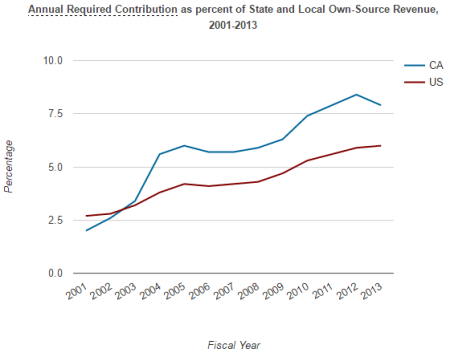
Source: Public Plans Database and Census of Governments

In an interview, Brainard mentioned two factors for the above-average share of tax revenue taken by California pensions. Most California government workers, including teachers and many police and firefighters, do not receive Social Security.

Only 40 percent of state and local government employees in California receive Social Security, according to the database. The Social Security coverage in some other large states: New York 99 percent, Florida 95 percent, and Texas 47 percent.

The cost of using the federal Social Security program to provide part of the retirement benefit (6.2 percent of pay each from the employer and the employee) would not show in data about the share of tax revenue taken by state and local pensions.

Another factor: The period covered by the research begins around 2000 when the three big state pension funds were spending a “surplus” from a stock-market boom not only on increased benefits but on lower employer contributions.

The California Public Employees Retirement System, which covers about half of all non-federal government workers in the state, sponsored the retroactive SB 400 rate increase for all state workers and dropped employer rates to near zero in 1999 and 2000.

Then as the stock market dipped, CalPERS had to begin raising employer rates not only to cover pension increases (AB 616 in 2001 authorized a bargaining menu for local government employees) but also to regain funding lost by the big employer rate cuts.

In addition to CalPERS, the California plans in the database include the California State Teachers Retirement System, the University of California Retirement System, the Los Angeles County Employees Retirement Association, and 11 other local systems.

The data covers most of the public pension members in California, but far from all of the pension systems. An annual report from the state controller lists 131 separate California retirement systems, many of them relatively small.

California systems in the database, with two major exceptions, paid their full Annual Required Contribution (ARC) to cover the annual or “normal” cost of pensions earned each year and the large debt from previous years, the “unfunded liability.”

Debt often is created when pension fund investments, expected by big California funds to earn 7.5 percent a year, fall short of the target, which critics contend is overly optimistic. Among other factors that can create debt is longer than expected life spans.

The California State Teachers Retirement System is listed on the database as paying only 50.9 percent of the ARC in 2013. Unlike other systems, CalSTRS could not raise employer rates. Now long-delayed legislation two years ago to pay the full ARC will more than double school rates by 2020, cutting deep into budgets.

CalSTRS spent its small and brief “surplus” around 2000 on several benefit increases and rate cuts. The pension fund was shorted when a quarter of the teacher contribution, 2 percent of pay, was diverted for a decade into a supplemental 401(k)-style individual investment plan for teachers with a guaranteed minimum return.

Three years ago, a Milliman actuarial report said if CalSTRS had kept its 1990 structure without the rate and benefit changes around 2000, pensions would have been 88 percent funded instead of 67 percent. A much smaller rate increase could have closed the funding gap.

The UC Retirement Plan is listed on the database as paying 63.9 percent of the ARC. A large surplus prompted the plan to give employers and employees a remarkable two-decade contribution “holiday.”

Most made no payments to the UC pension fund from 1990 to 2010. The surplus, driven by investment returns and other factors, peaked with a 156 percent funding level in 2000.

As painful rates were set to resume in a time of tight budgets, a UC task force said in 2010 that if normal cost contributions had been made during the two decades, the system would have been 120 percent funded instead of 73 percent.

CalPERS has not calculated how much of its current funding gap results from the pension increases and rate cuts during the surplus years. But a CalPERS chart showed that SB 400 accounted for 18 percent of the state worker employer contribution increase between 1997 and 2014.

Nearly half of the state worker contribution increase, 46 percent, was due to investment gains and losses, demographic and actuarial changes, and higher employee contribution rates. Payroll increases accounted for 31 percent of the change.

Critics say the SB 400 “3 at 50” formula has the most impact in local government, where police and firefighters are a major part of the budget. The big cities (Los Angeles, San Francisco, San Diego, San Jose, and Oakland) have their own pension systems and are not in CalPERS.

Public pensions have not recovered from huge investment losses during the recession. The Center for Retirement Research reported last month that the 160 plans in the Public Pension Database were 74 percent funded last year, 72 percent under new accounting rules.

The Center’s report showed that from 2001 to 2015 the CalPERS funding level dropped from 111.9 percent to 74.5 percent. During the same period, the CalSTRS funding level fell from 98 to 67 percent and UC funding plunged from 147.7 to 81.7 percent.
Kentucky Treasurer Will Intervene in Suit Between Former Pension Trustee, Governor

Kentucky Gov. Matt Bevin last month removed the chairman of the board of the Kentucky Retirement System – and even called a police presence at a recent meeting to stop him from attending.

Now, former chairman Thomas Elliot has sued the governor and intents to use funds from KRS to fund the suit.

Kentucky’s treasurer is seeking to stop the suit from moving further.

From the Associated Press:

Kentucky Treasurer Allison Ball filed an intervening motion Monday in the suit to stop the retirement board’s former chairman, Thomas Elliott, from using $50,000 in legal funding from Kentucky Retirement Systems to sue Bevin.

Elliott is suing to overturn Bevin’s order removing and replacing him. Bevin has also issued an executive order that removed all the current members of the retirement system board.

Ball said in a release that Elliott’s use of the funding is inappropriate, since he is no longer on the board.

“After conducting an internal review, it is clear there is no legal authority for a removed trustee to use retiree pension money to pay for legal counsel, which is what Mr. Elliott is attempting to do,” Ball said in the media release.

Kentucky Attorney General Andy Beshear has also sought to intervene in the suit in an attempt to overturn’s Bevin overhaul of the board.

Link Between Pension Trustee Composition And State Bond Ratings: Study

The composition of a pension system’s board of trustees is associated with that state’s bond rating, according to a working paper published by three researchers from Troy University and Rhodes College.

Specifically, elected board members are typically associated with lower bond ratings, while appointed and ex oficio board members are associated with higher state bond ratings.

Higher bond ratings imply better fiscal health — and better pension system management.

The paper explains:

Using data on state public pension systems and bond ratings for each state from each of the three major bond ratings agencies between 2001 and 2014, we find a positive relationship between outside board members and bond ratings. Having more outside members on a state pension board of trustees results in lower bond ratings and thus higher borrowing costs for the state. More specifically, we find that a 1 percent increase in the number of elected members on a pension system’s board of trustees decreases the state’s borrowing costs between $6.84 and $19.04 per $1 million in debt at a 5% interest rate.

[…]

These findings suggest that at least in the eyes of bond rating agencies, board composition does in fact matter due to spillover effects on a state’s fiscal health. Boards made up of inside members positively contribute to a state’s fiscal health. Importantly, this suggests that principal-agent problems may not be as particularly problematic as some research has suggested. Further, this may also be indicative of the prevalence of financial illiteracy that elected board members have been found to be associated with. Inside members may have stronger financial backgrounds, which does tend to be the case for both appointed and ex – officio members and appears to provide positive benefits

According to the researchers, pension systems with a board composed of a supermajority of insiders are linked to more economically and statistically sound results.

Study Finds Meager Median 401(k) Balances for Americans

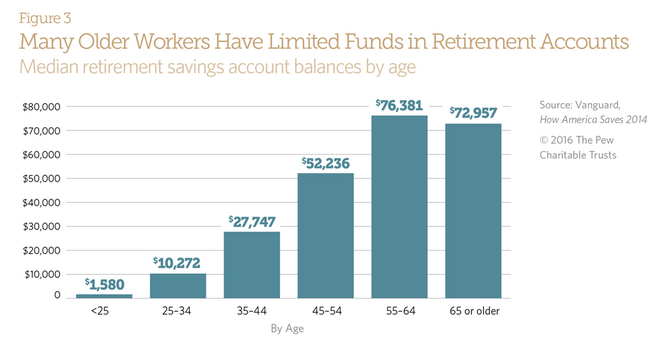
Screen Shot 2016-07-11 at 1.12.36 PMA report from the Charitable Pew Trusts found that the average American has $72,383 in 401(k) balance, but the actual median for those surveyed is only $18,433.

The report compliments another recent study on retirement income disparity from the Employee Benefit Research Institute, which found 40% of 401(k) plan participants have less than $10,000 and 20% have more than $100,000 in their accounts.

The Motley Fool explored the possible reasons for this picture:

The average American has $72,383 stashed in a 401(k), which sounds encouraging.

However, the average can sometimes be misleading, because a large balance in a few 401(k)s can skew the result — after all, consider a hypothetical example of five people with a combined 401(k) savings of $500,000. The average is $100,000, which sounds pretty good until you discover that one person has $450,000, two people have $15,000, and the other two have $10,000 each in their 401(k)s.

[…]

Millions delay enrolling in 401(k)s — or don’t enroll at all. This is in large part because of status quo bias. The idea behind status quo bias is that people tend not to change things unless they see a clear need for change. (Ever put off doing paperwork because it wasn’t your top priority? Yeah, me too.) It’s one of the reasons why millions of Americans who have access to 401(k)s delay enrollment; it’s just one more piece of paperwork, and they have other things to do.

Workers simply aren’t saving enough. Many will simply enroll in their 401(k) at whatever the automatic rate is and ignore it after that. An analysis of Vanguard plans revealed that 65% of plans had an automatic rate of 3% or less — not nearly enough for most workers to build a sufficient nest egg.

The article went on to propose solutions for managing 401(k) retirements including automating enrollment, increasing the default contribution rate, incorporating automatic savings increases in the plans, and spreading out matching funds.

Call It A Trend: Lawyers Go After 401(k) Fees

Last week, Pension360 covered the lawsuit against the so-called “most expensive 401(k) plan in America.”

According to experts, there are more lawsuits where that came from as lawyers target out-of-control 401(k) fees.

From Bloomberg:

Lawsuits such as this one are just the beginning, said Marcia Wagner, a principal at the Wagner Law Group who represents plan sponsors and vendors under the Employment Retirement Income Security Act. The case follows a parade of high-profile suits filed by Jerome Schlichter, of the St. Louis law firm Schlichter Bogard & Denton, alleging breaches of fiduciary duty at some of the largest plans in the U.S. The mega-settlements Schlichter has won, along with a U.S. Supreme Court ruling last year that put plan fiduciaries on high(er) alert about the need to continuously monitor plan investments, has encouraged more law firms to develop and expand their fiduciary litigation practices.

“It started with Schlichter doing cases against very large corporations in America,” Wagner said. “And now it’s going to start to be a free-for-all.”

The focus of the suits is expanding as well, with a wider array of plan permutations and fees coming under scrutiny. “The pace of cases being filed has quickened, and the areas of challenge have broadened,” said Richard McHugh, a lawyer and vice president of Washington affairs for the Plan Sponsor Council of America, which represents defined contribution plans. Additionally, he thinks the U.S. Department of Labor’s new fiduciary rule will widen the number of defendants who are named in these lawsuits.

With more attorneys seeing an opportunity, smaller plans are starting to feel the heat. After launching four 401(k) lawsuits alleging breach of fiduciary duty late last year, Minneapolis-based Nichols Kaster has filed four more in 2016, most recently against Fujitsu and American Century’s $600 million plan. This year has even seen a 401(k) plan with less than $10 million in assets get hit with a lawsuit, a development that garnered the attention of many players in the small plan universe.

China Pension Prepares to Make $300 Billion Entrance to Stock Market

China’s local pension funds are collectively readying their entrance to the country’s domestic stock market, and they plan to make a splash to the tune of $300 billion.

China’s pension system has historically invested only in government bonds. But the low returns aren’t a good match for the country’s aging population, according to the pension system. So, it was decided last year that pension dollars be allocated to equities.

That process will begin soon.

More from Bloomberg:

The country’s local retirement savings managers, which have about 2 trillion yuan ($300 billion) for investment, are handing over some of their cash to the National Council for Social Security Fund, which will oversee their investments in securities including equities. The organization will start deploying the cash in the second half, according to China International Capital Corp. and CIMB Securities.

For the nation’s equity markets — which are dominated by retail investors and among the world’s worst performers this year — the state fund’s presence is even more valuable than its cash, said Hao Hong, chief China strategist at Bocom International Holdings Co.

The NCSSF has “such a good reputation in being a value investor that if they take the lead, the signaling effect is actually quite strong,” said Hong, who had predicted the start and peak of China’s equity boom last year. “It’s almost like Warren Buffett saying he is buying a stock.”

[…]

The entry “will be a positive event in terms of sentiment but the actual impact won’t be drastic,” said Ben Bei, an analyst at CIMB Securities in Hong Kong. “The fund will tend to be prudent and the progress may be very gradual — that is, it will enter the market over the next several years.”

World’s Third-Largest Pension Picks Grosvenor, Blackrock to Lead $1 Billion Hedge Fund Entrance

South Korea’s national pension fund – the third largest pension fund in the world with $415 billion in assets under management – will be investing for the first time in hedge funds later this year.

The fund has picked two investment firms to lead the foray into hedge funds: BlackRock and Grosvenor, who will each be in charge of $500 million.

More from Reuters:

South Korea’s National Pension Service (NPS), the world’s third-largest pension fund, said it had chosen a BlackRock Inc unit and Grosvenor Capital Management to manage investments in funds of hedge funds in 2016.

[…]

“The upcoming hedge fund investment is expected to contribute to the generation of stable profits by diversifying risk for the fund’s entire portfolio,” NPS Chief Investment Officer Kang Myoun-wook said in the statement.

A bit of background from PulseNews:

Last year, NPS operation committee decided to invest in funds of hedge funds as an alternative investment as part of efforts to diversify its asset allocation and improve returns on its investments in a low interest rate environment. NPS initially planned to start to invest in hedge funds late last year, but delayed the process following the strife between former NPS CEO Choi Kwang and Hong Wan-sun then-chief investment officer at the National Pension Fund Investment Office.

In April, the fund drew up a guideline to evaluate investment performance in hedge funds and set a goal to invest 1 trillion won in funds of foreign hedge funds this year. Korea’s largest institutional investor plans to start to invest funds of foreign hedge funds and then gradually expand its investment in other hedge funds, according to an unnamed NPS official. Global consulting company Mercer is said to be advising NPS hedge fund allocations.

Hedge Funds Worst-Performing Asset Class for Pension Funds; REITs Best: Study

Screen Shot 2016-07-11 at 12.09.16 PM

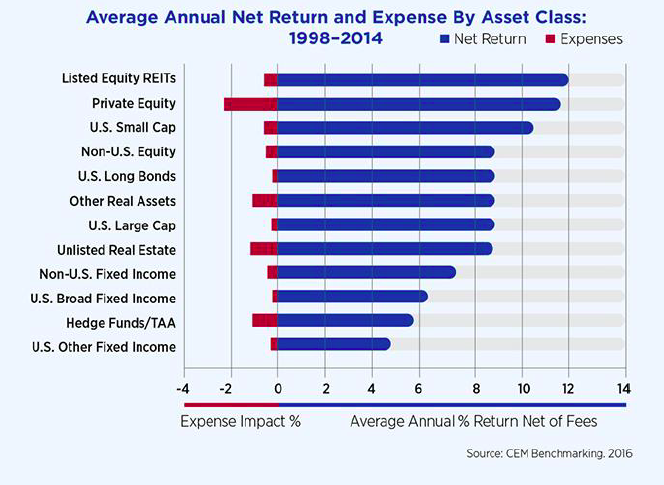
A study by CEM Benchmarking found that hedge funds provide the lowest net annual returns to US pension funds among all asset classes. With an average compound return of 5 percent, only cash provided lower return figures.

[Read the full study here.]

Bloomberg summarizes the results:

Hedge funds provided lower average net annual returns to U.S. pension funds than any asset class except cash, according to a report analyzing $8.4 trillion in defined-benefit plans from 1998 through 2014.

“If cash is excluded as an asset class, then hedge funds must be considered the worst performing,” with an average compound return of about 5 percent, according to the study of retirement-plan assets by CEM Benchmarking, a Toronto-based consultant for institutional investors.

Pension funds from New York City to Orange County, California, are weighing exiting hedge fund investments. Vicki Fuller, chief investment officer of the New York State Common Retirement Fund, the country’s third-biggest pension fund, said in June that hedge funds should face performance hurdles to earn their traditional “2 and 20” fees, or 2 percent of assets and 20 percent of gains. The California Public Employees’ Retirement System, the largest U.S. pension fund, divested its $4 billion hedge fund portfolio in 2014, saying the asset class was too expensive and complex.

The same study found that publicly traded real estate investment trusts (REITs) and private equity produced the highest annual net returns for pension funds.

New Jersey Budget Allocates Big Bucks to Pension Funding; But Mixed Bag for Public Workers

New Jersey governor Chris Christie just signed into law the $34 billion state budget, which – among other things – will push the state’s pension contribution up to $1.86 billion dollars.

The payment is less than the actuarially required contribution, but is the highest single pension payment in state history.

NJ Spotlight elaborated on the win for retired public workers:

Much of the increased spending authorized by Christie for the 2017 fiscal year will be earmarked for the state’s grossly underfunded public-employee pension system, pushing the pension contribution up to $1.86 billion. That’s a record-setting amount. And though the figure is less than the full payment calculated by actuaries, Christie was able to keep the increased pension payment in the budget even after the state dealt with a $1 billion revenue shortfall in late May. That will make it harder for him to question the affordability of a proposed constitutional amendment calling for similar annual pension-contribution increases that’s likely to go before voters this fall.

It’s not all good for public employees. Although their pension system will get an incremental funding boost, they will have to make healthcare-related concessions. NJ Spotlight:

The budget as enacted also banks on $250 million in undefined savings from employee healthcare plans that now have to be worked out between union officials and the administration. To add pressure, Christie says he will hold back funding for distressed cities and legislative add-ons until the savings materialize. Also, a proposed sales-tax cut that the Assembly passed last week in a broader plan to replenish the state’s Transportation Trust Fund with a 23-cent gas-tax hike should give public workers more cause for concern. The sales-tax cut could take away so much revenue from the budget in coming years that more drastic healthcare changes may become inevitable.


Deprecated: Function get_magic_quotes_gpc() is deprecated in /home/mhuddelson/public_html/pension360.org/wp-includes/formatting.php on line 3712